
 E-Paper



A chess contest that bucked all predictions
The World Championship match is tied 3-3, with Ding Liren's cautious play raising questions, while D Gukesh presses on despite challenges.


There were predictions of a “massacre” and a “bloodbath” leading up to the World Championship match. What we have on our hands after six games though is a 3-3 tied score between reigning world champion Ding Liren and challenger D Gukesh. Ding won only his first classical game in 304 days in this match. Gukesh, too, has only one win in six games so far and the tension is alive in the match.
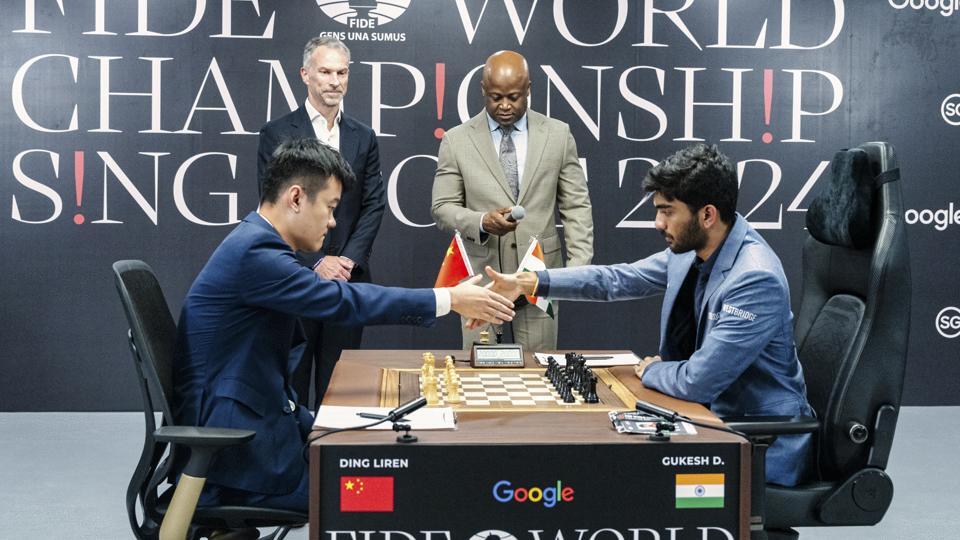
We look at a few talking points from the match so far.
Miraculous escape and missed chancesIt’s fair to say that Ding, contrary to expectation, has had more chances so far in this match than Gukesh. Bafflingly, barring Game 1, which he won, the reigning world champion appeared to have held back in the opportunities he got thereafter.
In Game 5, Ding had a positional advantage. The kind that Magnus Carlsen has juiced into many a win. Ding somehow didn’t end up taking it and what could have been a dangerous scenario for Gukesh turned into a miraculous escape and half a point.
In Game 6, Ding had a good position out of the opening, was comfortably up on the clock before he burned right through it, and then was the first to offer a draw.
Ding has been quizzed about it, rather crudely, at post-game press conferences, about whether it’s a crisis of confidence or health issues that have led him to not pursue the advantage on the board. His response has been that he didn’t realise he had an edge in Game 5.
Five-time world champion Viswanathan Anand has been, like the rest of us, baffled at Ding’s decision to go for a draw in Game 5, while clearly in a better position with no risks.
“Though we see it quite often in this match, you’re not supposed to get chances like this. If you get one, you’re supposed to sit there and work,” he said on the Fide live broadcast on Sunday, “The only explanation I could come up with is that he simply didn’t realise that he was better… that’s the only way you can continue the way he did.”
“My impression is that he’s still finding his feet, his confidence. I don’t know if it came from reading what everyone else was saying about him…But he can objectively look at his games this year and understand that ‘okay this is not what I need to be’ and perhaps that has affected him. If you contrast Game 1 and Game 5, in Game 1 he took the smallest chance he got, and in Game 5 it was even less to calculate. There were so many pleasant ways to play on with no risk. I still don’t have a complete understanding of why he gave up.”
Power movesOn move 26 of Game 6, Gukesh spurned Ding’s three-fold repetition offer despite being the one with an inferior position and no clear path to a win and forced his opponent to play on. Though Gukesh insists he did it for the love of chess and to explore counterplay, it can be counted as a power move in a match such as this one. Part of it could be rooted in Gukesh’s takeaway from Game 5, that Ding seems content with a draw and isn’t playing for a win.
Ding was gobsmacked by Gukesh’s decision, which could have ended badly for the Indian teen, but did not. Psychologically, to emerge unscathed from what may not have been the most prudent call must do Gukesh good. Viewers aren’t complaining. It’s the chess they signed up for. In a match like this you want players to do more than show up, blitz out preparation and shake hands after 25 moves.
Ding ChillingIf you must know, there’s an hour-long video of Ding, seated motionless on a chair in the players’ lounge area, his hands tucked to his sides – set to Lofi beats, on YouTube. The lounge or rest area is where players can catch a break between moves, and is monitored by cameras, and arbiters. The camera feed is shown on the broadcast feed. Ding has been seen munching on nuts, brownie chips and bananas in the room and sometimes just sitting looking straight ahead or with hands covering his ears.
“At some point they started filming the players’ lounge room and I was very opposed to it,” former world champion Magnus Carlsen said on the Take Take Take app. “Of course, the arbiter should be able to see what players are doing in the rest area but I’d no desire for the public to see that…I understand why it has interest…and Ding looks pretty chill but I still feel that it would be better if the area is private for the players.”
Opening surprisesDing has so far been pretty solid with White, while steering clear of risks and his reprisal of the London System from last year’s match in Game 6 did seem to surprise Gukesh, who spent over 50 minutes for the first 20 moves. In his three White games so far, Ding has opened with, e4, Nf3, and d4, and much like Carlsen predicted before the match, he could well have seven different first openings prepared for seven White games.
Gukesh, who lost with White in his first game, made a rather curious call to play the quiet Exchange French in Game 5 and didn’t get what he wanted out of it. Not only was Ding never in any danger in the game, he was also the one with an advantage. It remains to be seen how Gukesh approaches his next game with the White pieces (Game 7) on Tuesday.
Ambition and strategy Ding has so far been risk-averse in this match, while Gukesh has the one who’s pressing even if hasn’t been precise enough to get too much out of it. Contrastingly, while the reigning world champion can undermine his own prospects, the Indian can tend to over-evaluate his position.
“Gukesh has generally not impressed me,” Carlsen said after Game 5, “For Ding, it’s generally gone better than we thought and Gukesh has probably been a little bit worse.”
Ding not going for his chances, seemingly content to draw his games even in superior positions, can seem puzzling. It raises speculations over whether his intent is to see out the classical portion of the match and take matters into the rapid tiebreak. He won his world title in the tiebreaks last year against Ian Nepomniachtchi.
The match hits its halfway mark on Tuesday and it will be interesting to see what course it takes from here and who lands the first blow.