
 E-Paper



Gaza to Kyiv, via Washington: How 2 wars and 1 election intersect
For Israel, American elections have resulted in greater impunity, and for Ukraine, the elections have meant a desperate effort for more support.

 Prefer HTon Google


Moscow and Kyiv, Tel Aviv and Tehran have little in common with Detroit and Scranton, Phoenix and Atlanta. Beirut and Gaza, Pokrovsk and Kursk, have little in common with Milwaukee and Las Vegas and Raleigh. Yet, the fate of Russia and Ukraine, Iran and Israel, indeed the very future of Europe and West Asia and the global security architecture, rests on how swing voters in swing counties of seven swing states of America vote in the presidential elections. And it rests on how Senate battles shape up in states as distant as Montana and Texas, or House of Representative races in Alaska and Maine and New York.
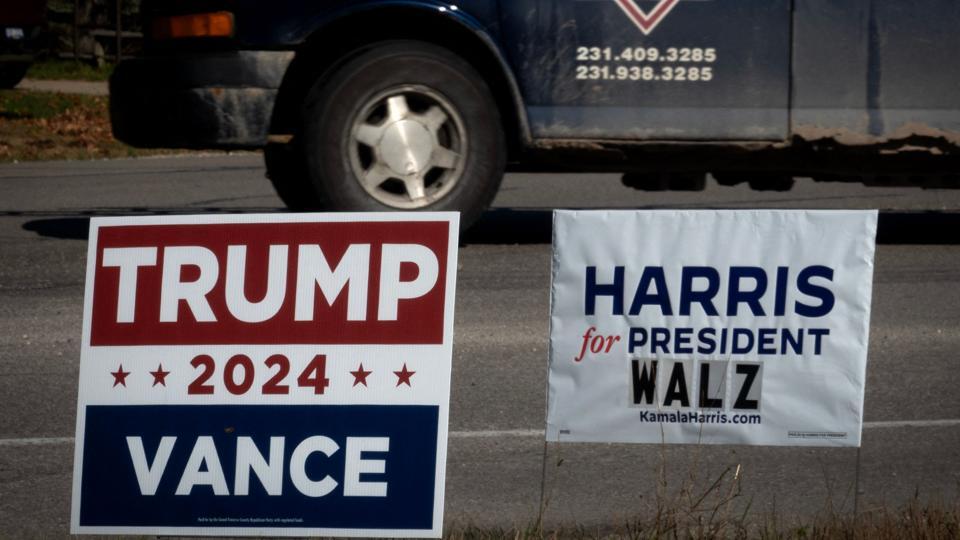
Domestic American politics has always shaped international politics, from the days of the US’s late but game-changing entry into the two world wars to the American posture during the Cold War. More recently, the vacillating public sentiment on the Main Street in American cities have led to both the post 9/11 wars in Afghanistan and Iraq and then, years later, the end of the wars.
And that is why so much of the intensified action across the Israel-Lebanon border or Russia-Ukraine border is as much to do with the political calculations of the protagonists who are calling the shots as the military calculations of the generals and security apparatus or dynamics on the ground. And Vladimir Putin, Volodymyr Zelensky, Benjamin Netanyahu and Ali Khameini’s calculations are focused not just on each other, but on Donald Trump and Kamala Harris. Global uncertainty is driven today by how these four leaders in Russia, Ukraine, Israel and Iran are doing their cost-benefit calculus, and how they think they can their strengthen their negotiating position in whatever situation arises post November 5 in Washington DC.
That high-level political calculus explains the intertwined fates of a woman seeking abortion rights in Georgia, a young person seeking a manufacturing job in Pennsylvania, a Muslim in Michigan furious about the killing of a relative in Gaza, a Ukrainian soldier hoping to reclaim land in Donbas, a Russian soldier fighting in the “special military operation” his leader sanctioned, a Palestinian civilian on the brink of hunger and holding on to life in Rafah, a Lebanese civilian seeking shelter in Beirut, and an Israeli villager seeking to return home to the country’s north.
The West Asian front
There is a mainstream American political consensus on Israel, from which parties can depart only on the margins. The US sees Israel as perhaps its closest ally, and, for a range of historical and political reasons, American politicians view protecting and defending Israel as a sacred duty. This gives Israel enormous latitude in its actions, more than any other American ally enjoys, to the extent that the US sometimes has to act against its own interests because it cannot be seen as acting against Israel.
This is the latitude that Netanyahu has exploited over the course of the last year after Hamas’s terror attacks. The US is firmly with Israel in its battle against Hamas in Gaza, Hezbollah in Lebanon, Shia militias in Syria and Iraq, Houthis in Yemen, and Iran in general. And it is quite delighted with the weakening of the abilities of the terror groups in the region.
But the Joe Biden administration also has had to contend with its values-based rhetoric that Israel has shattered to smithereens with its brutality; with a vocal progressive and Muslim constituency that is horrified at American complicity with this brutality; with the anger in the Arab world and the global south that forces even pro-America governments to turn critical of Washington when it comes to Israel; and with a more enlightened strategic community within the US that can see the perils of unilateral Israel aggression and benefits of a more long-lasting two-state solution.
All of this meant that Biden has asked Netanyahu to sign on to a three step ceasefire package deal with Hamas that would lead to an end to the offensive and release of hostages in Gaza. Biden has asked Netanyahu to agree a ceasefire with Lebanon in return for being able to return Israeli civilians to the north. Biden has asked Netanyahu to stop expanding Israeli settlements in West Asia due to the pressure of his Far-Right coalition allies. Biden has asked Israel not to take actions that can potentially lead to an escalation of the war with Iran. And Biden has asked Netanyahu to think of the “day after” in Gaza.
Netanyahu has chosen not to listen to any of these five specific items of advice and has done exactly what he has wanted — continuing the offensive in Gaza, expanding settlements in West Bank, eradicating the Hezbollah leadership and thus widening the war, responding fiercely to Iran, and acting without a plan for the future of Gaza. And the reason he has been able to do so in even greater degree than earlier in the year is because Biden’s political space to act against Israel has shrunk even more in his final months of office. Even the mildest rebuke to Israel invites charges of anti-Semitism and galvanises the American Right.
The reason Netanyahu is acting in this manner at this time is also because he knows Harris will not just echo Biden’s position of caution in private but will be far less of a fervent supporter in public; it is hard to see Harris proudly calling herself a Zionist like Biden does. But Harris also cannot reverse any of the gains Netanyahu makes for she has to operate within the mainstream consensus of American politics; for a woman of colour, her space to go against the pro-Israel consensus is even more limited.
This then, for Netanyahu, is the right moment to turn even more aggressive. The current administration can do little. A potential Democratic administration has to continue making supportive noises just like Harris did after Nasrallah’s assassination even though her advisers are deeply worried about a direct Israel-Iran war. And a Republican administration — Netanyahu’s preferred choice — will only celebrate and solidify Israel’s gains. It is precisely for this reason that Iran wants anyone but Trump in the White House, visible in Tehran’s hacking of the Trump campaign’s communication, a move that even the Democratic administration has to take up as an instance of clear election interference by a foreign power.
The European front
But if, in one case, American elections have awarded an American ally complete impunity, in another case, American elections have rendered an American partner demoralised and uncertain and an American adversary waiting gleefully with anticipation.
The war in Ukraine is approaching its third anniversary. The report card is mixed. Russia failed in its aim to take over Kyiv and install a puppet regime. Russia has lost men and material in degrees way greater than Moscow would have hoped. And Russia today is weaker in so far as its space for autonomous action has shrunk, its dependence on China has grown, and the prospects of its integration with the western economies have receded.
But Ukraine is bleeding and its capacity to bleed is less than that of its gigantic neighbour. Ukraine hasn’t made any major territorial gains -- defined as recapturing territory held by Russia -- since late summer of 2022 and its counteroffensive failed last year. There is a fatigue that has set in, especially among the young. Zelensky, still a hero for his resistance, now faces increased internal domestic opposition as his government has become synonymous with corruption. Ukraine’s ploy of turning the tables and distracting Russia by mounting operations inside Russia hasn’t quite worked, and instead, Moscow has not just held on to its gains from Crimea to Donbas but is on the cusp of wresting control of other key cities and towns in eastern Ukraine. The moral outrage against Russia’s action has faded, European politics is getting more fractured, and the American public appetite for the war has shrunk, reflected most starkly in Trump’s approach that values peace over Ukrainian sovereignty and unity, and values an accord with Russia over a reinforcement of NATO’s strength.
And that is why the next four months are critical for Zelensky. His entire pitch to Biden and Harris, and the US Congress, last week was for more support and sanction for a “victory plan” that appears to rest heavily on the West allowing Ukraine to use long-range missiles to target Russian military bases that are used by Moscow for its operations in Ukraine. The American intelligence establishment isn’t quite convinced that this is worth the risk. And the risk of giving Zelensky this license has only increased with Putin revising the Russian nuclear doctrine to include the nuclear option, in response to attacks by non-nuclear states with the support of nuclear states threatening Russian sovereignty. Either way, even a slowdown in Russia’s advances, or marginal gains by Kyiv, don’t necessarily change the fundamental balance of power in this war of attrition.
For Zelensky, a Harris win is thus critical to ensure that when there are eventual negotiations, Ukraine’s interests are protected as best as possible. A Trump win will not result in an immediate end to American support for Ukraine; even Trump has to deal with national security imperatives that American agencies will acquaint him with. Do remember that the US Congressional support for Ukraine earlier this year couldn’t have happened without Trump. That is why Trump also probably saw value in meeting Zelensky in New York. But a Trump win may well mean a more emboldened Putin, a Ukraine that will be forced to confront its weaknesses and come to terms with the reality that it will not get all its territory back, a NATO that closes the door on Kyiv’s entry, and a push for peace on terms that may work for Russia so that Trump can then project himself at home as the man who ends wars.
There are multiple variables that are shaping both the American election, and the two wars in West Asia and Europe. The outcome in the democratic theatre and military battlefields remain uncertain. Events have made every prediction appear unwise in recent years. But what is clear is that the fate of Russia and Ukraine, Israel and Iran, Europe and West Asia, is inextricably linked with America’s political and electoral trajectory.
 ABOUT THE AUTHORPrashant Jha
Prashant Jha was formerly the US correspondent and editor of HT Premium at Hindustan Times, and has also served as the newspaper's editor-views and national political chief. He is the author of 'How the BJP Wins: Inside India's Greatest Election Machine' and 'Battles of the New Republic: A Contemporary History of Nepal'.Read More


