
 E-Paper



As de facto Quad leader, Modi cements progress in Biden years
PM Modi's visit to the US strengthened India-US ties, advanced strategic interests, and positioned India as a key player in global peace negotiations.


New York Prime Minister Narendra Modi consolidated the achievements of the India-US relationship that were set in motion under the Joe Biden presidency. He emerged as the de facto leader of Quad and helped the group achieve a degree of higher strategic convergence. He left an impression on the multilateral stage with both his agenda of peace and India’s traditional demand for reform of global governance structures. He continued to position India as a possible player in eventual peace negotiations on Ukraine. He had bilateral meetings that spoke of India’s varied foreign policy priorities. He kept a laser focus on India’s own technological and economic imperatives. And he deftly managed a divided American political landscape.
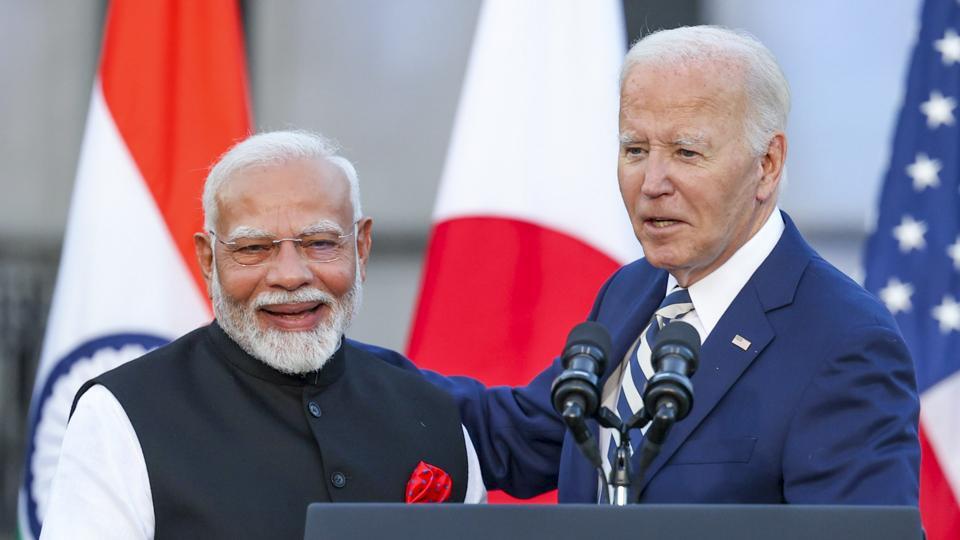
And he did all of this in less than 60 hours.
That is why Modi’s visit to Delaware and New York will rank as significant milestone in the foreign policy calendar of the first year of his third term.
Advancing the strategic interests
Indian policymakers are guided by two primary impulses. They are aware that Delhi’s primary geopolitical contradiction is with Beijing and anything that strengthens the hand of the Indian security apparatus in dealing with Chinese belligerence at the border, in the waters, in the neighbourhood and extended region, and in multilateral sphere is useful. They are also aware that India’s primary need is its economic and developmental transformation that can both generate jobs and equip India for the future at a time of great technological churn. Both these impulses make America an indispensable partner for India. Biden has also shown a greater appreciation for precisely these Indian needs and guided his administration in that direction, a gesture Modi recognises and clearly appreciates.
This framework is useful to understand the outcomes of the visit.
In the context of bilateral ties with the US, besides the personal warmth on display by Biden’s gesture in hosting Modi at his personal home in Delaware, a set of achievements helped India advance its goals. Under the initiative on critical and emerging technologies, the collaboration on semiconductors continued and India now is positioned to get its first national security fab, a product of synergy between the US defence apparatus and Indian startup ecosystem. There is consolidation of more conventional defence partnership with both Indian acquisitions of drones in the works and continued push for co-production and co-development even if there have been some delays. There remains a collaborative attempt to construct a clean energy supply chain outside China through a separate agreement. American manufacturing majors such as Ford continue to have interest in India.
And there is a clear signal from the US national security state to US capital, including big tech, that India is a trusted partner, at the very time that the same establishment is telling US capital to de-risk from China. This was also reflected in Modi’s meeting with the world’s most powerful and richest tech companies. There were regulatory and legal changes these companies suggested but there was also enthusiasm for the India story and appreciation for Modi’s personal outreach. Modi also met the head of a key American firm specialising in small modular reactors, a sign that this will be the next chapter in India-US nuclear collaboration.
To be sure, there were irritants such as the timing of a meeting of White House officials with Sikh activists who are critical of India and a case filed against the government of India by a terrorist who is a US national. But India kept its eyes on the big picture, and as foreign secretary Vikram Misri said at the final briefing of the visit, the big picture is the importance of the relationship.
In the plurilateral sphere, the same twin Indian strategic impulses got reflected in the Quad summit. Modi will soon become the only leader in the group who was there from the first summit in 2021 and will continue beyond next year, a fact that all the others in the group recognised. In the joint statement, there was greater strategic convergence on the China question and the greater willingness to call out Beijing’s aggression particularly in East and South China Seas. Biden’s hot mic moment caught the American leader candidly discussing the American assessment of China’s continued belligerence across all regions including South Asia. There was more focus on maritime security coordination given the recognition that waters of the Indo-Pacific will remain turbulent. There were hints at greater military coordination under the rubric of humanitarian and disaster relief.
There also remained a strong focus on offering a positive agenda to the rest of the region with a remarkable cancer moonshot initiative, more collaboration on infrastructure, technology and clean energy. India is now doing much more with Quad than any other such plurilaterals grouping, be it BRICS or SCO where it shares space with adversaries. And those familiar with discussions point out that other Quad countries find India’s inputs extraordinarily valuable for Delhi brings a perspective on security, development and technology that America and its treaty allies don’t necessarily have. India is the “value add” in the group, and this summit showed it again.
India’s strategic interests were also advanced in Modi’s bilateral discussions on the sidelines of the UN Summit of the Future in New York. Just sample who he met to get a sense of Delhi’s priorities. In the neighbourhood, where recent developments have put India at a disadvantage, India consolidated ties with Nepal with Modi meeting PM KP Oli, a somewhat difficult customer. To the east, Modi met Vietnam’s leader, To Lam, a meeting that makes sense given the developments in the Indo Pacific. To the west, Modi met the leader of Kuwait, where India both has energy interests and a large population and is the one Gulf country that has seen recent political instability. Modi briefly met the leader of Armenia, a country India has been supporting with defence exports in its conflict with Azerbaijan. Many of these countries may not seem like the most obvious choices but there was clearly a pattern.
Being a responsible power
But while keeping a sharp focus on India’s immediate and medium term strategic needs, India continued to advance its image as a responsible international power and nowhere was this more clearly reflected than on Ukraine, Palestine and India’s digital offering.
Modi met Zelensky for the third time in three months. The frequency of the interactions now clearly suggests that discussions have moved way beyond the abstract calls for peace to more specific discussions on how to get there, a fact that Misri acknowledged in a response to a question from HT. As Indian officials point out, there is barely anyone else from the democratic world who can speak to Vladimir Putin, Zelensky and Biden with the comfort level that Modi can. Whether this eventually translates into India acting as a host of talks, a facilitator of conversations, a courier of messages, an actor offering good offices — if already seems to be performing the last two roles — is to be seen. But just the fact that India is seen as a possible player on an issue that goes to the heart of the European security architecture is itself quite remarkable and is a telling example of the changes in global power dynamics.
Modi also met the Palestinian leader, Mahmoud Abbas, an incredibly important symbolic gesture given Israel’s continued brutality against Palestinians in Gaza. India’s political support for a two state solution is historic, its humanitarian support is clearly valuable, and in the “day after” scenario in Gaza, the Palestinian Authority may have a role. All of this can coexist with a fierce condemnation of Hamas’s terror. At a time when the region is heading for an escalation given Israel-Lebanon conflict, India’s continued engagement is useful. Modi may want to consider investing some political capital with Benjamin Netanyahu, another leader with whom he shares a high degree of trust, to counsel greater restraint.
And finally, Modi’s advertisement of India’s remarkable digital driven development story for global good helped New Delhi position itself as a player which went beyond the immediate crises and looked at what would really help people improve their everyday lives across geographies. Misri told HT at the briefing that India was working on models to push digital public infrastructure; there could perhaps be no greater example of the fusion of India’s tech, development and strategic strengths than DPI.
Put it all together and the report card reads well. Modi’s highly productive visit has helped India advance its strategic interests, pursue its economic and tech imperatives, and boost its global image.
 ABOUT THE AUTHORPrashant Jha
Prashant Jha was formerly the US correspondent and editor of HT Premium at Hindustan Times, and has also served as the newspaper's editor-views and national political chief. He is the author of 'How the BJP Wins: Inside India's Greatest Election Machine' and 'Battles of the New Republic: A Contemporary History of Nepal'.Read More
