E-Paper



Beneath the surface, death and despair in illegal Saurashtra mines
Villagers said that while there has been a reduction in the operation of these illegal mines over the past two months, this was more a function of the monsoon.

 Prefer HTon Google


On July 16, Khakhratal village in Surendranagar in Gujarat was in mourning. Thirty-seven-year-old Devsinbhai Rojara had entered a small cubbyhole of a mine, as he did every day, to earn his daily wage. It was pouring, the monsoon was raging, the pockmarked ground was unstable. The illegal mine collapsed, and while two others managed to make it out alive, Rojara was dead.
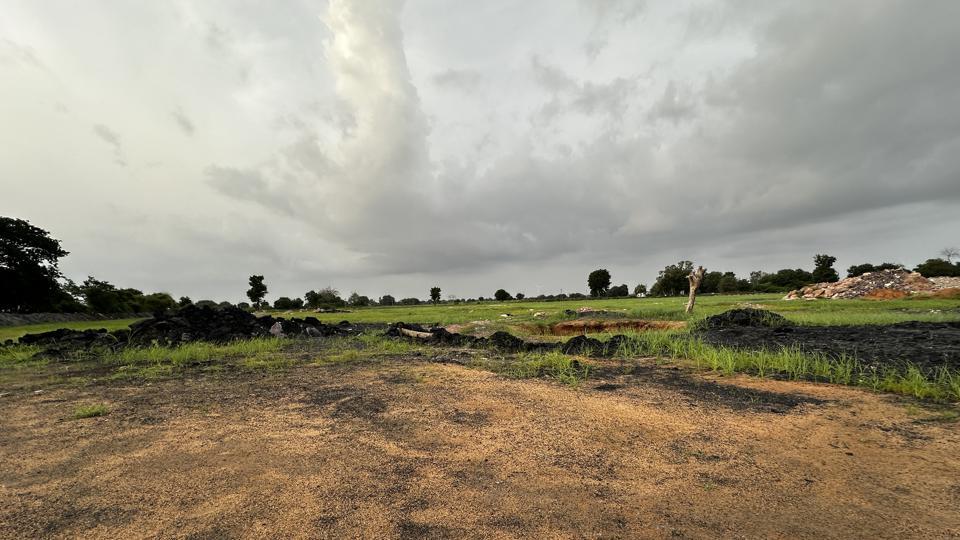
The pattern that followed was all too familiar. It was in existence for several decades in plain sight, stemming from rampant illegal coal mines that dot the district, breaking norms and risking life.
The district police filed a suo motu case under sections of the Mines and Minerals (Development and Regulation) Act, but came up against what they claim is a recurrent problem — a lack of witnesses. “When we went to take a statement from the family, they said he died working in the fields. The miners paid them compensation of ₹4 lakh and they left the village,” one police officer said, asking not to be named.
Gujarat government records show that 13 labourers have died working in illegal mines in Surendranagar district since the start of the year. And yet, these are only official numbers. Rojara does not count as one of the 13. “The actual death toll, including unreported cases, is likely much higher. Apart from locals, tribals from Godhra in Gujarat, Madhya Pradesh, and workers from states like Rajasthan and Bihar also work in these illegal coal mines,” an official from Surendranagar said.
Gujarat mining department officials said that there are illegal carbo-cell mines — wells are dug straight into the ground, with people lowered into the mine to extricate coal through rudimentary harnesses — spread across 24 villages covering approximately 50,000 square hectares in Surendranagar . It is not as if this illegal mining is new, or hasn’t been red-flagged earlier. In 2003, the mining department cancelled 31 leases for illegal practices. And since December 2023, the government has conducted a renewed crackdown.
But little has changed on the ground, which is witness to the region’s coal mining legacy, etched not only in the earth but the lives lost beneath it.
On July 14, Surendranagar’s dark secret reared its head in Gujarat’s political narrative when three labourers were killed in an illegal coal mine in Bhet village. According to the police, Lakshman Dabhi (35), Khodabhai Makwana (32), and Viram Keraliya (35), were in the mine when they encountered a pocket of toxic gas. One of them lost consciousness due to asphyxiation, two others tried to rescue him but died in the attempt. The police arrested four members of the local mine mafia under charges of culpable homicide not amounting to murder. As allegations of their connections with the local establishment swirled, Congress leader Shaktisinh Gohil raised the matter in the Rajya Sabha. “The illegal mining in Surendranagar has been going on for many years now, with operators thriving through collusion with those in power. The public treasury is drained, and the lives of the poor are being lost,” Gohil said.
It’s telling that the political uproar that has ensued has not been whether these mines exist — that is undeniable — but administrative culpability. Surendranagar’s BJP president Hitendrasinh Chauhan said: “Our party was the one to initiate action against this mafia. The Bhupendra Patel-led government is committed to ensuring no one involved will be spared.”
Beneath the surface though, despite the attention and despite the deaths, it is business — dangerous business — as usual.
Illegal networkIn Surendranagar, the roads that rumble through the mining villages all look the same. They are pock-marked; blackened with coal soot; see feverish activity during the day, and a threatening silence at night. A Google Earth image of Muli, Thangadh and Chotila talukas — the epicentre of the illegal mining — shows what looks like a land inundated with craters. Zoom in, and each of these craters are in reality holes dug into the ground, in fields, in any available square metre of earth.
Standing in a village in Thangadh taluka, a man points to a 15-feet-wide mine he has dug, employing 15 labourers to do so. “One well can sometimes give us 200 trucks of coal, repaying the ₹6 to 8 lakh you need to invest to dig the pit,” he explained.
First, locals said, miners dig bore wells using dynamite to blast holes in the earth to determine if the earmarked area has sufficient coal deposits. Much of this is on government land, villagers say. “Some mining is also done on agricultural land where miners pay ₹500 per tonne to the landowner,” said Naresh Makwana, who lives in Vagadiya village.
Officials say the miners lease mining work to contractors at the rate of ₹800-1,000 per tonne of coal. These contractors then hire a “mukkadam”, or gang leader, who recruits labourers for the job. “The mukkadam is responsible for managing the workforce and for any deaths that occur. They pay compensation to the deceased’s family and ensure that no police case is filed,” said a villager who has experience working as a mukaddam.
The unregulated industry had burgeoned into a well-oiled machine — large operators control multiple mines, some extending across entire villages and talukas. From a mine, which runs for almost a year, illegal coal worth ₹2 crore can be extracted. The coal extracted is then sold to the ceramic industry in Morbi and for the brick industry in Gujarat, Rajasthan, Madhya Pradesh, and Maharashtra, locals say. “The illegal mining activity has been going on for several decades, but it has picked up post-Covid. The price of coal has increased from ₹500 per tonne to about ₹3,000 per tonne,” one local said.
Any illegal system needs an illegal defence setup, and miners have erected their own check posts in the villages — to ensure that there is an alarm when government vehicles or outsiders transgress. “As soon as the vehicle passes, information is passed on to the illegal mine contractor,” Makwana said.
The dangerous minesInside this broad architecture of illegality are trapped the lives of Surendranagar’s daily-wage labourers — their everyday trapped between life and death.
An unpaved road leads to a small clearing in Muli taluka’s Dhoriya village, where, on an August morning, a small group of 15 men sit, peering into their phones. Most have white turbans wrapped around their heads — a shield against the oppressive heat. One of them, 32 years old, is in a white shirt, and trousers that extend to his ankles. There are specks of dirt on his clothes. But only specks. “The days when I go into the mine, the clothes are much, much dirtier,” he said, asking not to be named.
For the past four years, the man, who also works on farmland in the village, has spent several of his days and nights down in the illegal mines. “When we go down in the day, we get ₹600 a day. Sometimes, operations take place during the night, especially when there are government teams around. Then, the pay is higher and up to 800 a day,” he said.
But every rupee of that wage is fraught with danger.
When labourers descend a hole, often only five feet in width, the only support they have is a rickety metal platform, hitched onto a rudimentary pulley, in turn attached to a vehicle such as a tractor or an earthmover. They often go down to a depth of a 100 feet, carrying a shovel, and a steel container on their heads. “We have no protective equipment, but it is so hot inside that we have to strip most of our clothes away, and work essentially in our undergarments. We are there for hours on end,” the man said.
Coal is only found beneath three other layers under the soil—fireclay, sandstone and silica sand. “The sandstone doesn’t collapse easily, but it is the fireclay and the silica sand that are most dangerous. When we attempt to extract coal before properly clearing the fireclay and sand, the stones often collapse on us inside the pit. Then, very often, there is little escape, and there are deaths,” he said.
Then, there is always the threat of toxic fumes under the surface. In Bhet for instance, the 32-year-old said, the mining department had sealed an active mine with stones. “When people attempted to reopen it, they did not wait for the trapped gas to disperse,” the labourer said.
Government actionIn 2003, the Gujarat mining department first cancelled 31 leases for “carbo-cell” mining and asked the state-run Gujarat Mineral Development Corporation (GMDC) to explore the region officially for the prospect of coal.
“GMDC carried out the activity for 4-5 years, spending ₹10 crore on exploration before concluding that coal mining in the region was not economically viable. GMDC refused to mine the region in 2008, after which some local leaseholders went to court and sought permission to reopen the coal mines, arguing that the upper layers contained fire clay material. While no new leases were issued, these 31 mines were reopened. Illegal mining increased during Covid as locals faced financial issues, and transporting coal from other states and regions within Gujarat has become a major issue,” said Nirav Barot, geologist, mining and geology department, Surendranagar.
Political leaders from the region claim that the “scam” runs into thousands of scores. “The illegal mining scam is worth more than ₹5,000 crore. Besides the mineral loyalty loss to the government, such massive amounts of stolen coal cause not only environmental damage but risk the lives of the poor,” said Raju Karpada, a famer leader based in Surendranagar who is a member of the Aam Aadmi Party.
Officials of the mining department however, say, that they have intensified their crackdown on illegal miners over the past few months. “Since December last year, we’ve launched a full-scale effort to curb these activities. So far, we’ve shut down nearly 2,227 illegal coal mines across Surendranagar. Quick response teams have been deployed, and check posts have been established in the three talukas where such activities are most prevalent. Awareness pamphlets have been distributed and gram sabhas have been organized to reach out to the people for this issue,” said Barot.
Officials say that the district administration, mining department and the local police have filed more than 100 cases of illegal coal mining in the last two years, arresting more than 50 people and recovering ₹1.79 crore as penalty. To be sure, there have been convictions in these cases so far.
Villagers said that while there has been a reduction in the operation of these illegal mines over the past two months, this was more a function of the monsoon, than any government crackdown.
Vikram Dave, former president of the Wadhwan Nagarpalika said that Porbandar was once known as the “mafia capital of Gujarat”. “Now, thanks to carbo-cell mining, this district is the new hub for the mining mafia. When people get buried in the mines, because of the ecosystem that exists, families don’t even try to recover their bodies. All they do, is light an agarbatti close to the mine. That is the only memorial the dead get in Surendranagar’s mines.”