For five days, DK Shivakumar held his ground, refusing to back down. In front of an opponent with considerable heft and a pan-Karnataka appeal, he argued his case passionately, both in Bengaluru and Delhi. On Thursday, he did give in, acceding to the idea that he would not be the state’s next chief minister but the only deputy to Siddaramaiah. This could well mean more battles ahead, both with the BJP in 2024, and for his own space the Karnataka Congress, of which he will continue to be president. But if the 40-year-long political career of DK Shivakumar -- as troubleshooter, businessman, strongman, loyalist -- is anything to go by, he will be up for the fight, and for the next job at hand.
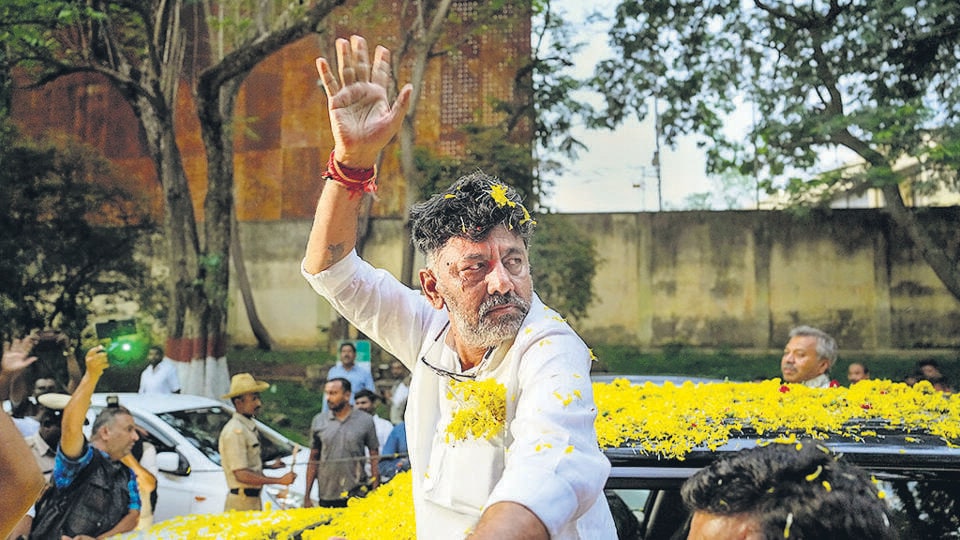
Karnataka Congress chief DK Shivakumar. (PTI)
Born in Kanakpura, a small village on the outskirts of Bengaluru to a family of agriculturalists, Shivakumar joined politics when he was studyingat RC College in Bengaluru. By the age of 21, the powerful orator who carried a sense of destiny was elected the general secretary of the Karnataka State Youth Congress.
In 1985, still in his twenties, Shivakumar made his first big political move, and went up against the Janata Party heavyweight HD Deve Gowda in the assembly elections in Sathanur. He lost but performed creditably, making waves for the fight he put up, winning 38.8% of the vote. Four years later, in 1989, when Deve Gowda did not contest, Shivakumar returned to Sathanur and entered the state assembly for the first time.
Troubleshooter par excellence
Soon, Shivakumar started forging his broader national identity as the man for a crisis. In 1991, when Veerendra Patil was unable to continue as chief minister because of failing health, Shivakumar helped steady an unstable party, and contributed to S Bangarappa being appointed the CM. He eventually served as the minister for state for prisons & home guards, his first administrative experience.
It helped that parallel to his burgeoning political career, Shivakumar grew as a businessman, with interests in hotels, educational institutions, agricultural land, and real estate in Mysuru, Mumbai, Kanakpura, Delhi and Bengaluru. In 2023, he was the third richest candidate in the state to contest, with assets of ₹1,413 crore.
In 2002, when the Vilasrao Deshmukh Congress government in Maharashtra was on a precipice, facing a no-confidence motion, Shivakumar was in the thick of the action. “Deshmukh got in touch with Shivakumar. Already a trouble shooter, Shivakumar huddled the Maharashtra MLAs in his resort on the outskirts of Bengaluru. The move saved the Deshmukh government,” a Congress leader, who did not want to be named, recounted.
Fifteen years later, Shivakumar was on the job again, instrumental in ensuring the dramatic victory of Ahmad Patel for his Rajya Sabha seat, shifting 44 dithering MLAs to Bengaluru.
It was a role he mastered, and party called on him to play it repeatedly.
In 2018, despite the Congress being the second largest party, Shivakumar helped engineer the formation of the government with the JD(S). And when that government collapsed under the weight of its own contradictions, Shivakumar fought the hardest, following the truant MLAs to Mumbai, sitting there in the rain, refusing to move until they met and returned with him.
Shivakumar made many friends, has always had one lodestar: Sonia Gandhi. In 2004, when Sonia Gandhi declined the chance to be Prime Minister, he led a protest outside her home in Delhi, beseeching her to reconsider. In his office in Bengaluru is a photograph of him and Sonia Gandhi -- one that referred to repeatedly this past week. “This is from the chintan shivir in Udaipur. She told me I had to deliver Karnataka, and I have done it,” he said.
From loyalist to leader
But as the target on his back has grown, allegations of corruption have followed. His latest election affidavit lists 19 cases against him, and in 2019, he spent 50 days in jail, arrested by the Enforcement Directorate in a money laundering case. True to form, he turned this imprisonment into a political opportunity, with Sonia Gandhi visiting him, and exiting prison to a grand welcome by his supporters in Bengaluru in October 2019.
Party functionaries close to Shivakumar said that over the years, conscious of an image that bordered on brash, he looked to course-correct. “He got training in how to speak to the media, what he should wear, even his beard,” a party leader close to him said. He began tweeting both in English and Kannada, and there was a team of photographers that followed him everywhere.
He took over as Karnatakta Congress president in 2020 and traversed the state, putting out any dissidence in the state unit, fractured by leaders often jumping ship from one party to another. He targeted the BJP for corruption, including social media campaigns designed to push the labels of “PayCM” and “40% sarkara” that stuck with the people. And he engineered one defection from the BJP after another.
Shivakumar has walked the line between leveraging his identity as a Vokkaliga, the second largest community in Karnataka, and being a pan-Karnataka leader. In the run up to the 2023 elections, he frequented Old Mysuru, the Vokkaliga heartland and Deve Gowda’s bastion. “But, compared to other leaders, in public, he didn’t just project himself as a Vokkaliga leader, and tried to create a pan-state image as well,” one Karnataka Congress leader said.
He was characteristically belligerent on the campaign trail, certain that the party would win 141 seats. Many, even within, had thought that number was an overestimation, and it was -- but only by six seats. He may not have become chief minister yet, but his supporters know Shivakumar has always been a fighter, and say that his time will come. “Siddaramaiah is a good orator and a mass leader. But Shivakumar revived the party. He should have become chief minister but has given it up for the party,” his old friend S Ravi said.
And his next assignment, the 2024 Lok Sabha elections, is just a year away.

 E-Paper