
 E-Paper



Odisha train accident: A ‘mistaken’ signal may have caused the fatal collisions
A railway report stated that the Howrah-Chennai Coromandel Express entered the loop line in Balasore because of a “mistaken” signal.

 Prefer HTon Google


A “mistaken” signal likely led to the Coromandel Express entering the railway line on which a goods train was parked a few metres ahead, resulting in a three-train accident in Odisha’s Balasore late on Friday that killed 290 people and injured 900, according to a preliminary probe by senior railway officials. The report also said the line on which the two trains collided was “partially corroded”.
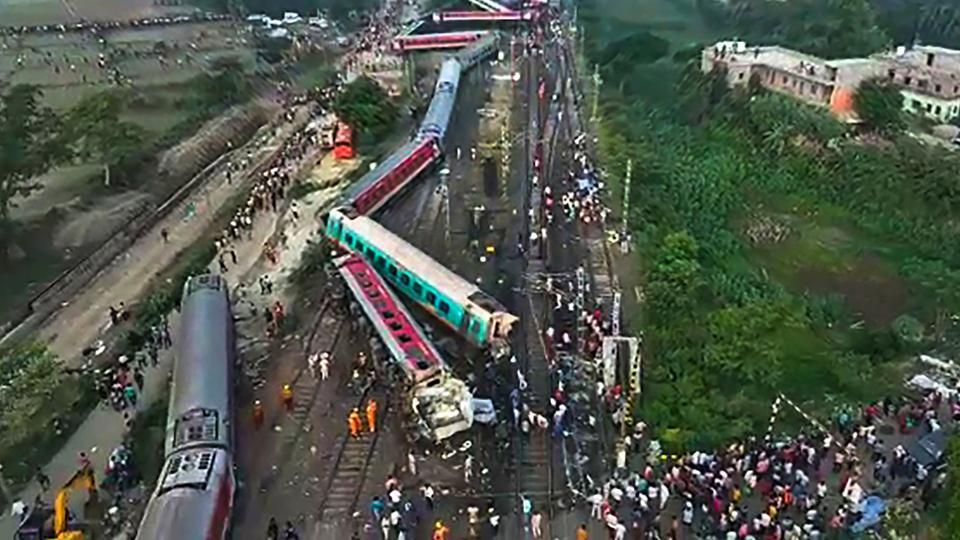
The report, seen by HT, stated that the Howrah-Chennai Coromandel Express entered the loop line near the Bahanaga Bazar railway station in Balasore around 7pm on Friday because of a “mistaken” signal, which was immediately withdrawn. It also mentioned that the Coromandel Express entered the loop line at a speed of over 120km/hour.
“After careful observation, (we) came to the conclusion that the signal was given and taken off for the main line for 12841 (Coromandel Express), but this train entered the loop line and dashed with the goods train which was on the loop line and derailed,” said the report signed by four senior railway officials, who inspected the accident site on Friday night.
A loop line is a railway track that diverts from the main line and rejoins it at a further distance. They essentially serve as service lanes for trains to make stoppages or overtake manoeuvre without affecting other trains.
The two-page handwritten report, put together by senior railway subordinates JN Subudhi, RK Banerjee, RK Panjira and AK Mohanty, was submitted on Saturday.
Also Read:Odisha train crash: Rescuers work overtime, 200 ambulances pressed into service
The exact cause of the accident will only be determined after a detailed technical inquiry by the commissioner of railway safety. The Union railway ministry has already ordered a high-level probe into the accident.
The report said the assessments were based on observations and records from the signal room at Bahanagar Bazar railway station.
“In the meantime, Bangalore-Howrah Superfast Express (12864) passed through another line and two coaches of the train derailed and turned turtle,” the report stated.
The two-page report said 21 of the Coromandel Express train’s coaches and two of the Bangalore Superfast Express were derailed. The sleeper coaches of both trains were impacted less than the air-conditioned bogies.
The railway line in question is not covered under the railways’ anti-collision mechanism ‘Kavach’, which automatically slams the brake if another train is detected on the same line.
“We will ensure such an accident does not happen in future,” Union railways minister Ashwini Vaishnaw said.
-kW0H-U20214218012MgB-250x250%40HT-Web.jpg)


