E-Paper



G20 challenge: Reaching a consensus on Ukraine war
The foreign ministers will meet just four days after a meeting of G20 finance ministers in Bengaluru ended without consensus on a joint statement because of opposition from China and Russia to a reference to the Ukraine war in the draft communique

 Prefer HTon Google


New Delhi: As G20 foreign ministers gather in New Delhi for what is expected to be a stormy meeting under the shadow of the Ukraine crisis, the Indian side will push the consensus reached at the leaders’ summit in Indonesia in order to find a way out, people familiar with the matter said on Tuesday.
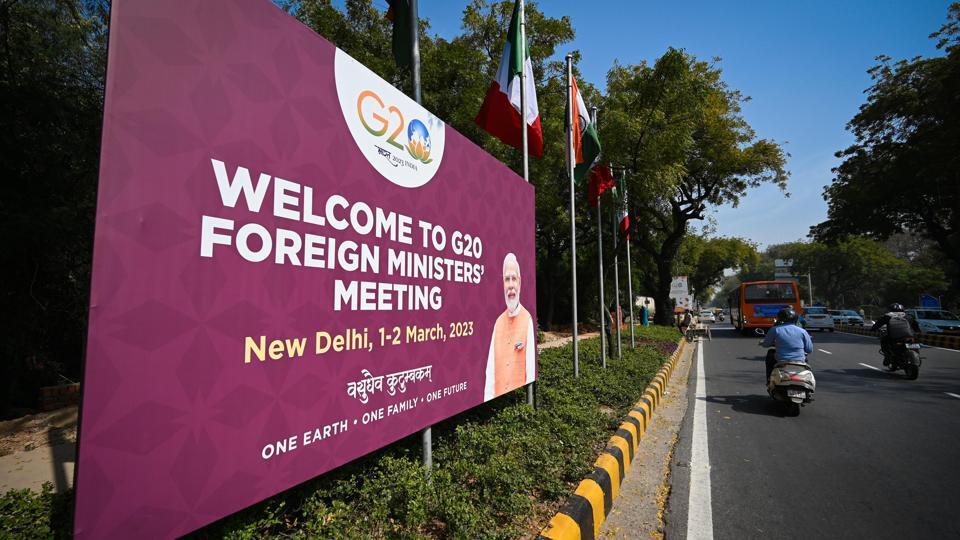
The foreign ministers will meet just four days after a meeting of G20 finance ministers in Bengaluru ended without consensus on a joint statement because of opposition from China and Russia to a reference to the Ukraine war in the draft communique. This was the first time the two countries took a joint stand on the Ukraine crisis at a multilateral forum since Russia launched the invasion in February 2022.
In a pointer to how the crisis in Europe is expected to dominate the G20 foreign ministers’ meeting, the UK said hours before foreign secretary James Cleverly’s arrival in New Delhi that he will “continue to call Russia out at the G20 and work with partners to mitigate the global impacts of Russian aggression in Ukraine”.
At the G20 finance ministers meeting, the representatives of France, Germany and Spain (a guest country invited by India) insisted that any joint statement should not step back from the language in the leaders’ declaration in Bali, which stated that most members of the grouping “strongly condemned the war in Ukraine” while simultaneously acknowledging “other views and different assessments of the situation and sanctions”.
Russia’s foreign ministry, in a statement issued after the meet, noted the “constructive role” played by India in the “fair consideration of interests and positions of all countries”, and accused the West of destabilising the activities of the G20 and using the forum in an “anti-Russian, purely confrontational manner”.
The rigid positions adopted by Russia and China on one side and the G7 on the other has heightened concerns that the G20 foreign ministers meeting during March 1-2 too could end without any joint statement.
Amid the Russian side’s insistence that the G20 is a forum for dealing with economic issues and not a platform for discussing the Ukraine crisis, the people cited above said the India’s “considered and balanced” position had contributed to forging the leaders’ declaration at the G20 Summit in Bali last November.
“Our endeavour was to reflect the Bali consensus in the G20 finance ministers’ meeting. This was expressed in the chair’s summary and outcome document. The Indian side will continue to push the Bali consensus because this is something all the members had agreed on,” one of the people said.
However, China on Tuesday appeared to again back the Russian position, with foreign ministry spokesperson Mao Ning telling a media briefing in Beijing that the Chinese side expects the G20, as the premier forum for international economic cooperation, to focus on “prominent challenges in the global economy and play a bigger role in driving world economic recovery”.
The people cited above also acknowledged that it would be difficult for a gathering of foreign ministers to completely avoid discussions on the Ukraine crisis, including its fallout on developing countries around the world.
Diplomatic circles will be closely watching a networking reception and dinner to be hosted on March 1 by external affairs minister S Jaishankar for his G20 counterparts and nine guest countries, as it will set the stage for discussions during two sessions the following day. The G7 foreign ministers had boycotted a similar dinner in Indonesia in July 2022 over Russian foreign minister Sergey Lavrov’s presence.
The first session on March 2 will focus on strengthening multilateralism and the need for reforms of multilateral bodies such as the UN, food and energy security, and development cooperation. The second session will be devoted to counter-terrorism and emerging threats, global skill mapping, and humanitarian assistance and disaster relief.