
 E-Paper



HT THIS DAY: August 24, 1951 — Korean truce talks suspended; UN accused of bombing Kaesong
The unexpected breach was made by a Communist liaison officer, who had summoned U.N. liaison officers to investigate the evidence that a U.N. plarie had napalmed and strafed the Kaesong neutral zone at 11 o’clock last night


Tokyo- U.N command H.Q. announced today the Communists had broken off the six-week-old Korea truce talks “from now on “-but a later Peking Radio broadcast merely said they were “suspended “ for today. The broadcast seemed to confirm the growing impression here that the breach was not irrevocable.
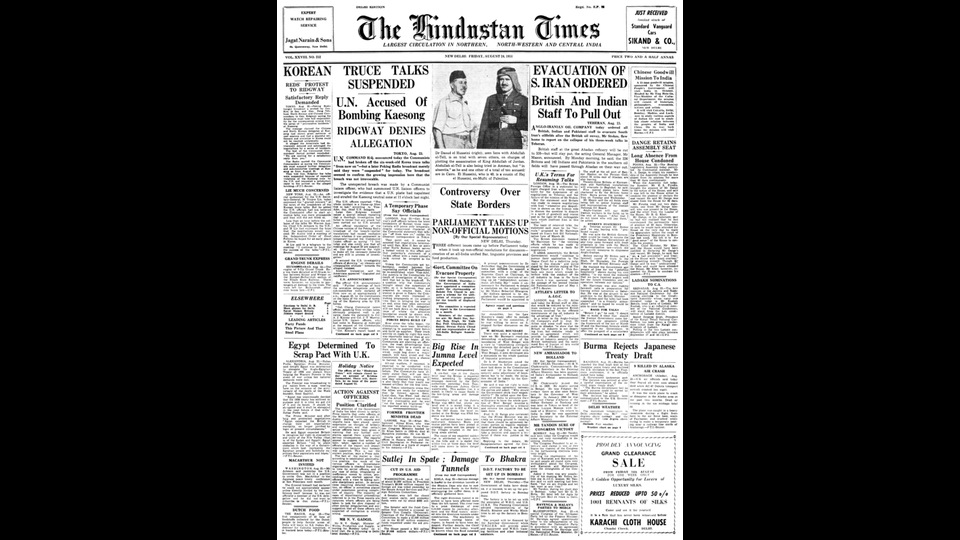
The unexpected breach was made by a Communist liaison officer, who had summoned U.N. liaison officers to investigate the evidence that a U.N. plarie had napalmed and strafed the Kaesong neutral zone at 11 o’clock last night.
The U.N. officers reported: “The whole incident is a frame-up from first to last,” according to Vice. Adm. Joy, chief U.N. delegate.
Later Gen. Ridgway himself issued a special release repeating that a thorough investigation had failed to reveal that any attack had been carried out by U.N. aircraft.
An official translation of the Chinese version of the Peking Radio broadcast of the breach-earlier translations had caused confusion about whether it was permanent or temporary-quoted the Communist liaison officer as saying: “I first lodge and also notify you that all meetings for August 23 are suspended. Our side reserves the right, to make all the necessary demands and are still in process of investigation.”
It accused the U.S. investigating others of showing “an irksome and irresponsible attitude “ towards the I alleged incident.
Another translation said the Americans appeared “disgusted and indifferent.”
U.N. ANNOUNCEMENT
The official U.N. announcement said: “Further meetings of both the armistice delegations and the sub-committee were declared of from now on at approximately 2 a.m., August 23, by the Communists on the basis of the charge of bombing of the Kaesong area by U.N. forces.
“Col. Chang, Communist liaison officer, speaking from written notes, obviously prepared well in advance made the statement to Col. A. J. Kinney and Col. J. T. Murray, junior U.N. liaison others, who had come to Kaesong at midnight at the request of the Communists to investigate the charges. “
Col. Kinney’s report based on investigation on the spot but in darkness suggests that the whole incident is a frame-up from first to last.”
“Col. Chang insisted that a U.N. Command aircraft had attacked Kaesong neutral zone at 11-20 p.m. on August 22, including strikes within the immediate conference , area,” it added.
Lt.-Col. Tsai then produced two small bits of metal which, he alleged, had hit the jeep of a senior Communist delegate. Col. Chang could not say whether one or more aircraft were involved. He stated he did not know how many bombs were dropped or how many passes the aircraft blew up.
NO BOMB CRATER
“ Col. Kinney and Col. Murray were then escorted to within 100 yards of the U.N. Command delegation house and there were shown a rumpled piece of rolled metal about 18 to 30 inches in size covered with oil and lying on the road. Col. Chang asserted this was a napalm bomb. There was no bomb crater near and no scorched earth, but about 25 yards away there was a minor depression in the earth about 24 inches in diameter and perhaps six inches deep.
“Col. Murray judges the depression as the possible result of a buried explosive of force about equal to a hand-grenade. Col. Kinney is certain it is not a bomb crater.
Near the Communist house other pieces of metal were pointed out, the report added. Two of these appeared to be pieces of a U.N. Command aircraft. Flush riveting, was noted on each piece, both of which about 12 inches square. The third piece was the pin of a rocket.
Vice-Adm. Joy reported his liaison officers concluded from the investigation that the scattered evidence may have been planted by having Communist aircraft fly over Kaesong dropping small cans of napalm, or else entirely manufactured on the ground.
Returning to the conference house, Col. Kinney stated the evidence plainly was not the result of U.N. bombing, the report added. He pointed out there was no damage evident to any structure, person or i even to crops.
SOLDIER QUESTIONED
“In the course of the discussion, Col. Kinney asked if anyone present had actually seen an aircraft. A Communist soldier was put forward who declared he had seen an aircraft at 11 p.m.
“Col. Kinney asked if this aircraft had shown light and the soldier answered: ‘ Yes, the head- lights were on.
“ At this point a European Communist intervened, charging Col. Kinney with tricking the soldier with a trap question. Col Kinney immediately requested Col. Chang to clear the area of news reporters at once. Col Chang complied after some argument.”
The report said the U.N. officers asked the Communist to preserve the evidence and renew the investigation by daylight. But he refused, saying the investigation had ended and he had to remove the evidence for analysis.
Gen. Ridgway’s announcement said neither Air Force nor Navy planes were over the Kaesong area. The only U.N. guns which could reach the area had not fired a shot for 24 hours.
He said flush riveting was not used by the U.N. to manufacture napalm tanks. “They are of rough construction, more economically produced since they are used only once.”
Gen. Ridgway referred to the alleged eye-witness of the attack who told liaison officers the aircraft had used headlights-and declared that U.N. planes did not use lights during night operations.
PRE-PLANNED MOVE
He also stated the decision to declare all meetings “ off from this time “ was a high level one which could “ not have been arrived at and transmitted to Col. Chang, in the interval between 11.20 p.m. of August 22 and 1.45 a.m. of August 23.”
Just before the break-off meeting, Adm. Joy had emphatically rejected three other Communist allegations that the U.N. had violated the Kaesong neutral zone.
On the war fronts the Eighth Army reported decreasing Communist resistance in the Yanggu sector. South Korean troops were attacking and had made limited gains. The east front offensive was moving again after being blocked on Tuesday by heavy Communist counter-attacks.