E-Paper



Vote share spoilers hit poll fortunes of 3 major parties in Gujarat
Did the Aam Aadmi Party (AAP) act as a spoiler in the 2022 Gujarat elections? If it did, how much of an impact did it have on the Gujarat results? An HT analysis shows that the answer is not straightforward

 Prefer HTon Google


Did the Aam Aadmi Party (AAP) act as a spoiler in the 2022 Gujarat elections? If it did, how much of an impact did it have on the Gujarat results?
Headline vote share for the AAP (12.9%) suggests that it is a distant third compared to the Congress, which has a vote share of 27.3%. If the vote shares of the two parties are added, it becomes almost identical to the Congress’ vote share of 41% in the 2017 elections. So, is the AAP cutting into Congress’s votes the single biggest factor behind the Bharatiya Janata Party’s (BJP) massive victory in the state? An HT analysis shows that the answer is not so straightforward.
Also Read | AAP needs to solve Gujarat puzzle on way to principal Opposition spot
Let us begin with a simple spoiler analysis where a spoiler is defined as a candidate finishing third but has a vote share which is larger than the victory margin. Out of the 182 ACs in Gujarat, 57 ACs have seen a candidate who finished third but had a vote share which was bigger than the victory margin. The Congress is the runner-up in 27 of these ACs and BJP is in 17 of these ACs. To be sure, the Congress and the BJP are not the only parties that have suffered because of spoilers. In fact, in 13 ACs, the AAP can claim to be a victim of the Congress spoiling its chances. The best way to understand the role of spoilers is to make a matrix of number of ACs with party which acted as a spoiler on one side and the party which finished second on the other.
See Matrix
Historical data further shows that spoilers are not the only reason for the BJP’s highest and Congress’s lowest seat share in the 2022 assembly election. In fact, as recently as in 2012, the BJP and Congress lost 25 and 29 ACs respectively to a spoiler, both numbers higher than in 2022.
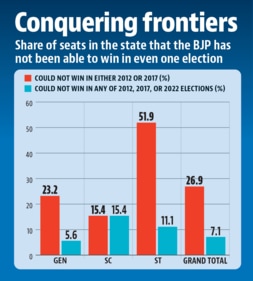
This suggests that an equally important reason for BJP’s big victory is an increase in support for the party in this election. The BJP has polled 52.5% votes, the highest by any party finishing first since 1990 and the BJP’s highest vote share in the state. This is also not because of the BJP polling a very high vote share in a particular part of the state. The median vote share of the BJP in this election – it is the middle value in a series of numbers – is 51.9%, also its highest ever. To be sure, it can always be argued that the BJP enjoyed tailwinds to its campaign because of a discernible fragmentation in the opposition camp which might have shifted a large section of the floating votes towards the party.