
 E-Paper



A grater mission: The world’s oldest cheese sample tells a story of survival

 Prefer HTon Google


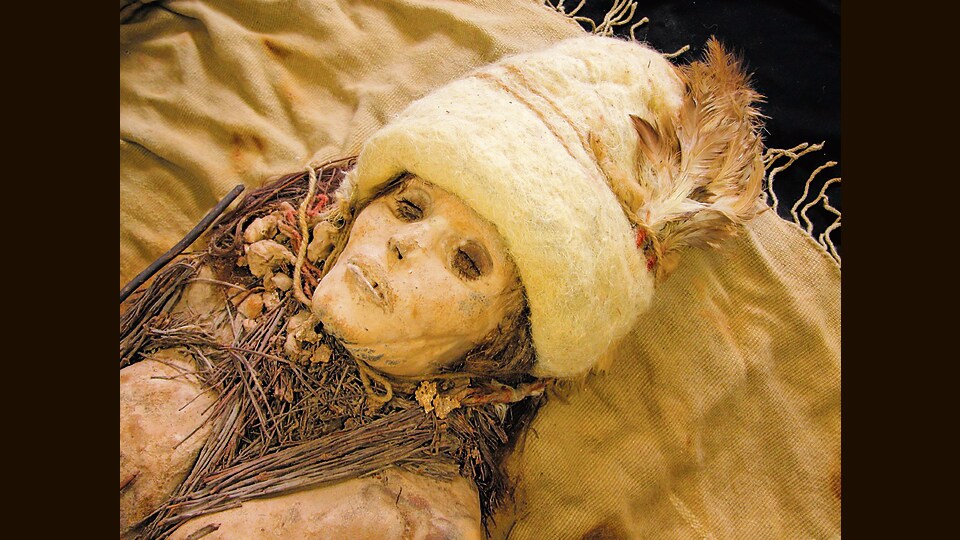
Remains found on Bronze Age mummies in China are being called the “smoking gun” for what was unfolding in the world 3,500 years ago.
When archaeologists discovered mysterious white granules smeared on the heads of Bronze Age mummies, and on the jewellery they wore, they suspected it was some kind of fermented dairy product. But they didn’t have the technology to tell exactly what it was.
A decade later, in 2014, protein analysis had advanced to the point where it could confirm that the granules found on the mummies in Xinjiang, China, were a type of kefir cheese — making this the oldest-known intact cheese sample in the world.
Another decade later, genetic analysis has revealed how it was made.
It turns out that the recipe from more than 3,500 years ago is remarkably similar in some ways, and in others, dramatically different, from the methods in use today.
The similarities are evocative: Two of the cheese samples were made from cow’s milk; a third from goat’s milk. These remain among the most popular choices today.
Even the bacterial and fungal species used to ferment the milk are familiar: Lactobacillus kefiranofaciens and Pichia kudriavzevii are still used to make the fermented-dairy drink kefir.
“The prehistoric cheese likely possessed mild, yeasty, boozy notes due to the alcoholic fermentation associated with the production of kefir,” says cheese historian Paul Kindstedt, a retired professor of food sciences at the University of Vermont, and author of Cheese and Culture: A History of Cheese and its Place in Western Civilization (2012).
The differences tell an interesting story too.
The cheese found in Xinjiang is helping researchers at the Chinese Academy of Sciences in Beijing study how the bacteria L kefiranofaciens evolved and adapted to the human gut over thousands of years, combining with other strains to become more stable and, vitally, to trigger less of an immune response in the human intestine.
It isn’t entirely surprising that the granules ended up smeared on the mummies, Kindstedt points out, given how integral milk, cheese and ghee were to spiritual rites in ancient cultures.
Documented evidence of such rites goes back to at least the 7th century BCE.
The findings in Xinjiang provide new evidence of this cultural and spiritual heritage, says Kindstedt. In so many ways, “this cheese is the smoking gun” for what was unfolding in the prehistoric human world, he adds.
The dairy product was, after all, a game-changer. For millions of years, adult humans were largely lactose-intolerant. Fermented dairy foods were the only way to absorb milk’s vital nutrients. Such fermentation also gave the highly perishable food an extended shelf life, making it easier to store and transport.
The ability to make cheese would have improved nutrition levels and altered life expectancy; it would have made migrations more sustainable.
There is, in fact, evidence of widespread cheese-making going back 7,000 years. Most of the earliest evidence comes from dental fragments and pottery shards.
In 2018, an international team of researchers found traces of milk fats on pottery shards that were at least 7,000 years old, in Croatia. It is believed that the shattered clay kitchen utensil was once a sieve used to strain cheese out of whey… making cottage cheese, then, far older than the idea of the cottage itself.


