
 E-Paper



Ecostani | Why Modi may find it difficult to accept Andhra and Bihar’s special status demand
Special status for Bihar and Andhra could disturb fiscal prudence and put constraints on central finances, which, in turn, will hamper key infra projects

 Prefer HTon Google


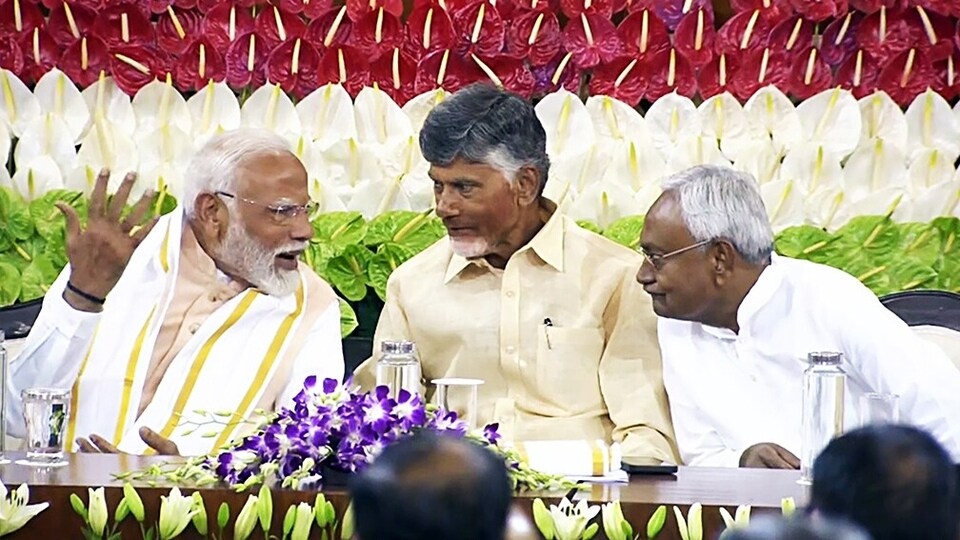
For the first time since 2014, Narendra Modi is dependent on the Chandrababu Naidu-led Telugu Desam Party (TDP) and the Nitish Kumar-led Janata Dal (United) to serve as prime minister of the country for the third term. The two wily politicians have a key demand — to grant special category status (SCS) to their respective states, which brings higher allocation of central funds for schemes, tax incentives for industry and rapid infrastructure development --- for their support.
The special category status was introduced in 1969 on the recommendation of the Fifth Finance Commission of the Union government to assist development based on economic and geographical hardships.
Currently, 11 States in India — Arunachal Pradesh, Assam, Himachal Pradesh, Jammu and Kashmir, Manipur, Meghalaya, Mizoram, Nagaland, Sikkim, Tripura, and Uttarakhand — have SCS. They fulfil four important criteria --- hilly and difficult terrain, low population density and/or sizeable share of tribal population, non-viable nature of state finances and strategic location along international borders.
The 16th Finance Commission headed by Aravind Panagariya will hear the demand for financial grants from all states for the devolution of funds in the next five years. The recommendation of the commission including devolution of funds for the next five years is binding on the government.
The commission can ask the Union government to discontinue or alter certain schemes including the special category status. However, past commissions have avoided recommending drastic changes to the SCS and avoided declaring any mainland state as backwards under this scheme as it shrinks the financial resources of the central government.
Granting special category status to Andhra Pradesh can open a pandora’s box of similar demands from other states. Andhra’s human development score for 2011-12 is higher than Bihar, Uttar Pradesh, Jharkhand, Madhya Pradesh, Rajasthan, Meghalaya and Manipur even though it has the lowest HDI among all southern states.
What government data and analysis show
On the multi-dimensional poverty index of the Niti Aayog for the year 2022-23, at least 19 states are above Andhra on the number of multi-dimensional poverty indo with Bihar leading the table with one-third of the population being poor.
Both the annual per capita income and per capita electricity consumption of Andhra Pradesh is much higher than the national average.
Andhra’s annual per capita in 2022-23 was ₹2,19,518 as compared to ₹49,470 for Bihar, ₹70,792 for Uttar Pradesh, ₹78,760 for Jharkhand, ₹1,21,594 for Madhya Pradesh, ₹1,24,798 for West Bengal, ₹1,50,676 for Odisha, and ₹1,56,149 for Rajasthan. Most of the northeastern states have per capita income less than that of Andhra.
On the Niti Aayog’s overall social progress index, the worst are Assam, Bihar and Jharkhand with Andhra Pradesh among the better ones. On overall social and economic performance, the 10 worst states are Bihar, Assam, Uttar Pradesh, Chhattisgarh, Madhya Pradesh, Rajasthan, Orissa, Jharkhand, West Bengal and Tripura, as per government data.
The above data clearly shows that Andhra does not have a case to seek special category status and Bihar will need a tweaking of the scheme contours to get some benefit. Andhra’s only ground to seek the status is that the status was promised when Telangana was carved out of Andhra Pradesh in 2014.
In 10 years since the law was passed in Parliament, the Bharatiya Janata Party (BJP) government at the Centre has not fulfilled the promise made on the floor of Lok Sabha.
In Bihar's case
Nitish Kumar, who has been part of the ruling National Democratic Alliance (NDA) for most of the past 10 years, can seek a special financial package for being backwards on most socio-economic indicators from per capita income to poverty to access to basic facilities for survival it continues to be on the lowest ebb.
For the Union government, accepting Kumar’s demand would not be easy as several states such as Jharkhand, Madhya Pradesh and Rajasthan have similar human development indices. Former Rajasthan chief minister and Congress leader, Ashok Gehlot, on Saturday, demanded a special category or backward status for Rajasthan. Similar demands will pour from other poorer status, who were once categorised as “Bimaru” with Bihar and would be difficult for the Centre to accept.
In the 10 years of the BJD-led NDA government, the overall flow of central funds to the states has reduced. The 15th Finance Commission reduced the flow of funds to states by one percentage point to 41% and increased the state’s share to extract the benefit of Central schemes. The Central share was reduced from 60% to 50% for almost all central schemes, except MG-NREGA, where the law provides for complete funding by the Union government.
In March 2022, the finance ministry ordered that money will not be released to states without the finalisation of utilisation certificates, which are states’ expenditure reports for money disbursed earlier.
Several state governments such as Tamil Nadu, Kerala and Punjab has alleged that getting its money from the Centre in the last decade had become more bureaucratic but finance ministry officials have countered the charge, saying they have to maintain fiscal prudence.
What will the government do?
Special status for Bihar and Andhra could disturb this fiscal prudence and put constraints on central finances, which, in turn, will hamper key infrastructure projects such as the high-speed train project between Ahmedabad and Mumbai, and the expansion of airports and highways.
With global economic headwinds and the overall economic outlook for the coming fiscal not so bright, the government will have to dig deep into its pockets to keep Naidu and Kumar happy.
But in politics, survival is considered more important than fiscal prudence. For that, Modi will likely buy time from the two wily politicians who know how to negotiate the grey chessboard of coalition politics well.


