
 E-Paper



Keeping up with UP | BJP's welfare schemes challenge the Dalit movement's legacy
The BJP's welfare schemes are seen as a challenge to Mayawati's legacy, emphasising the contrast between development-oriented policies and symbolic gestures

 Prefer HTon Google


Prime Minister Narendra Modi’s much-acclaimed scheme of distributing free ration to the poor under the Garib Kalyan Yojana Scheme came under attack recently from unusual quarters. Aware that the bulk of beneficiaries comes from her Dalit support base, Bahujan Samaj Party (BSP) national president Mayawati questioned the scheme, while speaking at a function held on December 6 to observe the 67th death anniversary of Dr BR Ambedkar.
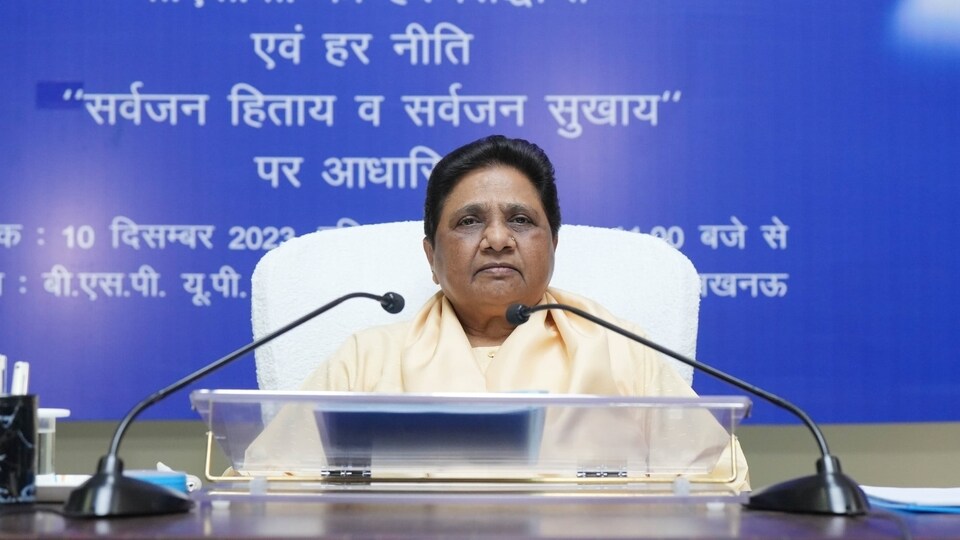
“Neither Ambedkar nor the freedom fighters could have ever thought that 81 crore people would depend on the government for free ration to feed themselves. What type of development is this that while there is no paucity of funds at the Centre and in the state, yet people are still living in acute deprivation?” Mayawati said.
While her statement reflects her fears of losing her core vote bank, experts say that the politics of welfarism has overtaken the Dalit movement’s quest for political power.
Kanshi Ram, who founded the BSP in 1984, exhorted Dalits and the downtrodden to seek political power as a means to access rights. What seems to be working on the ground are two schemes: PM Awas Yojana (for free housing) and Kisan Samman Nidhi (financial help of ₹6000 released annually in three instalments) started in 2015 and 2018, respectively.
“The Dalit movement for social equality created awareness and laid the foundation for political empowerment. It helped both Kanshi Ram and Mayawati attain power, while the masses suffered. Now they need economic empowerment and government schemes are only aiding in bringing in economic revolution,” Lalji Nirmal, chairman of the Ambedkar Mahasabha, told HT
Badri Narayan Tiwari, director at Allahabad’s GB Pant Institute for Social Sciences, said, “Dalits subjectively are orienting to become beneficiaries of government schemes. Though their desire for dignity will remain as a Left radical movement, it will weaken the Dalit movement as people who want economic betterment.”
Setback to Mayawati
Kanshi Ram initially emphasised the social and economic empowerment of Dalits. But he soon realised that political power was key to all problems and to acquire political power he took the route of politics of dignity.
Once he established the BSP as a favoured party of Dalits, political parties of all hues and shades, knocked on his door for alliances. It paid huge dividends as Mayawati became chief minister four times: in 1995, for 137 days, in 1997 for 184 days, in 2002 for 483 days and finally for a full term of five years in 2007.
In all her four terms, the BSP chief minister built parks, and statues and renamed districts and tehsils in Ambedkar’s name. By setting up the first Dalit memorial named Prerna Sthal in Noida, Uttar Pradesh in 2011, she avenged the indignation suffered by millions.
She often reminded her constituency of Ambedkar’s dream.
“I hope one day, not before very long, the depressed classes will become organised, will become conscious of the power they have got and will begin to put it to wise and effective use in order to secure their social emancipation,” Mayawati often said in her public speeches, quoting Dr Ambedkar.
The two BSP leaders Kanshi Ram and Mayawati often held that political power had long been a monopoly of a few while the majority were deprived of a chance of betterment.
Mayawati’s plan to safeguard the Bahujan Samaj from the Sangh Parivar’s brand of Hindutva — the core of which is religion — nevertheless knew that Dalits were at the forefront of the Ram temple movement. She also knew that it was a Dalit, Kameshwar, who had laid the foundation stone of the Ram temple in Ayodhya in 1989 and again, in 2002, two Dalits performed the shiladaan (a stone donated for the construction of Ram temples). Her message instead was to worship Ambedkar and Ambedkar’s ideology, as this alone would help them attain — and sustain — political and social empowerment.
However, Mayawati did not return to power after 2012, and her political value started diminishing post-2014.
Today her claim of wanting to give India its “first Dalit prime minister” in the next 12-13 years, is not only disbelieved but dismissed too.
In her book, Mere Sangharshmay Jeevan and Bahujan Movement ka Safarnama (My Life of Struggle and the Journey of the Bahujan Movement), she spelt out her mission: “Bahujan Samaj became the rulers and not the ruled. Parliament is the temple of power. We have to get a majority so that we are not dependent on others. Capture this for your emancipation.”
But such slogans — and the statues and parks — did not come with a guarantee of food and shelter, which is what the BJP has managed to target through welfare schemes.
From her perch in Lucknow, HT’s senior journalist Sunita Aron highlights important issues related to Uttar Pradesh


