
 E-Paper



Keeping up with UP | Mayawati going solo in 2024 elections is about keeping her options open
The BSP has partnered with nearly all parties to remain politically relevant. In some ways, the former UP CM has always been a lone ranger

 Prefer HTon Google


Mayawati, the national president of the Bahujan Samaj Party (BSP) has decided to go solo in the 2024 general elections — she made this announcement earlier this week.
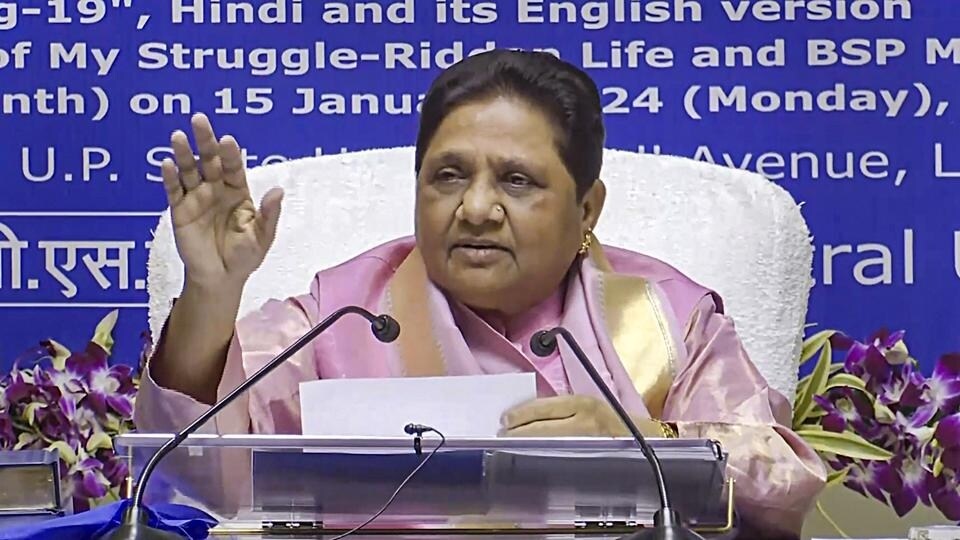
The declared mission of the BSP — a national party with 10 MPs from UP in the 545-member Lok Sabha — is to give the country its first Dalit prime minister, an obvious reference to Mayawati, the four-time Uttar Pradesh chief minister.
However, her announcement to go solo took none by surprise for another reason: the political stalwart wants to keep her post-poll options open and the Bharatiya Janata Party (BJP) would prefer the BSP as a spoilsport in the fray rather than as an ally. By appointing Congress’s Mallikarjun Kharge, a Dalit, as its chairperson, the INDIA (Indian National Developmental Inclusive Alliance) has closed the door on her, for now.
Yet, the BSP remained in demand as Mayawati could transfer captive votes in a way no other party could claim to do. But, now her hold on Dalits and her prowess to transfer her core votes will be tested in 2024.
According to a study by the Centre for Study of Developing Societies, the 2019 general elections in which arch-rivals the Samajwadi Party (SP)-BSP fought together in UP saw an erosion in her core vote bank of Dalits. The study also questioned her ability to transfer her captive votes to her ally. SP felt betrayed and insisted that BSP did not transfer core votes. Mayawati won 10 seats, SP ended up with five in that election.
However, Mayawati has done some smart pre- and post-poll alliances since 1993.
1993: When two fledgling parties join hands
Much of the religious frenzy had subsided after the demolition of the 16th-century Babri Masjid in Ayodhya on December 6, 1992. The BJP leadership was still in the process of evaluating the political consequences, as the country suffered large-scale rioting. Party veteran Atal Bihari Vajpayee had broken his silence and publicly expressed his unhappiness over the incident saying, “It [the demolition of the masjid by kar sevaks] should not have happened!”
In the Opposition quarters, Mulayam Singh Yadav was living in complete political isolation after his government opened fire on kar sevaks three years before in 1990. Having been part of many socialist outfits during his 25-year-long political journey till then, from Lok Dal to Janata Party to Janata Dal, he decided to float his own party.
Samajwadi Party was born on October 4, 1992, when the Sangh Parivar’s temple movement had reached its crescendo. Two months later the Kalyan Singh (BJP) government was dismissed following Ayodhya demolition on December 6.
This is when Kanshi Ram, heading a party formed in 1984, approached Mulayam Singh and they together saw an opportunity in the 1993 mid-term assembly polls.
Mayawati has repeatedly claimed that the alliance was sewn with two purposes: First, to unite Bahujan Samaj under the leadership of someone from the Bahujan Samaj, and second, to check the BJP’s popularity and growth following the demolition.
Though the BJP won 174 of 425 seats in undivided Uttar Pradesh’s assembly polls, it failed to muster the support of other parties in the post-demolition era. The SP (109) and BSP (67), with outside support of other secular parties, formed a coalition government that lasted 546 days.
The alliance collapsed violently as both parties worked with vengeance to prove their majority to the then Governor Moti Lal Vora. Then the infamous state guest house incident took place — when Mayawati locked herself in a room in the state guest house for safety while SP supporters forcibly took her MLAs — and the two parties became sworn enemies. Till 2019 assembly polls.
While the BSP accused Mulayam and his selfish politics of the alliance’s failure, SP leaders claimed that Mayawati had become too ambitious and wanted to be CM. The BJP, whose very basis of Hindu consolidation was affected by the SP-BSP alliance, grabbed the opportunity and assured her outside support.
The Dalit and Yadavs, the two antagonistic social groups led by two strong leaders —Mayawati and Mulayam— clashed in the heartland for power and rights. Cracks developed in coalition.
The BJP propelled the BSP to power and supported Mayawati as CM in June 1995. This partnership, too, lasted a mere four months as Mayawati pushed her pro-Dalit agenda and upset the BJP’s core votes of Brahmins.
The reconciliation
Mayawati once said that she was willing to forgive Mulayam Singh Yadav for the infamous State Guest House incident if he publicly apologised to her. Mulayam refused, saying he would not apologise for something he had not done. Rather, he said, trying to reframe the situation, it was he who had been magnanimous and ignored BSP’s baseless accusations against him. He also ruled out any possibility of an alliance with the BSP and accused them of doing politics of power and not of ideology or principles.
In 2019, however, both realised that for political survival, the BJP juggernaut in UP needed to be checked. The two parties decided to sink their differences. Looking extremely uncomfortable, they shared a public dais in April 2019. But the mathematics that worked on the paper failed on the ground. Their combined vote percentage in 2019 totalled 39.23 % (inclusive of RLD) as against a total of 42% in 2014 (when the parties had contested independently.)
The seeds of mistrust were first sown in 1995, and they sprouted again in 2019 with both SP-BSP leadership questioning each other's political integrity.
INDIA bloc
With INDIA now in the picture, Congress leaders in the state wanted to include the BSP, but SP, a constituent member, opposed it tooth and nail. Besides the credibility factor raised by SP leadership, the contentious issue was also seat sharing and was linked to their power in state politics.
Many believe that after the general elections, Mayawati may bargain hard in the post-poll scenario in case she has numbers in a hung house. Pragmatic in her approach, she has no love or hate for any party.
In the 1996 state assembly elections, the BSP contested the Vidhan Sabha polls with the Congress. The voters delivered a hung house and the assembly remained in suspension during which Mayawati joined hands with the BJP and formed the government on a rotational basis.
In fact, Mayawati herself has advised politicians not to bicker, as no one knew who may need whose support after the election.
Even the BJP had three bitter experiences of partnership with the BSP in 1995, 1997 and 2003 with Mayawati breaking their marriage of convenience, first after four months, second after 28 days of handing power in a rotational arrangement with the BJP, and third time after one year and 118 days. She benefitted from short tenures to enjoy a full term in 2007, after forming a majority government.
Now comes the 2024 general elections which will decide if the party will remain politically relevant or not. As of now, she may be down, but she’s certainly not out.
From her perch in Lucknow, HT’s senior journalist Sunita Aron highlights important issues related to Uttar Pradesh


