
 E-Paper



Nepal maintains a fine balance
The PM's four-day visit to New Delhi shows his prioritisation of India over China and a breakthrough in power trade talks for Kathmandu, Delhi and Bangladesh

 Prefer HTon Google


It’s not easy being Pushpa Kamal Dahal ‘Prachanda,’ Nepal’s prime minister (PM). More so when you are on a high-stakes visit to New New Delhi (the visit began Wednesday) and have distinctly dissimilar constituencies back home to please.
First, there’s a vocal group in the Nepali Congress, the largest among half a dozen parties supporting the government, crying foul about their leadership’s stubborn cohabitation with Prachanda’s Communist Party of Nepal (Maoist Centre), a party with a violent past.
Then the PM must also contend with the demons within. Until his party joined mainstream politics in 2006, the Maoists waged an ideological struggle against what they called Indian expansionism. That meant viewing Delhi with deep suspicion, a political schooling much of Nepal’s Right and Left forces still ascribe to. One of them is the main Opposition party in the hung Parliament, the Communist Party of Nepal-Unified Marxist Leninist (CPN-UML).
Still, Prachanda visits New Delhi on a reasonably sound political footing. Five months after he took office, he has finally been able to give his Cabinet a full shape. Though Parliament remains deeply fractious, none of the old parties has any appetite for early polls given the soaring popularity of new parties, particularly the Rastriya Swatantra Party. The general election took place only last November.
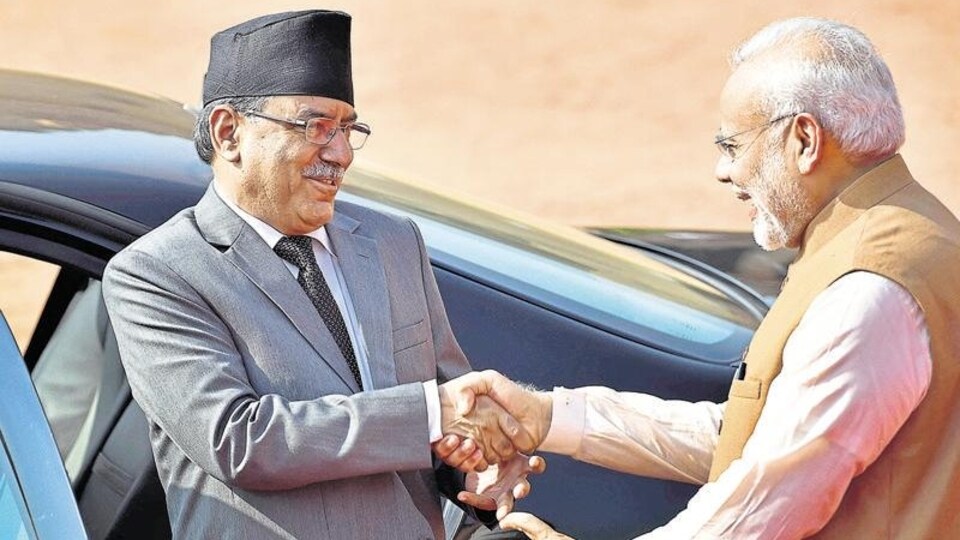
Prachanda arrives in New Delhi on his maiden foreign outing since he took office in December. He is also far more judicious and circumspect than in 2008 when he made his first visit to Beijing as PM, while still a firebrand Maoist. In March, however, he politely declined the invitation to make China his first port of call, notwithstanding strident appeals at home. To Beijing, this year’s Boao Forum of Asia held special significance: it was China’s first flagship event courting foreign leaders after lifting the zero-Covid policy; second, it came on the heels of President Xi’s re-election for an unprecedented third term. Unsurprisingly, Prachanda’s prioritisation of Delhi over Beijing has led many political grandies to question his nationalist credentials.
Given the complexity, but also the potential, of Nepal-India ties, any visiting PM from Nepal would have his pockets full: differences over boundary maps and Delhi’s continued refusal to accept the Eminent Persons’ Group (EPG) report have been two most thorny issues in Nepal. The report, prepared by a Nepal-India joint team of foreign-policy experts in 2018, makes recommendations in areas of trade, commerce, water resource, people-to-people contact and cultural ties in view of a vastly different political context since the Nehruvian era. Delhi seems happy with the status quo, including with the 1950 ‘Treaty of Peace and Friendship’ signed by Nepal's last Rana Prime Minister Mohan Shumsher and the Indian Ambassador to Nepal Chandreshwar Narayan Singh. The treaty still underpins Nepal-India ties, which many Nepalis find anachronistic.
The longstanding bilateral issues aside, Delhi and Kathmandu could quickly tick off a couple of boxes for now. Nepal has asked India for four additional air routes to facilitate its international flights. Once billed as a gateway to Buddhist pilgrims from around the world, there is a serious risk that the newly built airport near Lumbini, Buddha’s birthplace, could turn into a white elephant.
Second, agreements on power trade will go a long way in addressing Kathmandu’s deep political peeve that Delhi hasn’t done enough to advance obvious complementarities: Nepal sits on top of a vast hydropower potential while India and Bangladesh are both big energy-starved economies. In May, Kathmandu and Dhaka signed an agreement to jointly develop a 683-MW project to serve Bangladesh. Even more important, the two sides also agreed to work on a tripartite deal with New Delhi to facilitate regional power trade.
Here's what worries Nepal. It will be a net power exporter by 2026, provided it overcomes market unpredictability soon. Towards that end, Kathmandu is keen to sign a long-term intergovernmental power deal with New Delhi. India currently requires any power trader to get an approval from its Central Electricity Authority specifying the volume and duration of import. This means Nepal is also required to annually renew agreements for every single power project that exports power to India, adding further to red tape. India also bars imports of power produced from the projects that involve Chinese investors or contractors, who are currently undertaking some major civil works in Nepal. Unless there’s an immediate breakthrough, Nepal seems set to lose billions in lost revenues again this monsoon, its peak season for power production.
Prachanda will breathe easy if there’s a breakthrough at least in power trade and progress on additional air routes via India. With the regional power trade standing on a sound footing, it would be a major strategic gain for all three – Kathmandu, Dhaka and Delhi.
Akhilesh Upadhyay is a Senior Fellow at IIDS, a Kathmandu-based think tank. The views expressed here are personal


