
 E-Paper



Chandigarh’s air quality gets poor
The development comes at a time the administration is planning to ban the sale of firecrackers, fearing rise in Covid infections due to air pollution

 Prefer HTon Google


Chandigarh’s air quality turned poor for the first time this year on Wednesday.
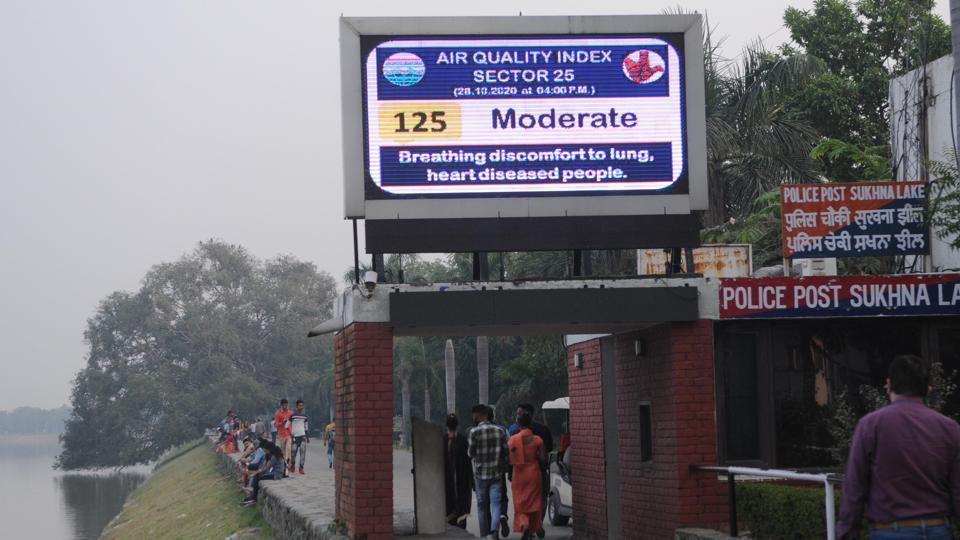
In the recent weeks, the Air Quality Index (AQI) stayed between 110 and 130 (moderate level), before starting to rise amid falling temperatures in the past two days, and crossed 200 at 2pm at the Continuous Ambient Air Quality Monitoring Station in Sector 25.
In 2019, it was on the same date (November 4) that the year’s peak AQI of 335 was recorded in the city.
The development comes at a time the Chandigarh administration is planning to ban the sale of firecrackers, fearing rise in Covid infections due to air pollution.
Last Diwali, AQI at the monitoring station in Sector 25, which gives live data, had gone up from 237 the previous day to 272. The highest AQI was recorded at the observatory in Sector 22, where it had shot up to 372 (very poor).
“The hourly readings may have crossed the 200 mark, but the daily average up to November 3 is 155 at the monitoring station in Sector 25,” said Debendra Dalai, vice-chairman of Chandigarh Pollution Control Committee.
Dalai said increase in AQI can be attributed to fall in the mercury, which leads to temperature inversion and decrease in wind speeds, and stubble burning going on in the region.
AQI could worsen in coming days
Surender Paul, director, India Meteorological Department, Chandigarh, said: “Although there is no significant change in wind speeds in the city, an anticyclonic movement has started forming over the region. It creates an airlock, preventing any scattering of pollutant particles in vertical motion.”
Paul said anticyclonic movement will continue in the city for the next few days, and with no rain likely in the city up to Diwali, the AQI could worsen if stubble burning increases in the region.
The AQI this year is still not as bad as last year, mostly due to the lockdown.
However, in the poor bracket, the air can cause breathing discomfort to most people on prolonged exposure. The prominent pollutant in the air is PM 2.5, produced by burning, construction works and automobiles. It is small in size due to which it can get directly absorbed into the blood stream and can cause asthma, lung cancer and even heart disease.
Cracker ban decision likely today
Amid fear of second Covid wave, the Chandigarh administration is considering banning the sale of firecrackers. However, the decision, which was expected on Wednesday, has been put off.
It is likely to be taken by UT administrator VP Singh Badnore on Thursday.
Even though a draw of lots for allotment of 96 licences for the sale of firecrackers was held on Tuesday, the administration withheld issuance of the licences. The administration had taken views of health experts, who advised against the bursting of crackers. There is a concern that pollution caused by firecrackers may cause spike in coronavirus cases in the city, UT adviser Manoj Parida had said on Tuesday.
The administration had even issued a health advisory, asking people to stay indoors and desist from bursting firecrackers in order to prevent air pollution and to protect the elderly and people with co-morbidities.
Congress divided over the issue
Devinder Singh Babla, Congress councillor and leader of opposition in the municipal corporation House, on Wednesday posted a request to Badnore on Twitter, seeking complete ban on firecrackers in Chandigarh during Diwali this year. “It will lead to pollution levels beyond control and will further worsen the Covid situation and lead to spike in cases, making it difficult for senior citizens to breath,” he wrote.
However, party’s city chief Pardeep Chhabra along with three other local leaders wrote to the administration, demanding the sale of firecrackers “if they have no ill-effects”, stating the “Congress is with cracker traders”, whose livelihood would be affected otherwise.


