
 E-Paper



High Covid positivity rate remains a concern in Chandigarh
A high positivity rate suggests that testing has been restricted to a particular group without encouraging more people in the community to come forward and get sampled

 Prefer HTon Google


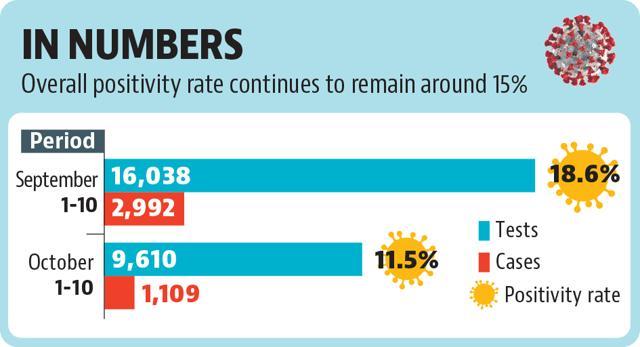
The Covid-19 positivity rate in Chandigarh has dropped by 7% in the first 10 days of October when compared with the same period in September, though the overall rate continues to remain around 15% even as there has been a drop in the number of cases recently.

Positivity rate is the percentage of people testing positive for every hundred tests conducted.
Comparing the two periods (September 1-10 and October 1-10), the number of fresh cases has seen 62% drop and tests have gone down by 66%.
However, there seems to be a renewed effort to increase the testing numbers, as the health department has started aggressive sampling in containment zones. While, on an average only around 650 tests were conducted in the first five days of this month, around 900 have been conducted daily in the next five days. In fact, 1,334 people were tested on October 12, highest this month. Overall, 88,819 people have been tested so far, of whom 13,260 have tested positive (positivity rate of 14.9%).
What high positivity rate suggests
A high positivity rate suggests that testing has been restricted to a particular group, such as those reporting for testing or seeking medical treatment, without encouraging more people in the community to come forward and get sampled
Throwing more light on it, a community health expert at the Post Graduate Institute of Medical Education and Research (PGIMER), who did not wish to be named, said, “High positivity rate indicates that the authorities are testing sick patients and those reporting for testing, which is as per the established protocol. However, if more random samples of high-risk groups or people in professions that have more public interaction, such as vendors, policemen and salespersons, are taken, it can lead to a higher case detection. It will also bring down the positivity rate.”
The World Health Organisation had also suggested a positivity rate below 5% for a period of 14 days is an indicator that the epidemic is under control and that social restrictions can be gradually relaxed.
What is admn doing to increase testing
Health officials said that testing more people has been a real challenge in the wake of declining numbers of new cases as residents have stopped coming forward to get tested.
Dr Amandeep Kaur Kang said that mobile testing teams have been sent to the MC office and UT secretariat besides congested areas like Hallomajra and Manimajra for testing people who come forward voluntarily. She said special drives for random testing have been conducted at the Police Colony, vegetable market and various community centres too.
“If we see the single-day positivity rate, it has decreased from 30-35% from the peak time (in September) to 6-7% in recent days,” said health secretary Arun Gupta.
Claiming the criticism over low testing in the first few months of the pandemic is “unwarranted”, he said: “As the prevalence was low, there was no need to randomly pick up people for tests. But now when we see widespread infections, we have resorted to non-targeted testing in containment zones as well as in market areas where public presence is more. Earlier, people themselves reporting was almost equal to our capacity for testing, which has now decreased. So, it also gives us more room for testing more people who seem to be at high risk.”


