
 E-Paper



Capital back in lockdown
The decision was taken in a Covid-19 review meeting held between Delhi’s lieutenant governor Anil Baijal and Kejriwal on Monday morning.

 Prefer HTon Google


A six-day lockdown will be in force in Delhi till the morning of April 26, chief minister Arvind Kejriwal announced on Monday, citing a relentless surge in Covid-19 infections that has risen by close to 600% in the last two weeks and has now inundated hospitals and triggered a shortage in critical medical supplies.
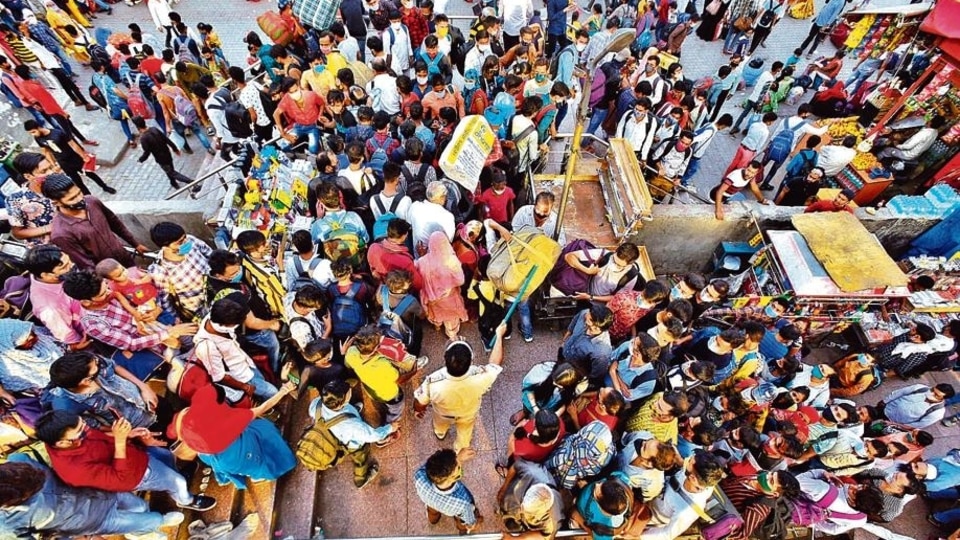
Kejriwal said the city added 23,500 new cases in the last 24 hours, and that the curfew was necessary to allow enhancements in the numbers of beds and supplies of life-saving drugs and oxygen to catch up. The city, according to Delhi’s health bulletin on Monday, now has 76,887 active cases. It also registered a record 240 deaths -- the first time casualties were above 200 in a single day.
“Delhi’s health system is now unable to take in more patients. It is now necessary to impose a lockdown in Delhi from 10 pm today to 5am on Monday (April 26). Essential services will remain open, food and medicine shops will be allowed to operate, weddings will be limited to 50 guests. A detailed order will be released soon,” he said.
The decision was taken in a Covid-19 review meeting held between Delhi’s lieutenant governor Anil Baijal and Kejriwal on Monday morning. “The situation of Covid-19 in NCT of Delhi has again been reviewed and it has been observed that there has been a very sharp increase in Covid-19 cases along with very high positivity rate over the last few days and therefore, it is felt that in order to contain the fast spread of the virus, a curfew needs to be imposed in the territory of NCT of Delhi, except for essential activities/services, as an emergency measure, in order to break the transmission chain of Covid-19 virus and for the overall well being and safety of the people of Delhi,” said the order issued shortly afterwards by chief secretary Vijay Dev.
While the restrictions are not entirely a curfew, movement will be prohibited unless someone is seeking or providing essential services, medical help, or has to go to a handful of exempted workplaces, such as government offices. People in some of these categories will require an e-pass from the government, the order added, while others will need to show an identity card. The rules are almost identical to those for the weekend and night curfews that have been in place in Delhi.
According to HT’s dashboard, the average number of cases added in the Capital each day has risen 586% from April 4 till April 18. In this period, the average test positivity rate – a proxy for how large an outbreak may be beyond case numbers – has risen from 3.57% to 19.39%. The daily positivity rate, according to the Monday bulletin, was 26.12%.
The Delhi government’s Delhi Corona mobile application showed that as of 10.30pm, only 26 Covid-19 ICU beds with ventilators (and an equal number without ventilators) were vacant in the city. More than 83% of the city’s nearly 20,000 hospital beds for Covid-19 patients were occupied, the app showed.
This surge prompted a consensus among citizens to support a lockdown-like period of restriction. The Confederation of All India Traders (CAIT) said the decision was a “much-needed” step. “The CAIT was continuously demanding a lockdown in Delhi... We have urged the L-G and the CM to nominate five nodal officers dividing Delhi into five zones namely Central, East, West, North and South Delhi to collaborate with CAIT team leaders for ensuring smooth passage of supply of essential goods to Delhi people. According to our estimate, each day there will be a business loss of about ₹600 crore per day in Delhi during the curfew,” said Praveen Khandelwal, secretary general, CAIT.
Some trader groups, who were initially opposed to restrictions because of their economic toll, on Sunday suggested they will voluntarily close some markers to arrest the surge.
Also read: Delhi govt forms 12 oxygen audit committees to plug wastage
The Delhi government also issued a circular advancing the summer vacation in all schools. The vacation, earlier scheduled from May 11 to June 3, will now begin from April 20 and schools will remain shut till June 9.
“Since the past 15 to 20 days we have been demanding a complete lockdown in Delhi as we had sensed the trouble when numbers started rising from March end. Now, the things have been delayed to such an extent that the entire system has collapsed with no beds, no ventilators, no oxygen, no medicines all over the city. The Delhi government must take extra caution on the issues which may lead to huge mortalities. It must act on war footing to save precious human lives. RWAs of Delhi will support the government in every possible manner,” said BS Vohra, president of east Delhi RWAs.
The Delhi government and the L-G’s office also began efforts to discourage migrant workers from attempting to return to their cities in order to avoid the sort of crisis that took place during the nationwide lockdown one year ago. “I am requesting all migrant workers with folded hands to stay where they are. This is a small lockdown. It is just a matter of six days. If you leave, you’ll waste your time, energy and money in going and coming back only. I am there for you. We will take good care of you all. Please do not leave the city. I am hoping we will not need to extend this lockdown any further if all of you cooperate with us,” Kejriwal said at the briefing. Senior officials in the L-G office said Baijal has asked officials to strictly address the issue of migrant workers who might start congregating at transit points across the city to leave for their home states.
“If you ask me, the lockdown became inevitable. The situation was getting out of hand; the medical system was collapsing. Patients were running from pillar to post to get a bed. It was also very difficult to get an RT-PCR test; you cannot wait for four to five days for a result when the disease course is of 10 days,” said Dr GC Khilnani, former head of the department of pulmonology at AIIMS. “A lockdown was required to curtail the transmission. Yes, there are economic consequences but this is a matter of life and death. The policymakers waited for the infection to get under control but it did not, so a lockdown had to be implemented,” said Khilnani, a former member of Delhi’s first committee on Covid-19 control and management.


