
 E-Paper



Yamuna floods swathes of Capital after 45 years
The Delhi government closed schools, colleges and universities till Sunday, asked people to not step out of their houses.

 Prefer HTon Google


Surging waters of the Yamuna marooned vast swathes of the Capital on Thursday, forcing thousands of people out of their homes, inundating landmarks and arterial roads in the city, and throwing traffic out of gear in what was the first floods in the Capital in 45 years.
Also read: Water supply in these areas of Delhi to be affected in next two days. Full list
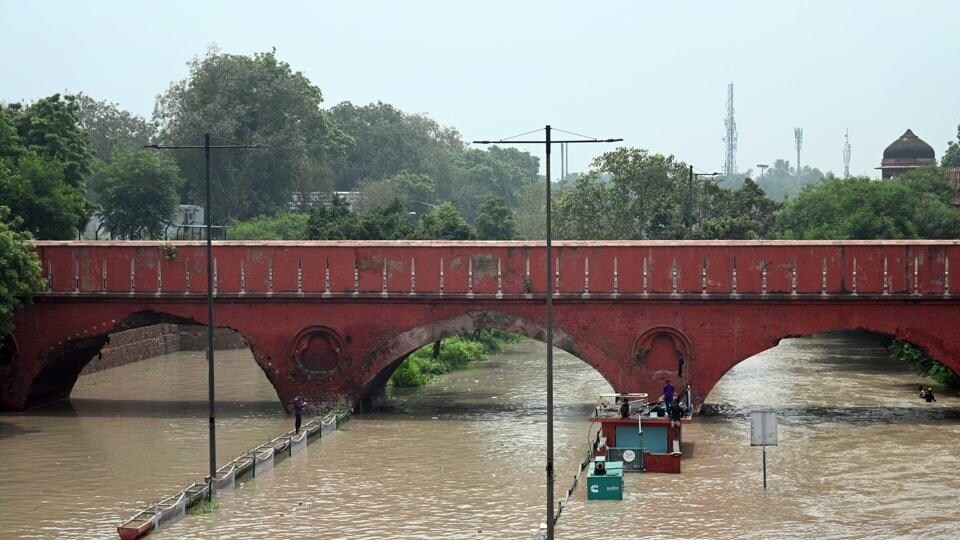
From bungalows in Civil Lines to the iconic archways spanning the Salimgarh underpass, from the perennially choked Kashmere Gate bus station and intersection to the Yamuna Bank Metro station; and from the shanties of the Yamuna Pushta to within 100 metres of the chief minister’s residence, columns of water swished around on roads and inside neighbourhoods, forcing the authorities to deploy 47 boats and rafts to rescue people.
Lalit Lal, a resident of Civil Lines whose bungalow was flooded, said, “I have been living in this place for last 40 years. I never saw such level of water in this area. Over 50 bungalows have been flooded. People have shifted to higher floors, many left on their own. We are also leaving.”
The deluge also forced the closure of three water treatment plants, prompting the government to ask people to conserve water and announce rationalising of water supply to deal with the looming shortage. The Delhi government closed schools, colleges and universities till Sunday, asked people to not step out of their houses and called for offices to allow their staff to work from home as rescue personnel scrambled to pull people to safety. The Yamuna touched 208.66 metres, the highest level ever recorded and more than three metres above the danger mark. On Wednesday, the river had swelled to 208.08 metres at 11pm, breaking the previous record of 207.49 on September 6, 1978, the last time the city suffered floods.
Chief minister Arvind Kejriwal, lieutenant governor VK Saxena, revenue minister Atishi, chief secretary Naresh Kumar and other officials attended a Delhi Disaster Management Authority meeting. “All government offices, barring those which cater to essential services, will work from home. We are issuing advisories to private offices to work from home as much as possible,” he said after the meeting.
“I would like to request people to not step out if it is not essential,” he added. Delhi also blocked interstate buses and trucks at the border
Swirling waters swamped six of the Capital’s 11 districts and submerged key sections of the Ring Road and parts of Vikas Marg, the underpass near Delhi Secretariat, as well as portions of Metcalfe Road, Bela Road (Civil Lines) and Pusta Road near Geeta Colony.Neighbourhoods such as Civil Lines, Yamuna Bazar, ISBT, Feroz Shah Kotla, Majnu ka Tila, Wazirabad, Mayur Vihar, Jaitpur, Vishwakarma Colony, Usmanpur and some parts of Burari were affected. Water also touched the back ramparts of the Red Fort.
Despite four consecutive days of sunshine in the Capital with little or no rainfall, water levels in the Yamuna have continued to rise due to a deluge in the hills that has sent torrents of water gushing downstream, past overflowing barrages and dams.
DDMA said interstate buses coming to ISBT, Kashmere Gate, will be stopped at Singhu Border, and Delhi Transport Corporation (DTC) buses will ferry passengers to the city. DDMA also directed that borders at Chilla, Loni and Badarpur will only allow heavy vehicles carrying essential goods. All businesses and commercial establishments in and around Kashmere Gate — which is completely submerged — will be asked to close till the situation improves, officials said.
With the water level at 208.61m at 11pm, authorities in Haryana’s Yamunanagar closed the Hathinikund barrage, the last on the river before the Capital. The respite from that is not expected for another 48 hours.
The day began with the Yamuna at208.51 at 9am, and rose to 208.62 at 1pm before stabilising between 1pm to 4pm at 208.62m,. In the evening, it started rising and touched 208.66 at 7pm. It remained 208.66m till 9pm when it started decreasing. It stood at 208.63m by 10pm.
As the Yamuna breached its banks and flooded roads, traffic was thrown off gear as the police blocked access to many submerged stretches such as Bhairon Marg; Ring Road between IP Flyover and Chandgi Ram Akhara, and between Kalighat Mandir and Delhi Secretariat; and Outer Ring Road between Wazirabad Bridge and Chandi Ram Akhara.
Hours-long snarls were reported from Sarai Kale Khan, Barapulla, Apsara Border, Lal Quila Road, and ITO. This included the road that leads to Kejriwal’s residence from Ring Road, around 100 metres from the residence. A Delhi government official said there was no threat of flooding on Flag Staff Road where CM’s bungalow is located on an elevated area.
The entry and exits to the Yamuna Bank metro station on the Blue Line were temporarily closed with the approaching roads being flooded. The Delhi Metro Rail Corporation (DMRC) said metro operations were continuing for now, but trains were running at restricted speeds of 30 km/hr over the four metro bridges built across the Yamuna.
In many parts of the Capital, people waded through chest-deep water, often taking refuge on road dividers jutting out of the water, Cars and vehicles parked on the streets and in front of houses were submerged under water.
“My brother has been discharged from the hospital today. Now we are unable to get a cab or auto to go home because all the roads (around the hospital) are flooded,” said Ranjeet Sharma, a resident of Burari.
But if there is no fresh rainfall in the hills, Friday might bring better news. The water level in the Yamuna might dip marginally by early Friday morning to 208.45m, according to a forecast by the Upper Yamuna Division of the Central Water Commission.
Vivek Pandit, a priest who lived in an ashram on Shankracharya Road in Civil Lines, said the premises was flooded. “The water has accumulated in the campus of the ashram. Around 30 people stay in the ashram. We also have several cows in the campus,” he added.
Over 1,500 animals were rescued by different authorities, said a Delhi government official.
22km of embankments built along the river after the 1978 floods helped forestall wider damage in the city. Kejriwal also said National Disaster Relief Force personnel with boats were working in flood-affected areas. “Over 20,000 people have been shifted to the relief camps. There are about 50 boats at present, but if needed, the number may be increased as per requirement,” the CM said.
“Honourable Prime Minister Narendra Modi ji called from France and inquired about the waterlogging and flood situation in Delhi as well as the efforts being made to deal with it. He directed all appropriate steps to be taken in the interest of Delhi with help from the central government,” Delhi’s lieutenant governor VK Saxena said in a tweet in Hindi.
A Delhi government official said all district magistrates and officials from irrigation and flood control department are on the ground, monitoring the sensitive areas because the water level is very high and some points along the embankments are considered vulnerable.lsor


