
 E-Paper



Antibody tests begin in Delhi to identify plasma donors
Plasma therapy uses one of the blood components rich in the virus-fighting antibodies in people who have recovered from Covid-19 to help critical patients fight the virus better.


The first batch of 42,000 rapid testing kits arrived in Delhi on Friday, which are to be deployed to evaluate 92 cured patients, being discharged from Lok Nayak hospital for plasma therapy trial, to treat the coronavirus disease (Covid-19), as well as containment zones and hotspot areas.
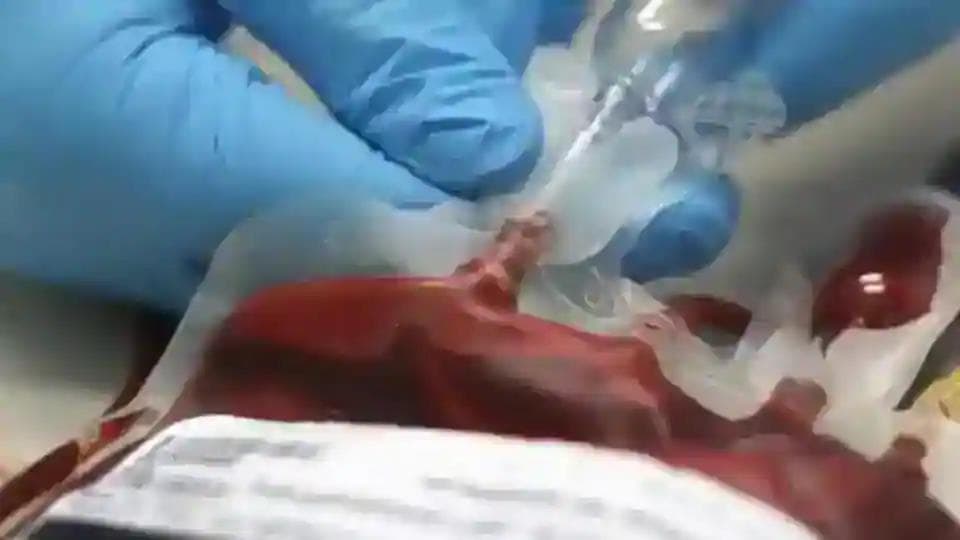
Plasma therapy uses one of the blood components rich in the virus-fighting antibodies in people who have recovered from Covid-19 to help critical patients fight the virus better.
“The blood samples of 92 patients, who were being discharged from the hospital after recovering, are being collected. Based on the test report, they will be selected as donors,” said Dr JC Passey, director, Lok Nayak hospital, which is conducting the trial in collaboration with the Institute of Liver and Biliary Sciences (ILBS).
The plasma derived from the two millilitre blood samples collected from the recovered patients will be diluted repeatedly and tested with the rapid antibody kits to measure the amount of antibodies present.
“The plasma is diluted 1:1, then 1:2, then 1:3, just to check till what level of dilution the sample comes out positive. The solutions that test positive at the highest level of dilution are the ones with high antibody levels. Ideally, a neutralising antibody test must be done where the antibody is added to a viral culture to check its effect, but that can only be done in BSL III laboratories. This is recommended as the best practice the world over in the absence of the other test,” said Dr SK Sarin, director, ILBS.
The Delhi government did not use rapid testing kits for community testing on Sunday, as the kits are yet to reach the Capital’s district offices. The state health minister Satyendar Jain had on Saturday said that the “technicians” were undergoing training for the roll-out the next day.
“We do not yet know how the tests would be done and whether the kits are prick-based or blood has to be drawn. There was some state-level workshop yesterday, but none of the staff from the district offices have been trained yet,” said an official from one of the district offices, requesting anonymity.
An official from another district confirmed this, saying, “Once the kits reach us, we will be able to figure out how to go about them. The drive will likely begin from Monday or Tuesday.”
The Indian Council of Medical Research (ICMR) had revised its guidelines on Saturday to allow rapid testing in hotspots. Earlier, the tests were to be done only in areas with very few or no cases at all.
A third state-level official confirmed that testing would be started from Monday, to be done by the Auxiliary Nurse Midwife (ANM) posted across government dispensaries in the city. “They will go into the community to perform tests,” said the third official. The testing will be started in all hotspots across the city at once.
To scale up testing, the district administration has arranged mobile testing vans and makeshift camps outside containment zones, said an official from the chief minister’s office.
Meanwhile, Jain did not rule out the possibility of community transmission in Delhi, citing around 200 cases for which the sources could not be traced so far while some were asymptomatic, had no travel history, or came in contact with anyone with a travel history connected to a Covid-affected country. “There is a chance (of community transmission). We will be in a better position to say anything after the 42,000 rapid antibody tests are conducted in a week,” he said.
Delhi stumbled into another crisis on Sunday with food distribution centres in the city having come under the radar of health teams, after a volunteer tested positive for the Sars-Cov-2. Following this, 700 workers spread across several food distribution centres had to be quarantined and the staff replaced immediately. The food centres in Delhi collectively provide meals twice a day to around a million people currently, most of whom are migrant workers, deputy chief minister Manish Sisodia said.
Chief minister Arvind Kejriwal on Sunday said all those who visit the centres regularly, assuming the same set of people more or less depend on the same centres for food, and officials and volunteers deployed across over 1,500 food distribution centres in the city – which includes shelter homes, school buildings and community halls – will be among the first batches to be tested with the rapid antibody kits.
Unlike real time-polymerase chain reaction (RT-PCR) kits which detect the virus’s genetic material (RNA) in swabs to diagnose a current Covid-19 infection, the rapid tests detect antibodies in the blood and indicate if a person has been infected in the past and has developed immunity to the virus. It can show results within 30 minutes. Once a person tests positive after the antibody test, an RT-PCR test is done to confirm the result.
Collection of samples for the rapid antibody test is also much easier than for the RT-PCR test. “Taking a throat swab generates aerosols that may contain the virus and infect the healthcare worker taking the sample. The healthcare workers have to be in proper PPE kits for collecting RT PCR samples,” said another Delhi government health official.
To encourage RT-PCR test in the community, the government set up 22 Covid-19 sample collection centres in hotels and dharmashalas and started giving ₹100 as incentive per sample to each team collecting the samples in the community.