E-Paper



Can Congress reclaim Assam with an alliance?
The Congress, which ruled the state for 15 years from 2001 to 2016, has changed its electoral tactics and stitched together an alliance to leverage the consolidation of a previously fragmented anti-BJP vote base to recapture power in the state.

 Prefer HTon Google


Forty-seven of the 126 assembly constituencies (ACs) in Assam will go to the polls on March 27. The remaining 79 ACs will go to the polls on April 1 and April 6. Among the four states going to the polls in this election cycle, Assam is the only one where the Bharatiya Janata Party (BJP) is an incumbent. The Congress, which ruled the state for 15 years from 2001 to 2016, has changed its electoral tactics and stitched together an alliance to leverage the consolidation of a previously fragmented anti-BJP vote base to recapture power in the state. Will it work? What will be the nature of the contest in the state? Here are four charts that explain this.
1. The BJP rode the 2014 Modi wave to a dominant position in Assam
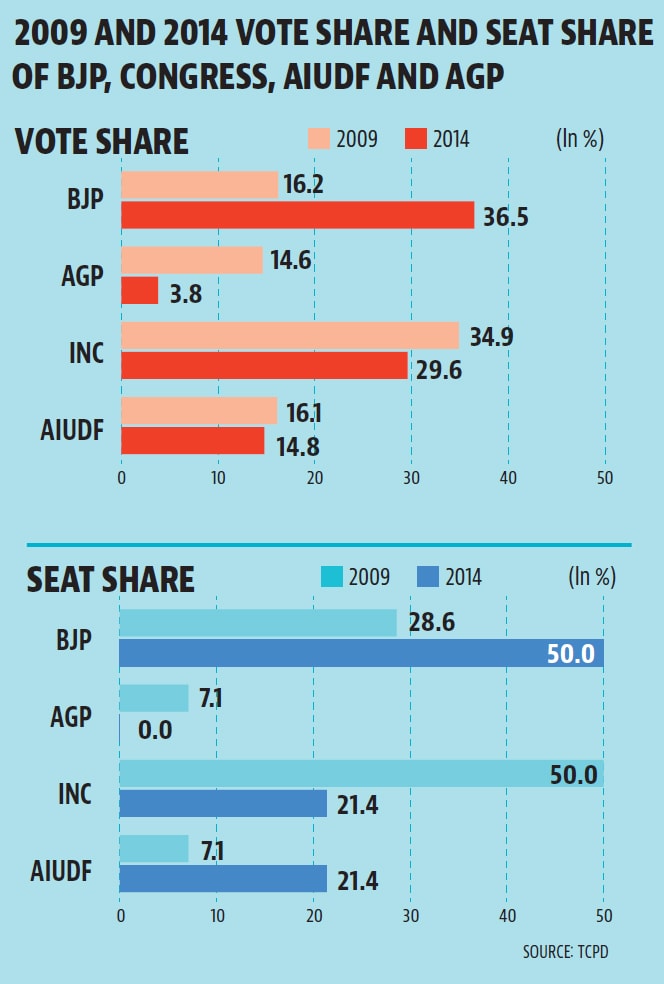
Assam is the biggest success story of the BJP after 2014: The party used alliances to strengthen its political position and became a dominant player in the state. The BJP contested 13 out of the 14 Lok Sabha constituencies in the 2014 Lok Sabha elections, and won seven of them. While the Congress was seen as the biggest loser due to the BJP’s rise -- its seat tally came down from seven in the 2009 elections to just three -- it was not the only party which lost ground due to the BJP’s rise. The Asom Gana Parishad (AGP) suffered a massive fall in its vote share and failed to open its account in the state. The All India United Democratic Front (AIUDF) actually recorded its best performance in the 2014 Lok Sabha, winning the same number of seats as the Congress, despite a smaller vote share.
2. The 2014 advantage prepared ground for an alliance dominated by the BJP in 2016
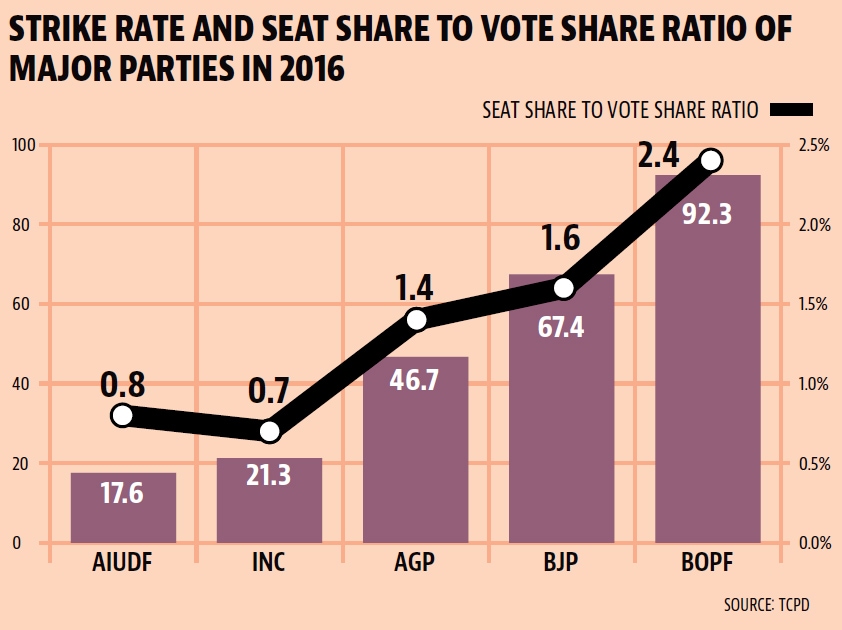
An AC-wise disaggregation of the 2014 Lok Sabha results shows that the BJP crossed the majority mark in the state on its own. However, it did not take the risk of going it alone in the 2016 assembly elections, even though the Congress was facing strong anti-incumbency after having been in power for 15 years. The BJP formed a tripartite alliance, including the AGP and the Bodoloand People’s Front (BPF), in which the BJP kept 71% of the ACs for itself. This strategy paid off, and the BJP ended up with a seat share of 47.6% despite getting just 29.5% of the total votes polled. While the BJP’s alliance partners added 26 more ACs to the National Democratic Alliance’s (NDA) tally, giving the NDA a two-thirds majority, they could not match the BJP’s performance. The Congress, which contested the polls on its own, could win only 20.6% of the ACs despite having a greater vote share than the BJP. A comparison of strike rates – seats won as percentage of seats contested – and seat share to vote share ratio, a useful metric of a party’s ability to convert popular support into seats, of key parties underlines the success of the BJP’s electoral tactics in Assam.
3. The BJP’s success has muted an important contradiction for the Congress
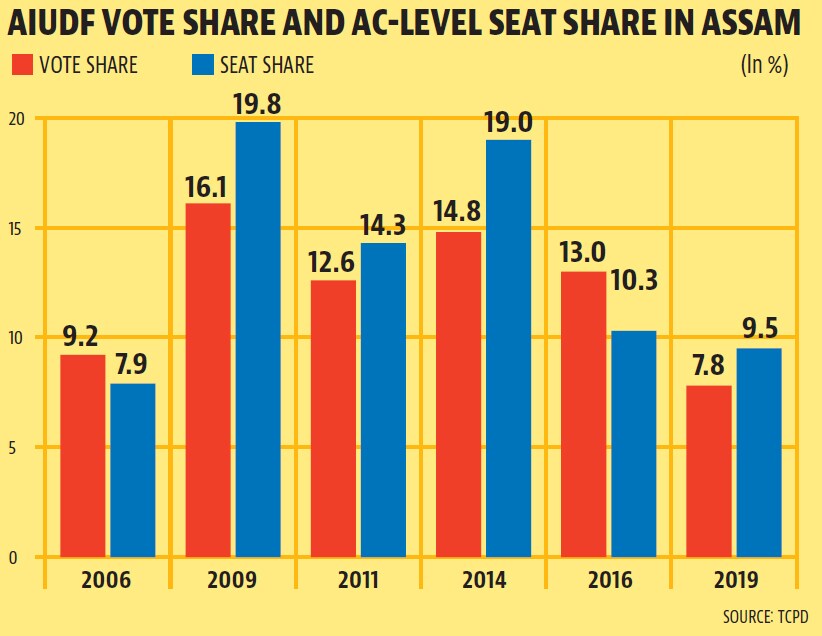
As was pointed out by HT, Assam’s politics primarily revolves around the contradictions of language and religion. The rise of the Badruddin Ajmal-led AIUDF, which was established in 2005 as a party of Bengali-speaking Muslims, has been among the biggest political manifestations of the linguistic divide within the state’s Muslim voters, who account for more than one-third of the total population. That the AIUDF’s rise coincided with the Congress’s rule, both in the Centre and the state, implies that Muslims were not concerned about the BJP. This has changed with the rise of the BJP since 2014. The AIUDF’s vote share has been coming down since 2014, one of its best performances in elections in the state. The AIUDF’s 2019 vote share and seat share (on an AC-wise basis) was almost half of what it was in 2014. This was primarily a result of Muslims deserting the AIUDF for the Congress, which was seen as a stronger force to take on the BJP. The AIUDF’s decision to ally with the Congress and agree to contest just 21 ACs, the lowest it has contested since its formation, needs to be seen in this regard. To be sure, the Congress has also allied with the BPF, which was an alliance partner of the BJP in both 2016 and 2019 elections.
4. Can Congress use the alliance route to reclaim Assam?
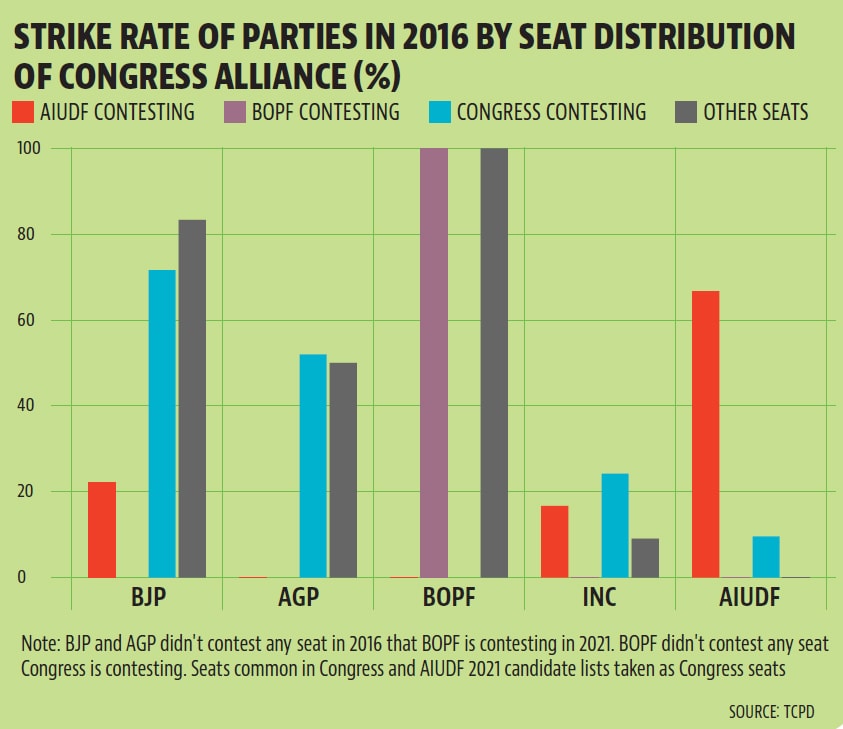
Not necessarily. The Congress is contesting 95 out of the 126 ACs in Assam, according to the list of candidates announced by it until March 18. The AIUDF is expected to contest 21 seats, while the BPF has declared a list of eight candidates so far. The Congress’s two regional allies have geographically concentrated support bases in the state. In 2014, when the AIUDF recorded one of its best ever performances in the state, 94% of its votes were concentrated in the Barak Valley, Central Assam, and Lower Assam subregions, which accounted for 65% of the total votes polled in the state and 61% of ACs (77 of 126). The BPF, when it contested on its own in 2011, managed just 6.1% of the total votes in the state, which was mostly concentrated in the Lower Assam and North Assam subregions. Even if one were to add the AIUDF’s vote to the Congress in the 2014, 2016 and 2019 elections, its seat share will not increase significantly. The Congress’s seat distribution so far, though, has been in line with the performance of its alliance partners in the 2016 assembly election, with each partner contesting seats where their strike rate was the best. However, it is the Congress that will have to deal with the BJP and the AGP. The strike rate of the BJP and the AGP was better in seats the Congress is contesting than in those where the AIUDF is.