
Sign in

7 LeT terrorists used rocket-propelled grenades on army soldiers in Poonch

The jihadists were hiding in the jungles of the Poonch area and waiting for an ambush on a convoy.

Updated on: Apr 21, 2023, 11:26:12 IST
Share
Share via
  • facebook
  • twitter
  • linkedin
  • whatsapp
Copy link
  • copy link

Prime facie investigation into the Poonch terror attack in Jammu and Kashmir on Thursday that led to the death of five Rashtriya Rifles jawans and left one injured revealed that the role of no less than seven Lashkar-e-Taiba (LeT) group. This is the fourth incident involving Indian Army casualties in the Poonch-Rajouri area.
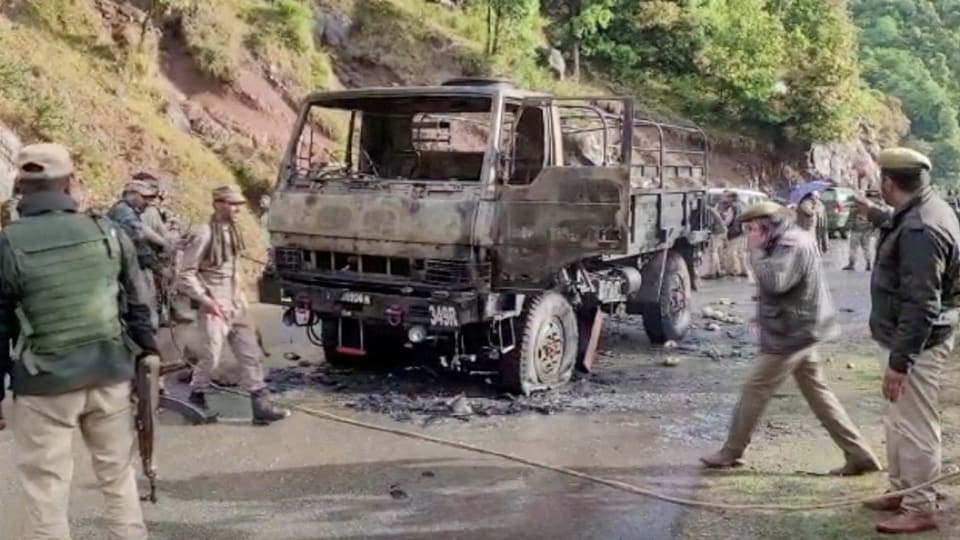
Armed security personnel walk at a site of an attack inspecting charred army vehicle after terrorists opened fire at an Indian army vehicle in Poonch. (REUTERS)

The area where the incident took place is 7 km from Bhimber Gali in the Line of Control (LoC), and a thickly-forested within the Indian side of the LoC. There were intelligent inputs to confirm the presence of Pakistan-based terrorists in the area. The jihadists were hiding in the jungles and waiting for an ambush on a convoy.

Watch: 'Can Target G20 Venues In J&K': Pak-backed terror group PAFF owns Poonch attack | Details

According to inputs from the Jammu and Kashmir Police, the terrorists used rocket-propelled grenades and assault rifles against the RR jawans travelling in the truck.

It's still not clear whether the truck got fire through the direct RPG hit or was set on fire by terrorists after the gunning down the Indian troopers.

While Nagrota-based 16 Core has launched a massive manhunt for the terrorists in the sector, the incident has direct links to Pakistan's opposition to the G20 event in Srinagar in May. Over the past month, the Pakistan government has asked G20 members, particularly its 'iron-brother' China, to boycott the event.

“The incident has been deliberately planned by the Pakistani-deep state to instigate violence in Jammu and Kashmir and Uttar Pradesh. and deliberately spread fear among the delegate attending the G20 event,” said a senior J&K official.

  • Shishir Gupta
    ABOUT THE AUTHOR
    Shishir Gupta

    Shishir Gupta is Executive Editor at Hindustan Times and one of India's top journalists covering national security, strategic affairs, foreign policy and geopolitics. Over the past three decades, he has extensively reported on India's military, diplomatic and security landscape, covering every major conflict and national security challenge, from the 1999 Kargil War and the 2020 East Ladakh standoff to Operation Sindoor in 2025. He has also covered major terror attacks, including the IC-814 hijacking, the 26/11 Mumbai attacks and the 2025 Pahalgam terror strike, along with numerous Pakistan-backed terrorist incidents in the Kashmir Valley and across India. He has reported on national and state elections for more than three decades. A recognised authority on strategic affairs, Gupta has covered India's nuclear programme since the Pokhran-II (Shakti series) tests in May 1998 and has written extensively on global nuclear issues, Indian diplomacy and the country's expanding global outreach. He has also reported widely on international conflicts and terrorism, with a special focus on the Indian subcontinent. Gupta has interviewed Prime Minister Narendra Modi more than four times, including Modi's first interview with the print media after becoming Prime Minister in May 2014. His other interviews include three with the Dalai Lama, as well as conversations with Benjamin Netanyahu, Amit Shah, Yogi Adityanath, S. Jaishankar, Nirmala Sitharaman and Piyush Goyal. He is the author of Indian Mujahideen: The Enemy Within (Hachette, 2011) and Himalayan Face-off: Chinese Assertion and Indian Riposte (Hachette, 2014). He was awarded the Chevening-Wolfson Joint Scholarship at Wolfson College, University of Cambridge, UK, in 1998 and participated in the International Visitor Leadership Program (IVLP) of the US State Department in 2006. He received the Ben Gurion Prize from Israel in 2011 and the K. Subrahmanyam Prize for Strategic Studies in 2015 from the Manohar Parrikar Institute for Defence Studies and Analyses (MP-IDSA). Since 2024, he has hosted Point Blank, Hindustan Times' weekly YouTube show on global geopolitics.Read More