
 E-Paper



‘A divisive intent’: Madras HC rejects plea by Annamalai against hate speech case
The high court said a judge, who decides these cases, “cannot be sitting in a pulpit nor would ignore what is happening in the society” during the relevant point


CHENNAI: The Madras high court on Thursday refused to quash a hate speech case against Tamil Nadu Bharatiya Janata Partry chief K Annamalai over his claim in a 2022 interview that an international Christian missionary NGO backed the boy who approached the Supreme Court over bursting firecrackers to destroy the culture of the majority religious group, Hindus.
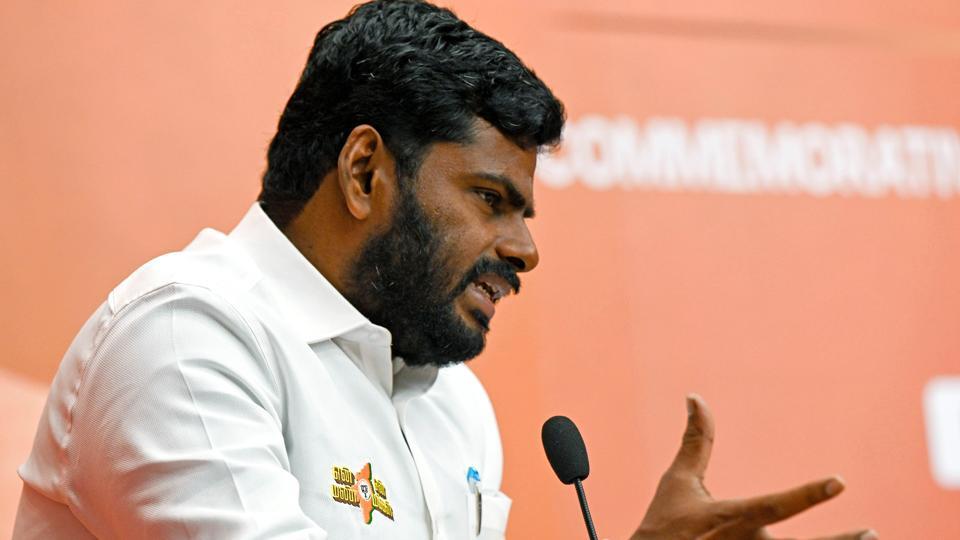
“Prima facie, the statements disclose a divisive intent on the part of the petitioner to project as if a Christian NGO is acting against Hindu culture. The intent can be gathered from the fact that the statements were made two days before the Diwali festival,” justice N Anand Venkatesh said.
“The intent can also be gathered from the fact that this particular extract of the interview was culled out from the main interview and it was shared on the Twitter (as X was known earlier) handle of his party,” the high court in its 59-page verdict that praised the well-considered order of the judicial magistrate that was under challenge and rejected the BJP leader’s argument that there had been no violence following the statement.
The single bench cited the Supreme Court’s ruling in the case of Pravasi Bhalai Sangathan in 2014 which made it clear that “every such hate speech need not immediately result in violence or disturbance to public order”. “The Apex Court warned that such statements can act like a ticking bomb, which will wait to burst at the appropriate point of time by creating violence and in the most extreme cases, even to genocide. These observations are more relevant in this social media era,” justice Venkatesh said.
“A Judge, who decides these cases, cannot be sitting in a pulpit nor would ignore what is happening in the society during the relevant point of time,” the court said. It also rejected questions raised about the complainant’s character, saying it was not a personal dispute and that the court was “dealing with a larger issue impacting the society and nation”.
The high court also noted that Annamalai, “a well-known leader and a mass influencer”, was a former senior IPS officer and expected to know the law,
“From the speech of the petitioner, it is unmistakable that he was attempting to portray a calculated attempt made by a Christian Missionary NGO, which is funded internationally, to destroy Hindu culture. It also whips up a communal fervour when he says “we are all running to the Supreme Court to counter this”. The public was, therefore, led to believe that Christians are out to finish off Hindus and that “we” (in this context Hindus) were running to the Supreme Court to defend it. A petition filed in the interests of the environment was suddenly converted into a vehicle for communal tension.”
“This is another case which serves as a reminder to those in positions of power and influence whose words and deeds have a wider reach and impact on the citizenry of this country”.
The justice drew from various cases on hate speech and laws on secularism from the UK, USA and Canada which he said could apply to the Indian situation. “If religion becomes a bellicose jingoism, it can prove to be fatal to the secular fabric of this country,” the judge said.
The justice concluded his order quoting former Chief Justice of India PB Gajendragadkar in the 1996 Yagnapurushdasji versus Muldas case where he reflected on the pluralistic nature of Hinduism.
