
 E-Paper



Mann Ki Baat has helped improve democracy: Amit Shah
The 99 episodes of this dialogue in Mann Ki Baat have provided a platform to the creative prowess and moral fiber of the country, Amit Shah said.

 Prefer HTon Google


Prime Minister Narendra Modi’s monthly radio programme, Mann Ki Baat, has strengthened the foundation of India’s democracy by improving the dialogue between citizens and the government, Union home minister Amit Shah said on Wednesday.
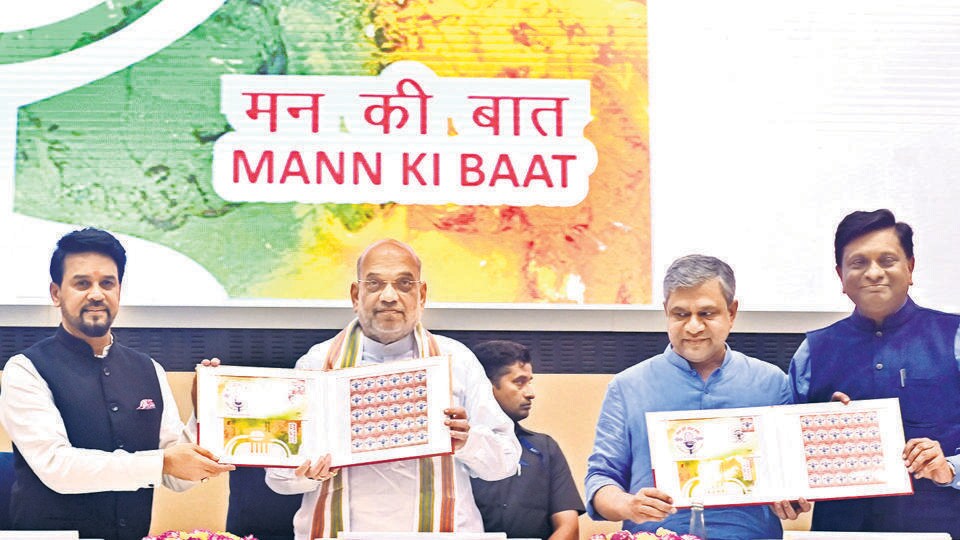
The minister was speaking at an event to mark the 100th episode of Mann Ki Baat, which will air on Sunday, April 30.
“The Prime Minister has brought about the removal of casteism, nepotism and appeasement politics — the very things that corrupted the expression of general franchise — from Indian democratic system. Now Indian politics has moved to a system of political performance where those who perform deserve to serve people,” Shah said at the event, also attended by railways minister Ashwini Vaishnaw and Union information and broadcasting minister Anurag Thakur.
“The 99 episodes of this dialogue in Mann Ki Baat have provided a platform to the creative prowess and moral fiber of the country,” Shah said.
Contending that similar conversations by other world leaders have carried a political colour, Shah said Mann Ki Baat has been “devoid of even the slightest political hue”.
The minister hailed the PM’s communication methodology, saying it is based on four pillars “insofar as it is emotional, it is spiritual, it is intellectual and it stimulates physical action”.
Read: Aamir Khan praises PM Modi's Mann Ki Baat: That is how you lead by communication
The three Union ministers also unveiled a commemorative postage stamp and coin on 100 episodes of Mann Ki Baat to mark the momentous event.
In his address, Vaishnaw said the change in political scenario in 2014 brought about an alignment between the people and the government, something that had earlier been a space of friction.
Thakur talked about the gradual expansion of Mann Ki Baat, which was initially aired in Hindi language before its English version started in January 2016, and followed by its Sanskrit version from May 2017. Currently, Mann Ki Baat is broadcast in 23 languages and 11 foreign languages, Thakur added.
Besides, the programme is also aired in 29 dialects — 25 from the Northeast and four from Chhattisgarh. “The Indian languages are Hindi, Sanskrit, Punjabi, Tamil, Telugu, Kannada, Marathi, Gujarati, Malayalam, Odia, Konkani, Nepali, Kashmiri, Dogri, Manipuri, Maithili, Bengali, Assamese, Bodo, Santhali, Urdu and Sindhi,” the I&B ministry said in a release. “The dialects are Chhattisgarhi, Gondi, Halbi, Sargujia, Pahari, Sheena, Gojri, Balti, Ladakhi, Karbi, Khasi, Jaintia, Garo, Nagamese, Hmar, Paite, Thadou, Kabui, Mao, Tangkhul, Nyishi, Adi, Monpa, Ao, Angami, Kokborok, Mizo, Lepcha and Sikkimese (Bhutia).”
The ministry added: “French, Chinese, Indonesian, Tibetan, Burmese, Baluchi, Arabic, Pashtu, Persian, Dari and Swahili are the foreign languages in which the broadcast is done.”
According to I&B ministry data, the duration of the first episode of Mann Ki Baat broadcast on October 3, 2014 was of 14 minutes, which increased up to 19 minutes in the second episode, and 26 minutes in the third episode. Each episode since the fourth has been of 30 minutes, it added.
The prime minister has mentioned more than 700 individuals and 300 organisations in his monthly broadcast so far, including 37 individuals and 10 organisations from foreign countries.


