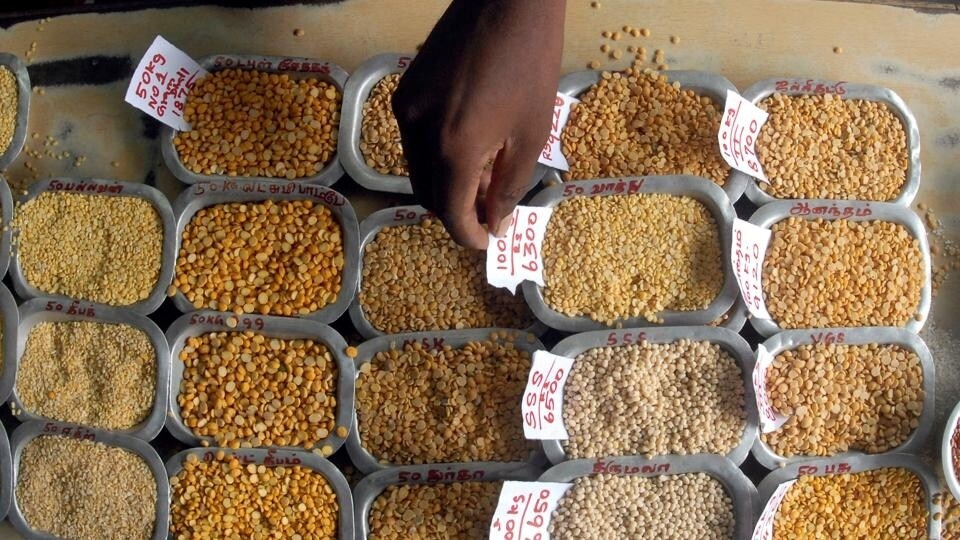
The government has imposed caps on the quantity of two widely consumed varieties of pulses, a measure known as stock-holding limits invoked to control inflation
The El Nino weather pattern last year stoked prices of pulses, a common source of protein for most Indians, despite a 37% jump in overall domestic production since 2015-16, which has helped India cut down on costly imports.
India’s output of pulses dipped to 23.4 million tonne in 2023-24 from 26.1 million tonne a year ago, the agriculture ministry estimated (REUTERS)
Yet, the goal of self-sufficiency in lentils has been elusive, which has kept prices high and availability low. Rising protein-led prices can be a significant driver of inflation and household expenses, even as the Narendra Modi government has imposed a slew of price-control measures in a year of general elections.
El Nino is a weather phenomenon marked by a warming of the Pacific Ocean, whose effects ripple around the globe. In India, it brings dry weather and lessens rainfall, like it did last year, and potentially, drought.
In early 2008, a global surge in food prices led to a domestic price spiral. Between 2004-05 and 2013-14, pulses, as a group, saw a price spike of 143%, pushed up by global prices and rising protein demand due to better purchasing power, according to a Reserve Bank of India paper by the late former deputy governor of the central bank, Subir Gokarn. He calculated that many Indians had crossed an income threshold beyond which protein intake — pulses, eggs, and meat — increases.
Shortly after the Modi government assumed office during its first term in 2014, it focused on farm and trade policies to raise pulse output to avoid reliance on volatile imports. Long-term import deals with nations, such as Mozambique, were signed to hedge against the rise in global commodity prices.
Overall, the output of pulses as a group, at 27.5 million tonnes in 2022-23, is slightly higher than the previous year’s production of 27.3 million tonnes, according to official data.
According to the agriculture ministry’s data, a campaign to distribute improved seeds raised pulses productivity by 34.8%, from 727 kg/hectare in 2018-19 to 980 kg/hectare in 2021-22. The policy push to boost output led to a fall in imports.
The value of pulses imported by the country peaked in 2016-17 at $4244.13 million. In 2022-23, India’s pulses import bill stood at nearly $1943.89 million, despite a weakening rupee, according to official data. An appreciating dollar makes imports expensive.
Widely consumed pulses or ‘dals’, a staple of most Indian diets, include pigeon peas (arhar or tur), black gram(urad), moong (green gram), split chickpeas (channa) and Bengal gram.
Yet, the gains are fragile. Increasing weather uncertainties can quickly firm up prices if output drops. This year, prices of pigeon peas (tur) and black gram (urad) have been elevated because of a patchy monsoon last year in rain-fed growing belts in Karnataka, Andhra Pradesh and Telangana.
Maharashtra, a major tur grower, saw unseasonal heavy rains in October. This has led to a drop of 18.3% and 3.7% in production tur and urad, although overall output went up slightly, according to the agriculture ministry’s estimates.
The output and productivity of key pulse varieties vary widely, depending on where and how they are grown. India still imports 5-6% of its domestic needs, and consequently, ‘imports’ inflation when global commodity prices go up.
The government has imposed caps on the quantity of two widely consumed varieties of pulses — tur (pigeon pea) and urad (black gram) – that retail shops and traders are allowed to store, a measure known as stock-holding limits that are invoked to control inflation.
However, commodity traders said prices are likely to rule high. The Centre may consider government-to-government deals if supplies don’t improve, an official said, requesting anonymity. The consumer affairs ministry took stock of imports last month, asking importers to quicken shipments from Myanmar, a key exporter of pulses to India.
Shortages have led to wholesale prices of pigeon peas rising above minimum support prices. In Maharashtra’s Latur, a major trading hub, pigeon peas have been selling at ₹9000 per quintal (100 kg) compared to a federally fixed floor MSP of ₹6,600 per quintal.
Traders say the government’s raising of MSP on pulses by up to 10.4% for the summer-sown season will help increase acreage this year. “Higher MSPs will definitely lead to higher output but the key concern is weather,” said Harsha Rai of Mayur Global Corporation, a leading pulses trading firm.

 E-Paper