
 E-Paper



Grief, lessons and hope: 25 years of super cyclone in Odisha
Since then, Odisha has faced nine cyclones successfully.


Renubala Patro is 62 and prone to bouts of forgetfulness, yet remembers vividly the faces of her three daughters and two sons before they were washed away by the tidal surge from the sea on October 29, 1999.
Also Read | Cyclone Dana: Several trains cancelled, delayed due to storm. Check details
That day, 25 years ago, seawater from the Bay of Bengal drawn by winds exceeding 260km/hour pummelled her modest hut in Hanagotha village of Erasama block in Jagatsinghpur district. She has even contemplated ending her own life.
“My son pleaded to save him. I can never forget his face. I was washed away by the waves and was found four days later hundreds of metres away. Why did I survive?” she asked.
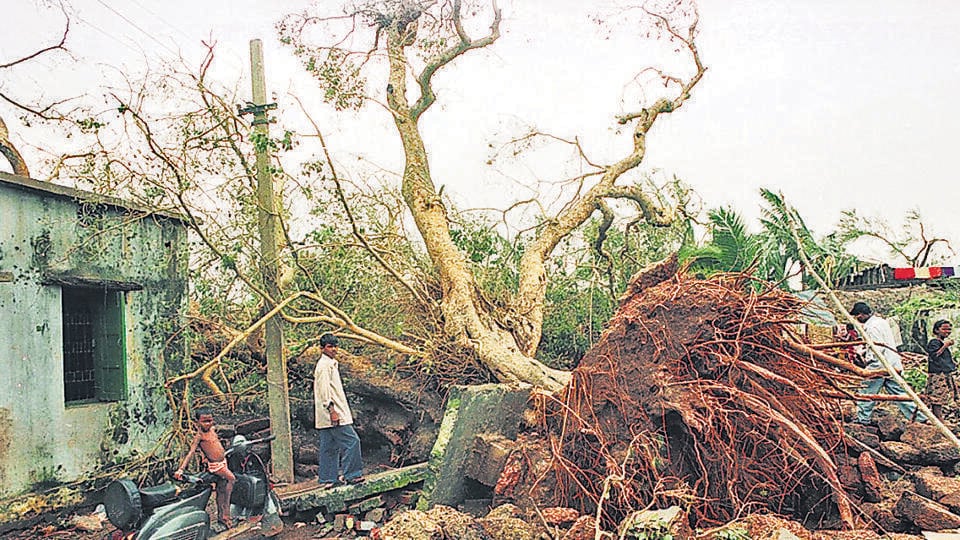
As Odisha (then Orissa) gears up to face Cyclone Dana, it’s perhaps time to remember how in 1999, the worst ever storm of the country in over five decades ripped through the riparian state of Odisha killing nearly 10,000 people and affecting over 13 million others across 12 of the state’s 30 districts.
Apart from the staggering human casualty, the 1999 super cyclone (official name BOB 06; back then, cyclones weren’t given common names as they are now) destroyed almost 1.6 million houses leaving almost 2 million homeless. It also ruined almost 1.8 million hectares of agricultural land, uprooted over 90 million trees and damaged 90% of school buildings, dispensaries, offices in the affected districts apart from thousands of kilometres of roads including National Highways.
The disaster led to the formation of Odisha Disaster Management Authority (earlier Odisha Disaster Mitigation Authority), the first such body in India and later Disaster Management Act in 2005 and the state became a global example in disaster management through handling of successive natural disasters such as cyclone Phailin and Fani.
Also Read | Cyclone Dana intensifies: 5 ways to stay safe if you are in Odisha, West Bengal
And the disaster led to a change in regime: people voted out the Congress government a year later, punishing it for its inept handling of the cyclone , and voted to power the Biju Janata Dal led by Naveen Patnaik, who remained in power for the following 24 years.
Since then, Odisha has faced nine cyclones successfully.
And since then the state’s per capita income has increased almost 10 times from ₹15,100 in 1999-2000 to ₹1.61 lakh in 2023-24. Yet at the Ground Zero of the 1999 cyclone, the Erasama block, much remains the same.
When the cyclone struck his village Nagari in October 1999, Badal Giri, a 71-year-old sharecropper in Nagari village was in the temple town of Puri with his wife and parents-in-law who were visiting from Midnapore in Bengal. As the mighty winds ravaged his village, snuffing away the lives of 14 members of his extended family including his three sons, daughter-in-law and three brothers, Giri tried to rush back, but was prevented by the fallen trees. “When I came back two days later, I frantically searched for my family. My wife still cries thinking of my family members,” said Giri, who is battling diabetes and other old-age related diseases while struggling to survive in a house that badly needs repairs. The ₹2.25 lakh that he received as ex-gratia from the government for the deaths of his three sons was lost to a chit fund company a few years ago with little chances of getting it back. “Were my sons alive, I would not have been forced to do odd jobs at this age. The cyclone finished everything. Now my wife and I are waiting to die,” said Giri.
Cyclone shelters
The high death toll in the 1999 super cyclone was due to non-availability of safe shelter in the coastal villages of the state, structures that could have withstood the intensity of the cyclone and the storm surge. When the cyclone struck, there were only 23 cyclone shelters constructed by Indian Red Cross where 42,000 people took shelter. Since then, Odisha has built 500 multi-purpose cyclone shelters and 311 flood shelters in the coastal districts.
More may be needed — given both the higher population, as well as the heightened risks of cyclones from the climate crisis.
The Red Cross cyclone shelter in Khuranto village that saved the lives of hundreds of people in 1999, can house not more than 600 people — and badly needs repair. So does the cyclone shelter at Nagari village which is potentially unsafe.
“At least 1,000 people have to be housed in the cyclone shelter at Nagari, but it has space for about 600-700 people. Due to constant exposure to saline winds, the structure has become weak and anything may happen,” said Sandhyarani Swain, a local social worker.
Executive director of Odisha State Disaster Management Authority, Kamal Lochan Mishra said that though the number of cyclone and flood shelters may seem inadequate, this may not be a limiting factor. “We also use other government buildings as temporary shelters. The district collectors have been asked to clean and maintain the existing ones,” he said.
Debabrata Patra of Action Aid said there is an urgent need to do an audit of the cyclone shelters .
Another issue that is yet to be sorted out is rolling out of the district disaster management plan that was announced with lot of fanfare two years ago. “The district disaster management plan deals with minute details of evacuation as well as relief and post-disaster rehabilitation with details on each family of a village. In times of disaster, such plans would help the government reach out to the vulnerable population quickly and effectively,” said Khulana Swain, a local social worker. It’s important to implement this, he added.
Proper housing
While much more needs to be done, experts as well as people on the ground agree that the massive growth of proper (pucca) houses in Jagatsinghpur as well as other coastal districts has proved to be a major game-changer. After the 1999 super cyclone, 600,000 pucca houses under Indira Awas Yojana were allotted for the victims. Since then more than a million pucca houses have been built and more are being rebuilt.
The kutcha (makeshift) house of Mamata Kar in Ramtara village was washed away in Erasama in the 1999 super cyclone. A few years later, she got a pucca house and has managed to rebuild her life ; one of her sons is a chartered accountant. “Now I feel much safer. Naveen babu saved us,” said Kar, referring to Patnaik who prioritised construction of pucca houses in cyclone-prones areas from his first tenure as CM in 2000. The number of pucca houses in the state has increased from just about 15% of the total houses in 1999 to more than 60% as per National Family Health Survey of 2019-21.
Meanwhile, in Khuranto village of Erasama,Red Cross Nayak, is getting ready to celebrate his 25th birthday on October 29. The first son of Khirod Nayak and Basanti Nayak, a poor couple from Khuranto village in Erasama, his birth in a cyclone shelter built by Red Cross was nothing short of a miracle. As Basanti went through labour pains on October 29, she almost washed away till she managed to make it to the cyclone shelter, one of only 23 such in the state in 1999.
“Ten minutes after I made it to the cyclone shelter, my son was born even as howling winds beat down the walls of the shelter and not an inch left to stand. Someone sharpened a 20 paise coin to cut the umbilical cord. My brother-in-law named him Red Cross as he was born in the Red Cross cyclone shelter,” said Basanti. The unusual name has been a cause of much mirth as well as annoyance for Red Cross Nayak, but he has taken it in his stride and now aspires to be a college lecturer after completing his post graduate in economics in Cuttack’s Ravenshaw University.
 ABOUT THE AUTHORDebabrata Mohanty
Debabrata Mohanty is a senior assistant editor of Hindustan Times who works as state correspondent from Odisha covering the state's politics, governance, public policy, natural disasters, environment and its society for close to three decades. With his long years of reporting from the state capital of Bhubaneswar, Mohanty has been known as one of the most experienced and credible journalists covering Odisha for the national English dailies. His reporting combines on-ground detail with deep institutional knowledge detailing the state's changing politics, governance issues, administrative reforms and the functioning of its public institutions. He has regularly reported on issues ranging from legislative developments and public policy implementation. Politics is his core areas of expertise as he closely tracks Odisha's political landscape, including the rise and transformation of the Bharatiya Janata Party (BJP), the Biju Janata Dal (BJD), the two principal political parties in Odisha. His long association with the state's political establishment enables him to write on contemporary developments in a larger political context. Mohanty takes a deep interest in writing human interest stories, environmental issues and documenting the impact of cyclones, floods, heatwaves, and other climate-related events in one of the most disaster-prone states. His coverage extends to public health, governance reforms and stories on accountability of government institutions. Before joining Hindustan Times, Mohanty worked with The Indian Express, Mail Today, and The Telegraph, where he covered at least six general elections and as many assembly elections. In 2007, he was selected for the prestigious Chevening Young Indian Print Journalist Programme at the University of Lincoln, United Kingdom, where he received advanced training in print journalism. In 2009 he won the Press Institute of India-International Committee of Red Cross award on conflict reporting for his on-ground reportage of 2008 Kandhamal riots.Read More
