
 E-Paper





Follow the latest breaking news, major developments and agenda-setting stories from India and around the world with the newsdesk at Hindustan Times. Operating round the clock, the desk brings together experienced editors, reporters and correspondents to deliver fast, accurate and contextual reporting across subjects that influence public policy, governance, business, society and international affairs. The HT News Desk covers politics, elections, government policies, the economy, business and markets, science and technology, the environment, law and order, infrastructure, education, climate issues and geopolitics, while closely tracking developments across states, institutions and global capitals. The team also leads coverage of major breaking news events, policy announcements, court proceedings, natural disasters, public emergencies and significant international developments. Reports published by the newsdesk are based on information gathered from reporters on the ground, official statements, government agencies, court records, regulatory filings, recognised institutions and other authoritative sources. Stories undergo editorial scrutiny and verification processes to ensure accuracy, fairness and relevance, and are updated as events evolve and additional information becomes available. Whether covering a key political decision in New Delhi, an economic policy shift affecting millions, a landmark court ruling or a major global event, the HT News Desk aims to provide readers with reliable, fact-based journalism that delivers not only the latest developments but also the context and analysis needed to understand their wider implications.
Jammu and Kashmir DDC election results: Independents dominate in Srinagar, win 7 out of 14 seats
Three seats went to Apni Party and one each to the BJP, PDP, National Conference and J&K People’s Movement, said district election officer Dr Shahid Choudhary.


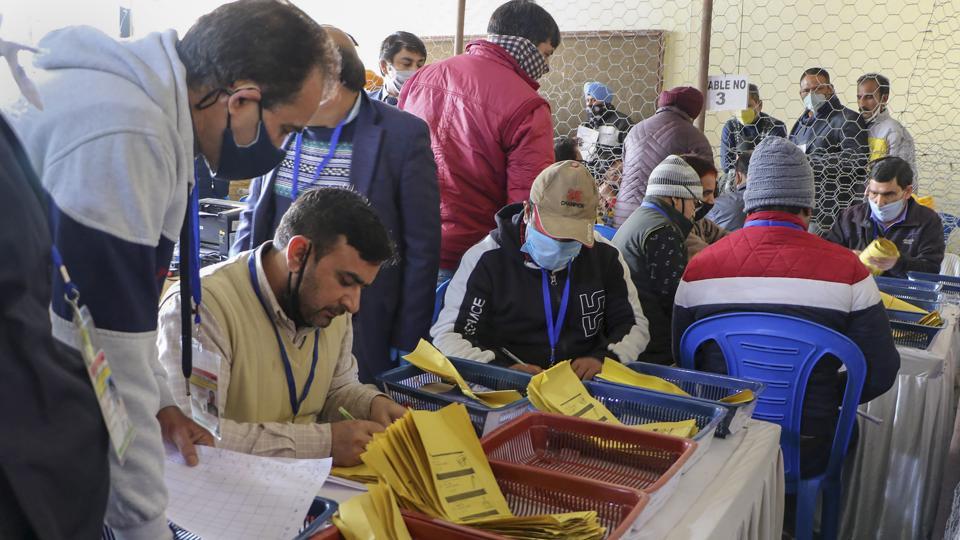
Counting of votes for the eight-phased district development council (DDC) elections in Jammu and Kashmir began at 9 am on Tuesday and is currently underway. Later in the day, Srinagar district election officer Shahid Choudhary said that of the 14 DDC seats in Srinagar, seven were won by independent candidates and three went to Apni Party. One seat each, Choudhary said, was won by the Bharatiya Janata Party (BJP), National Conference (NC), People’s Democratic Party (PDP) and the Jammu and Kashmir People’s Movement (JKPM).
NC and PDP are among members of the six-party People’s Alliance for Gupkar Declaration (PAGD).
“Out of 14 DDC seats in Srinagar, independents have won seven seats, Apni Party emerged victorious at three seats and one seat each by BJP, PDP, National Conference, Jammu and Kashmir People’s Movement,” news agency ANI quoted Choudhary as saying.
BJP’s Ajaz Hussain was among those victorious from DDC seats in Srinagar, clinching the Balhama seat. Speaking to media, Hussain said, “We fought against PAGD candidate and BJP emerged victorious at this seat today. I congratulate people of Jammu and Kashmir and the security forces.”
NC candidate Kaiser Mir and independent candidate Shabir Aad Reshi were victorious from Khimber and Hawan constituencies respectively.
Voting for DDC elections took place between November 28 and December 19, with nearly 2,200 candidates in the fray from 280 seats. These are the first elections in the Valley post abrogation of Article 370 last August, which led to the scrapping of special status of the region and splitting of the-then unified state of Jammu and Kashmir into independent Union territories of Jammu & Kashmir, and Ladakh.


