
 E-Paper



MMR’s air quality monitoring mechanism takes a hit as most stations go kaput
Three air quality-monitoring stations, located at Malad, Colaba, and Navi Mumbai, have been dysfunctional for the past week under the System of Air Quality Weather Forecasting and Research (SAFAR).


The densely populated Mumbai Metropolitan Region’s (MMR) air quality monitoring mechanism has taken a hit because of the raging coronavirus disease (Covid-19) outbreak coupled with several monitoring stations have been lying dysfunctional, data showed.
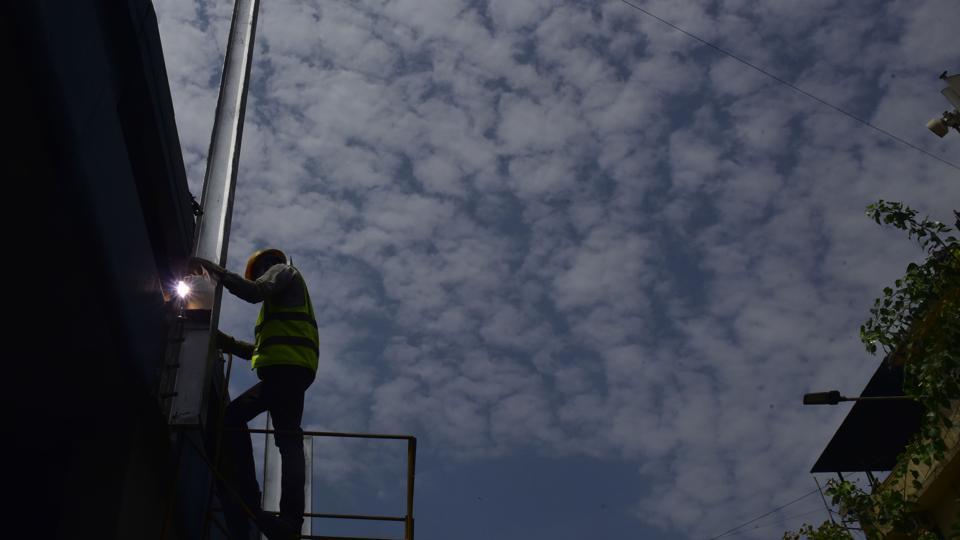
Three air quality-monitoring stations, located at Malad, Colaba, and Navi Mumbai, have been dysfunctional for the past week under the System of Air Quality Weather Forecasting and Research (SAFAR).
While four stations under the Maharashtra Pollution Control Board (MPCB) at Borivali, Worli, Navi Mumbai (Nerul) and Dombivli have not been operational since June.
The Borivali station has gone kaput since April 11.
“The four stations have reported technical snags pertaining to internet connectivity and power failure. There is also an accessibility issue with the Borivali station because it is located inside the Sanjay Gandhi National Park. Though the data is not being regularly updated on the website, it is being meticulously collated,” said VM Motghare, joint director (air quality), MPCB.
SAFAR has been monitoring and forecasting air quality using real-time information from 10 stations in MMR -- the urban agglomeration around Mumbai -- since June 2015.
While MPCB launched its air quality-monitoring stations across 15 locations in MMR last year.
At present, the overall pollutant-measuring indicator --- air quality index (AQI) -- for Mumbai is done on the basis of an average of seven stations
-- Bhandup, Mazgaon, Borivli, Chembur, Worli, Bandra Kurla Complex (BKC), and Andheri -- for SAFAR and 11 stations for MPCB.
MPCB data is used to tabulate annual average air quality information made available to the Centre’s National Clean Air Program (NCAP), which was launched in January 2019.
SAFAR researchers said all three monitoring stations are located near Covid-19 containment zones.
“This is the first time we are monitoring air pollution data, when some of our stations are not functioning,’ said Gufran Beig, project director, SAFAR.
“We have a team of engineers, who regularly visit these stations to ensure that there are no technical snags. However, the frequency of their regular visits has vastly reduced because of the pandemic. Besides, restrictions are in place since many of these stations are located near or within containment zones. We are hoping that the data will be live again soon,” he added.
HT had reported on April 15 that there were data gaps in MPCB’s real-time AQI data, when officials had said the state pollution control board was not listed as an essential service during the Covid-19 lockdown restrictions imposed by the Maharashtra government in end-March in a bid to contain the spread of the Covid-19 outbreak.
“Three monitoring stations such as Borivali, Nerul, and Dombivali are located in containment zones, while the Worli station has reported technical glitches. There have been persistent issues with the station at Borivali. Work is in progress to resume the availability of real-time air quality data,” said an MPCB official, requesting anonymity.
Independent researchers have called for the installation of an automated facility for an uninterrupted supply of real-time air-quality data.
“By definition, these stations don’t need human intervention and they are designed to be operational 24x7. We need to ascertain the causes of these stations going offline and the specific technical snags that are deterrent to their smooth functioning,” said Ronak Sutaria, an independent air quality expert.
On Thursday, Mumbai’s AQI was 50, which comes under SAFAR’s “good” category.
The corresponding count for MPCB was 54 or “satisfactory”. SAFAR has predicted 47, or “good” for Friday.
“Air quality in Mumbai is likely to oscillate between good and satisfactory level for the next week depending on how much rain the city receives. Pollution levels are likely to rise in end-July or early August, if there is a break-monsoon period,” Beig said.