
 E-Paper



NPR-NRC impact: Civic bodies in UP, Bihar, Maharashtra and Bengal flooded with birth certificate applications
Most of the state governments will start enrolment for NPR from April 1, 2020, and the register would be updated by September 2020.


A sudden increase in the demand for birth certificates, a crucial document for enrolment in the National Population Register (NPR), has been reported from various minority-dominated areas of at least four states amid the row over the Citizenship (Amendment) Act.
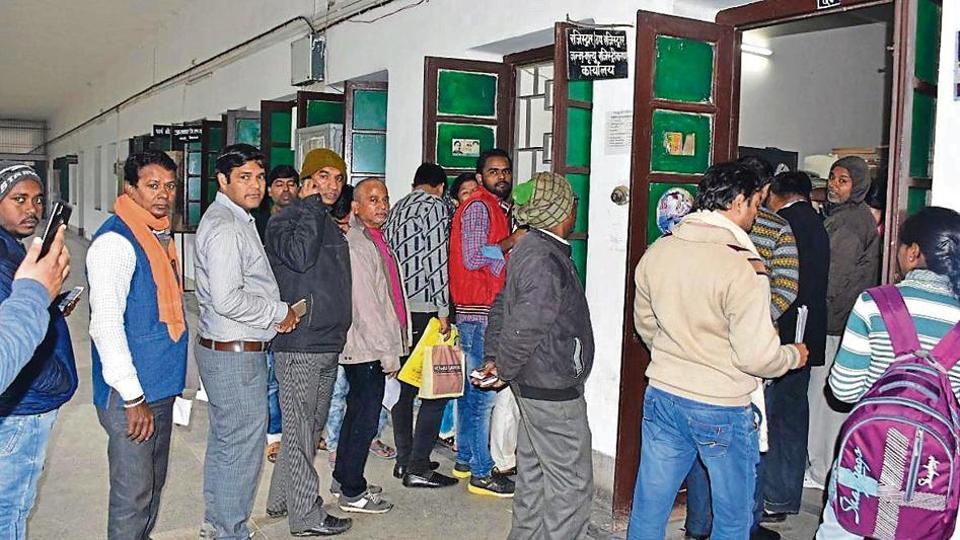
Most of the state governments will start enrolment for NPR from April 1, 2020, and the register would be updated by September 2020. The government would be seeking the date and place of a person and his or her parents’ birth in the exercise.
Birth certificates are issued by urban and rural local bodies and once the birth is registered, the document can be sought anytime. If the registration is not done within one year of the birth, then one has file an application with the first magistrate, who can direct the registrar of births to issue the certificate.
Getting a birth certificate is turning to be a problem for the elderly like Sarfaraz of Uttar Pradesh’s Agra.
“I was born in 1968 and never felt the need of a birth certificate but now with CAA, NRC and NPR, I am following others. And to prove my nationality, I will have to produce a birth certificate, which I am going to get from Agra Nagar Nigam registration department,” Sarfaraz said.
Scenes were not different at the municipal offices in Prayagraj, Varanasi, Meerut, Hapur and Bulandshahr, where officers said the number of applications for birth certificates has gone up in the past two months.
Akram Khan, 50, a businessman resident of Kareli locality in Prayagraj and his 45-year old wife Sadia Bano, have visited the municipal office several times to get their birth certificates.
“I never thought that I would suddenly need a birth certificate in my 50s. Born and brought up in Prayagraj, I decided to get birth certificates made for me and my wife following the talk that even citizens of India may need to prove their citizenship,” Akram said.
He added that there were many people from his age group at the municipal office who are trying to get the document.
In Varanasi, a 71-year-old weaver also gave the same reason.
“I have heard that the birth certificate will be required for NRC. That is why I have applied for it,” he said as a tailor from Bajardiha standing next to him in a queue for the certificate nodded.
Officials too said they are busy handling the applications.
“Now suddenly a large number of people in their 30s and 40s are coming for birth certificates,” AK Jain, a clerk at Prayagraj Municipal Corporation, said.
In Lucknow, the number of birth certificates issued in December last year has gone up three times to 6193 as compared to the same period in 2018 from 2012.
“There has been an increase in demand for birth certificates, especially by aged Muslims. Seeing the spurt, we have decided to issue the certificates at a zonal level too,” Ashok Singh, the chief tax fixation officer of Lucknow Municipal Corporation, said.
Singh, who is also in charge of birth and death section, said 30% of the applicants were over 40 years of age.
Varanasi Swasthya Adhikari (city health officer) Ramshakal Yadav said there were no instructions that birth certificate was mandatory (for CAA or NRC) but still people are applying.
Meerut city’s health officer Gajendra Singh said his office has witnessed a 40% jump in applications for birth certificates from people in the age group of 10 to below 60 years.
In many places, people are taking the help of lawyers to complete the formalities for getting birth certificates, especially those who claimed to have been born at home.
“I had to bring my lawyer to apply for a birth certificate as I was born at home,” Niaz Ahmed, a 57-year-old resident of Lucknow’s City Station Golaganj who just got his birth certificate, said.
“I have also applied with full documents with the help of my lawyer as I was also born at home,” Shadab Hussain, of the same locality, said.
Local representatives are also as busy because they are authorised to give people proof of residence.
Rafeeq Ansari, the Samajwadi Party MLA from Meerut city, said 400 to 500 people, most of them Muslims, approached him every day to seek his letter required to apply for birth certificates.
“Local MLAs and MPs are authorised to endorse residential proof of a person. So people are approaching them in large numbers, especially after the announcement of CAA,” Ansari said.
Councillor of Katehar ward in Varanasi, Afzal Ansari, said ever since CAA came into focus, people were confused about citizenship issues and were seeking birth certificates. “Many people have approached me also,” he said.
Similar rush for birth certificates was also seen in several places in Bihar, including the capital city of Patna and Muslim-dominated Seemanchal region.
“An average of 4000 people registered for birth certificates monthly between January and November 2019. In December 2019, the registration figure was 6600. Of these, 25% were those in the age bracket of 40 to 50 years and predominantly from the Muslim community,” said Patna’s district statistical officer, Mahesh Prasad, who is also additional district registrar of births and deaths.
In West Bengal, the rush for birth certificates and other documents was witnessed between October and November 2019 and after chief minister Mamata Banerjee’s announcement in December that NPR and NRC will not be implemented in the state, there has been a dip in the queue for documents, officials said.
However, many people are still queuing up to get the documents in Malda and Murshidabad districts.
“I have raised the issue in the state assembly and have written letters to the DM. It is mostly Muslims who have panicked,” Malda’s legislator Mostak Alam said.
In Murshidabad, Trinamool Congress’ spokesperson Ashok Das said, “Mamata Banerjee has said that CAA and NRC will be not implemented in this state. We are appealing to the common people not to panic and not to share their personal information with anyone.”
Maharashtra government officials said there has been a sudden demand of birth certificates in several Muslim dominated areas such as Malegaon and Aurangabad.
“We have opened additional offices to cater to the increase in demand,” a Maharashtra government official told news agency PTI.