
 E-Paper



Only jobs to Kashmiri youth can heal wounds in the valley | Analysis
Home minister Amit Shah did not speak on the matter of jobs during the debate in the parliament that concluded in the abrogation of Article 370 and Article 35 A.

 Prefer HTon Google


After the effective scrapping of Article 35 (A), the key question confronting unemployed young people in the newly formed Union territories of Jammu and Kashmir (J&K) and Ladakh will be whether they get to keep the right to government jobs the constitutional provision had offered them. Unemployment is a major concern in the Kashmir Valley and has been cited by experts in the past as one of the reasons for young men taking up arms against the State.
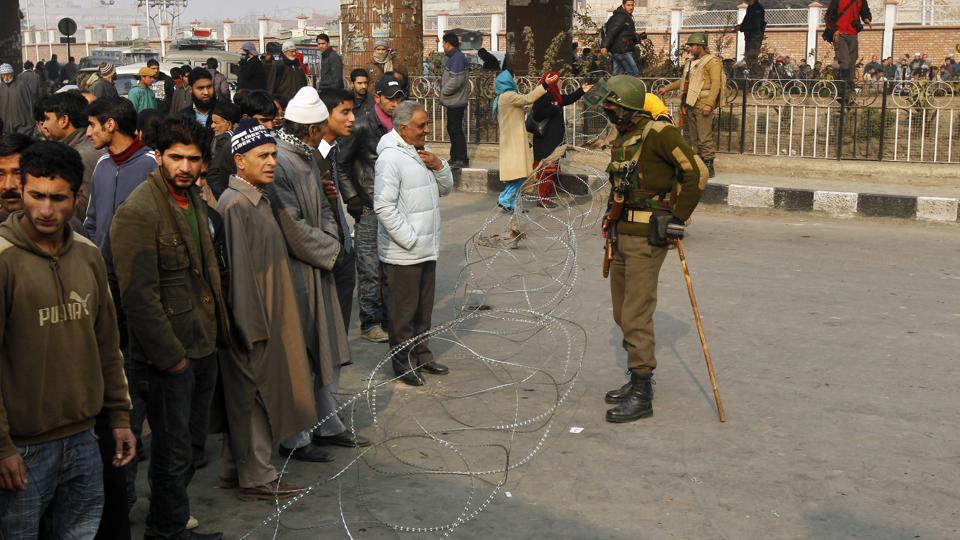
Home minister Amit Shah was silent on the matter of jobs in the parliamentary debate that concluded on Tuesday in the nullification of Articles 370, which gave special status to the state of J&K, and Article 35 A, which reserved benefits such as government jobs and property ownership for people deemed to be permanent residents of the erstwhile state of J&K.
Also watch: ‘Will embrace Kashmiris:’ Amit Shah as LS passes bifurcation bill, scraps 370
The nullification of Article 35 A could effectively mean that all government jobs in the new union territories would be up for grabs for all citizens of India unless special safeguards are provided by the Centre in subsequent rules to be issued in the next few months.
As of now, the youth in the state will not have the first claim over government jobs in the state, which had been the practice since 1954 when Article 35 A came into force. This is happening at a time when several state governments are invoking regionalism by ensuring locals get preference in government and private jobs.
On July 24, the Andhra Pradesh assembly passed a law reserving 75% of jobs in the southern state for local candidates in factories, industrial units, joint ventures and private projects taken up in the Public Private Partnership (PPP) mode. In mid-July, Madhya Pradesh chief minister Kamal Nath told the state assembly that he would bring a law to reserve for locals 70% of jobs in the private sector in return for incentives that have been offered by the state government to the employers.
Goa chief minister Pramod Sawant went a step further, promising 80% of private-sector job for Goans; 60% of these jobs would be permanent in nature.
In November 2017, the Karnataka government brought in a policy reserving 70% of the jobs in the private sectors for locals. The Maharashtra government in November 2008 reserved 80% of the jobs in micro and small scale industries for Maharashtrians.
Several states have introduced measures in the past decades to ensure locals get jobs in the government sector.
Chhattisgarh, West Bengal, and Odisha have a mandatory test in the state language to apparently minimize the possibility of outsiders getting government jobs. Hindi-speaking states such as Madhya Pradesh, Uttar Pradesh, Rajasthan, and Haryana provide age relaxation for state residents in the state service commission examinations.
Although Kashmir’s special status now stands gone, some other states will continue to enjoy special status under Article 371 of the Constitution. This article provides special land and job rights to natives in Sikkim, Nagaland and Mizoram, it also limits the powers of Parliament to enact any law that interferes with tribal religious laws, customs, and their judicial system. Article 371 prohibits the buying of agricultural land in Himachal Pradesh.
A look at the Jammu and Kashmir Reorganisation Bill, 2019, which now defines the nature of the Union territory of J&K and Lakakh, does not have any provision for safeguarding interests of residents. Issues involving services that include regulating jobs in the government sector will be the prerogative of the Lieutenant Governor. The Jammu and Kashmir police, the biggest employer of local young men, would now be under direct control of the central government via the Lieutenant Governor.
Jobs have long been considered a crucial aspect in mainstreaming young people in the region, perhaps more vulnerable to pro-militancy propaganda in the changed circumstances.
Both the United Progressive Alliance (UPA) and the National Democratic Alliance (NDA) governments at the Centre have run schemes to coach young candidates for taking up government and private sector jobs. They did have a positive impact, with the unemployment rate in Jammu and Kashmir being lower than other northern states, according to the Periodic Labour Force Survey done by the National Sample Survey Office for the period 2017-18.
The state ranked 11 among 21 states ranked by the JustJobs Index of quality jobs, compiled by the Azim Premji University. Moreover, government data shows that Jammu and Kashmir is not as under-developed as perceived by mainland India.
Even so, young Kashmiris need to be assured that, despite the effective revocation of Articles 370 and 35A, skill development and employment creation schemes will continue and many more jobs will be generated in which the locals receive preference. This could serve as a balm for young people tormented by uncertainty over their future.


