
 E-Paper



Soft power: India sends Buddha relics to Thailand to counter Chinese efforts
The relics of Lord Buddha and his disciples were taken to Bangkok last month by an Indian delegation and will be displayed for 25 days in four cities of Thailand

 Prefer HTon Google


India has sent several sacred relics of Lord Buddha and his disciples to Thailand, where they were personally received by Prime Minister Srettha Thavisin, with the development being seen as part of New Delhi’s efforts to counter Beijing’s attempts to use Buddhism to project soft power in Southeast Asia.
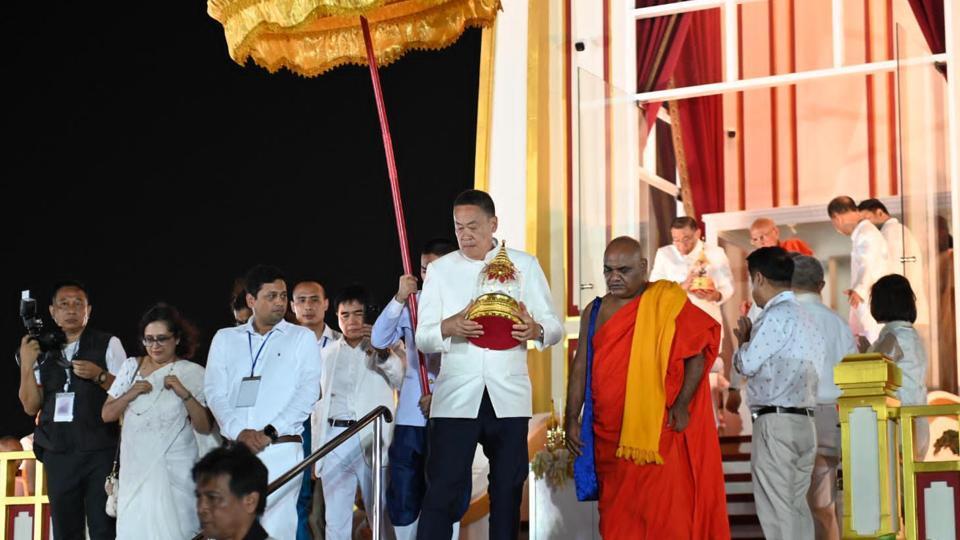
The relics of Lord Buddha and his disciples, Arahant Sariputta and Arahant Maha Moggallana, were taken to Bangkok last month by an Indian delegation and will be displayed for 25 days in four cities of Thailand. After being displayed at Sanam Luang royal palace ground in Bangkok, the relics were taken to Chiang Mai on Monday.
Soon after the relics were flown into Bangkok on a special Indian Air Force (IAF) flight, they were given a guard of honour and later received by Thavisin and members of his council of ministers before being put on display in a red-and-gold pagoda for 11 days.
Also Read:HistoriCity | Varanasi is a microcosm of Hindu India, it’s also a city of reformists
The relics of Lord Buddha are drawn from the National Museum in New Delhi and were excavated at Piprahva, considered a part of the ancient Buddhist site of Kapilavastu, while the relics of the disciples are from a monastery at Sanchi in Madhya Pradesh. Their exposition in Thai cities was arranged to mark the friendship between the people of India and Thailand and the 72nd birth anniversary of King Maha Vajiralongkorn, people familiar with the matter said.
The Thai king and his wife visited the relics on February 26 and spent almost an hour at the site, the people said.
On several days, almost 100,000 people visited the pagoda that was custom built for the relics, they said. Besides Thai devotees, people from Cambodia, Laos and Vietnam also visited the site in Bangkok to pay homage to the relics.
“Buddhist culture was always ours. This exposition of the relics in Thailand is one way to counter China’s efforts to project soft power through Buddhist culture,” one of the people cited above said.
After being displayed in Chiang Mai province till March 8, the relics will be taken to Ubon Ratchathani province (March 9-13) and Krabi province (March 14-18).
Amid the dragging military standoff on the Line of Actual Control (LAC), China has sought to position itself to have a greater say in Buddhist affairs, such as appointing the successor to the current Dalai Lama. While Buddhism originated in what is modern day Nepal and India, China’s state media has sought to portray it as an “ancient Chinese religion”.
Many of these steps appear to have been taken by Beijing with an eye on the situation in the Tibet Autonomous Region, where the Dalai Lama remains an influential spiritual leader. On the other hand, the people cited above said India perceives Buddhism as an important factor in building stronger relations with Southeast Asian nations such as Thailand and Vietnam.



