
 E-Paper



Virus spreads in aircraft but transmission risk low: Study
Closed indoor spaces have become a particular worry for the spread of the Sars-Cov2, which can linger on as aerosols; people usually breathe out microscopic viral particles even when they speak but the volume increases drastically if someone coughs or sneezes.


Two people were most likely infected with Covid-19 on a 4 hour, 40 minute international flight in the early days of the pandemic, according to a new scientific study that confirms the possibility of viral spread in an aircraft but also highlights that the risk may be lower than previously believed.
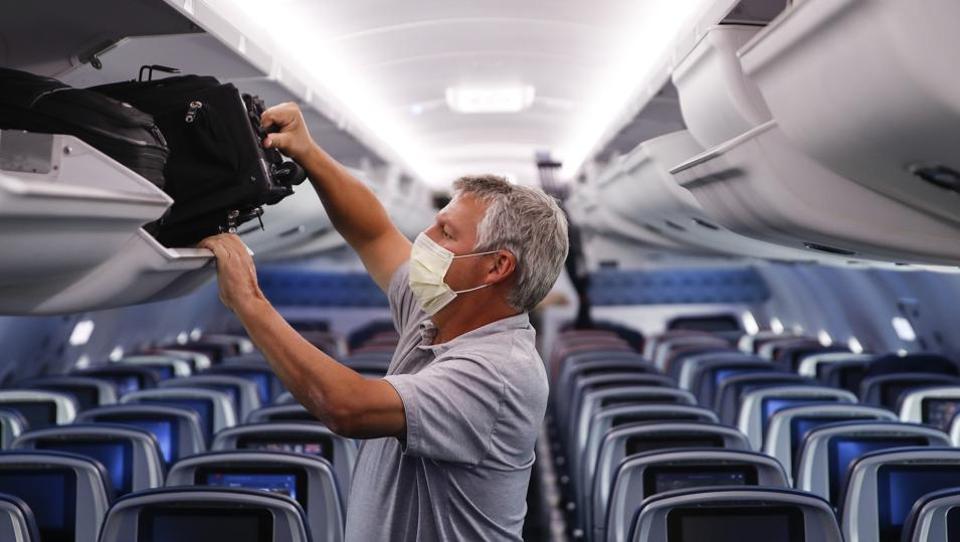
The two were among 102 passengers on a Tel Aviv-Frankfurt flight on March 9. Among these were seven confirmed Covid-19 infected persons, or index patients, with four being symptomatic during the flight. None of the passengers wore a mask.
“When we started with the interviews to determine whether transmissions had occurred, we expected the rate of suspected transmissions to be higher, as there was an unusually large number of index cases, some of which were symptomatic, on the plane. The passengers did not wear masks,” said Sandra Ciesek, director of the Institute for Medical Virology at Frankfurt’s Goethe University, in an e-mail interaction with HT.
Ciesek, one of the authors of the study that was published on Tuesday on the JAMA Open network, said that it appeared “as though the air circulation inside the airplane cabin may have reduced the rate of transmission” and that wearing masks could further reduce the risk of spread.
The seven index patients, the study notes, may have picked up the infection from a hotel manager a week before the flight. “At the destination airport, we conducted a medical evaluation of the tourist group, including testing Sars-CoV2 in a throat swab specimen. In addition, we contacted all passengers four to five weeks later by phone and conducted structured interviews,” they said.
In all, 71 of the other 78 passengers (91%) who had been exposed to the group on the flight completed the interview and serum samples were obtained from 13 of these individuals six to nine weeks after the flight. An analysis of these revealed that two of the people who had contact with the infected group also got the virus, although the researchers acknowledge the slim chance that transmission may have also occurred before or after the flight.
Several of the passengers could not be reached, and it was not clear whether they too were infected, the authors note, identifying it as another of the limitations of their study.
Closed indoor spaces have become a particular worry for the spread of the Sars-Cov2, which can linger on as aerosols; people usually breathe out microscopic viral particles even when they speak but the volume increases drastically if someone coughs or sneezes.
In such circumstances, experts have feared that a long flight may be particularly risky, even as airline industry representatives say cabin air circulation systems replace air at a regular rate and passenger jets have adequate particulate filtration devices.
The researchers indicate this may be a possibility. “The airflow in the cabin from the ceiling to the floor and from the front to the rear may have been associated with a reduced transmission rate. It could be speculated that the rate may have been reduced further had the passengers worn masks,” they say in the report.
According to Ciesek, both passengers with likely infections on flight were seated within the two-row perimeter. “This means seating in the same row as an index passengers as well as the two rows in front and behind. It has previously been demonstrated that the risk of droplet-mediated transmissions is higher in this area,” she said.
The professor underscored that “it is important to note that transmission of Sars-CoV2 in air travel may occur. Measure to prevent transmission should be applied, such as the wearing of masks”.
