
 E-Paper



Bodies of two men trying to escape volcanic eruption in Pompeii nearly 2,000 years ago excavated
The remains of the two victims, lying next to each other on their backs, were found in a layer of gray ash at least 2 meters (6.5 feet) deep.


Skeletal remains of what are believed to have been a rich man and his male slave attempting to escape death from the eruption of Mount Vesuvius nearly 2,000 years ago have been discovered in Pompeii, officials at the archaeological park in Italy said Saturday.
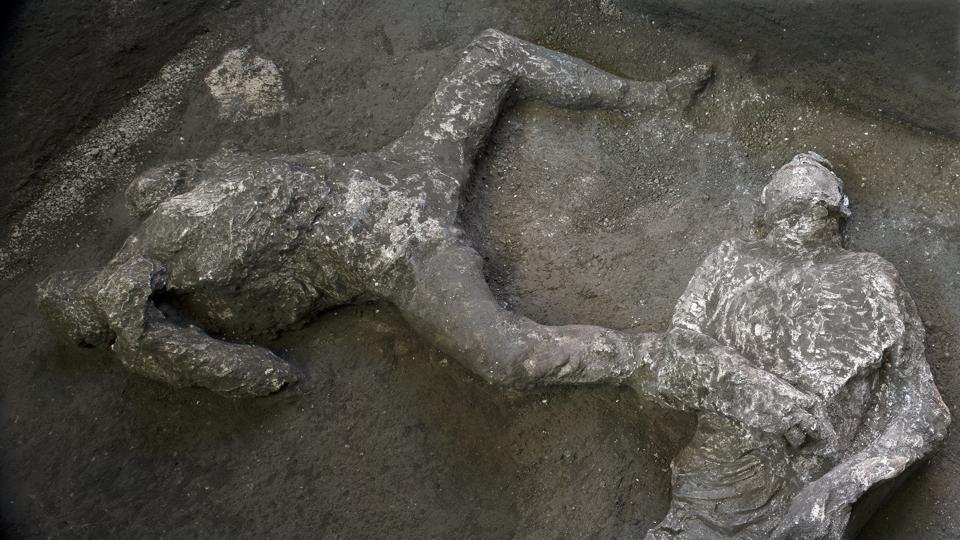
Parts of the skulls and bones of the two men were found during excavation of the ruins from what was once an elegant villa with a panoramic view of the Mediterranean Sea on the outskirts of the ancient Roman city destroyed by the volcano eruption in 79 A.D. It’s the same area where a stable with the remains of three harnessed horses were excavated in 2017.
Pompeii officials said the men apparently escaped the initial fall of ash from Mount Vesuvius then succumbed to a powerful volcanic blast that took place the next morning. The later blast “apparently invaded the area from many points, surrounding and burying the victims in ash,” Pompeii officials said in a statement.
The remains of the two victims, lying next to each other on their backs, were found in a layer of gray ash at least 2 meters (6.5 feet) deep, they said.
As has been done when other remains have been discovered at the Pompeii site, archaeologists poured liquid chalk into the cavities, or void, left by the decaying bodies in the ash and pumice that rained down from the volcano near modern-day Naples and demolished the upper levels of the villa.
The technique, pioneered in the 1800s, gives the image not only of the shape and position of the victims in the throes of death, but makes the remains “seem like statues,” said Massimo Osanna, an archaeologist who is director general of the archaeological park operated under the jurisdiction of the Italian Culture Ministry.
Judging by cranial bones and teeth, one of the men was young, likely aged 18 to 25, with a spinal column with compressed discs. That finding led archaeologists to hypothesize that he was a young man who did manual labor, like that of a slave.
The other man had a robust bone structure, especially in his chest area, and died with his hands on his chest and his legs bent and spread apart. He was estimated to have been 30- to 40-years-old, Pompeii officials said. Fragments of white paint were found near the man’s face, probably remnants of a collapsed upper wall, the officials said.
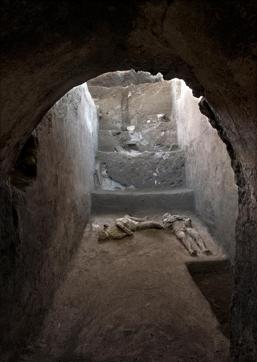
Both skeletons were found in a side room along an underground corridor, or passageway, known in ancient Roman times as a cryptoporticus, which led to to the upper level of the villa.
“The victims were probably looking for shelter in the cryptoporticus, in this underground space, where they thought they were better protected,” said Osanna.
Instead, on the morning of Oct. 25, 79 A.D., a “blazing cloud (of volcanic material) arrived in Pompeii and...killed anyone it encountered on its way,” Osanna said.
Based on the impression of fabric folds left in the ash layer, it appeared the younger man was wearing a short, pleated tunic, possibly of wool. The older victim, in addition to wearing a tunic, appeared to have had a mantle over his left shoulder.
Mount Vesuvius remans an active volcano. While excavations continue at the site near Naples, tourists are currently barred from the archaeological park under national anti-COVID-19 measures.