
 E-Paper



People ‘mine’ ice ahead of snow festival to build life-sized castles, pagodas in China. See pics
The 37th Harbin International Ice Snow Festival is due to begin on January 5.


For more than 300 “ice miners” in Harbin, work begins in the numbing cold before dawn every day on the frozen Songhua, a broad river that winds its way through the northeastern Chinese city.
Wielding long ice picks, the workers break up the frozen surface of the kilometre-wide river into crate-sized blocks of ice.
Many of them construction labourers or farmers, they wear knee-high rubber boots, down jackets, thick gloves and hats with flaps to protect their ears from the frigid air.

“We come to mine ice at 6 a.m. every day,” said Zhang Wei, 40. “We need to work overtime sometimes, until 8 or 9 p.m., even late after midnight.”
Lunch is brief - a bowl of piping-hot noodles, dumplings or steamed buns. Makeshift canteens built with wooden poles and see-through sheets offer a little warmth.

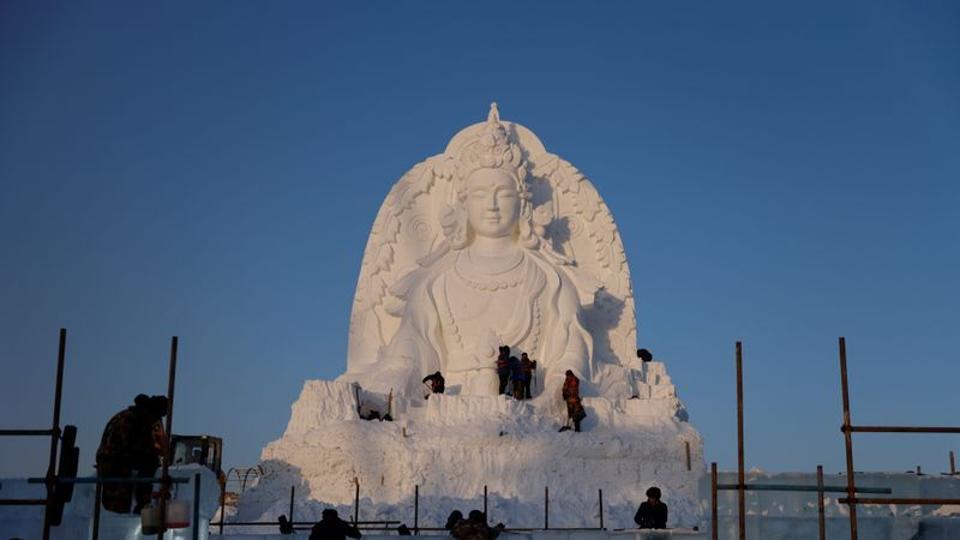
Every day since early December, tens of thousands of ice blocks have been prised out of the river and moved by truck to the venue of Harbin’s annual winter festival, where they are used to build life-sized castles, pagodas, bridges and even a functioning hotpot restaurant.

Ice from the river is essential.
“Artificial ice isn’t that thick, and isn’t strong enough to stand in the wind,” said Wang Qiusheng, who has been carving ice for the festival for 20 years.
Organisers are racing to complete the sculptures at the festival venue - a busy scene of forklifts, cranes and scaffolding.

The ice blocks are painstakingly laid on top of one another while workers shape, trim and cut them to size with chainsaws, pickle forks and tooth chisels.
The 37th Harbin International Ice Snow Festival is due to begin on January 5, and will feature skiing, sledding, mass weddings, winter swimming and a theme park of ice sculptures bathed by coloured lights.

With China’s international borders heavily restricted due to the coronavirus pandemic, domestic tourists are expected to account for the bulk of visitors marvelling at the ice sculptures next month in temperatures below minus 35 Celsius (minus 31 Fahrenheit).