
 E-Paper



Economics is driving the Lankan friendship
Ranil Wickremasinghe’s visit was dominated by economic deals. But the success of obtaining security by development will depend on how efficiently India delivers

 Prefer HTon Google


Sri Lankan President Ranil Wickremesinghe has long been considered a friend of India. He became president under unprecedented and unexpected circumstances. In July 2022, then President Gotabaya Rajapaksa was forced to surrender his office and flee the country in the face of widespread public revolt triggered by a serious economic crisis. Usually, Sri Lankan leaders visit India soon after they assume office but Wickremesinghe had to first meet the challenge of stabilising Sri Lanka’s economy and its turbulent politics. India was also waiting to see him take control of his country before extending an invitation for the visit.
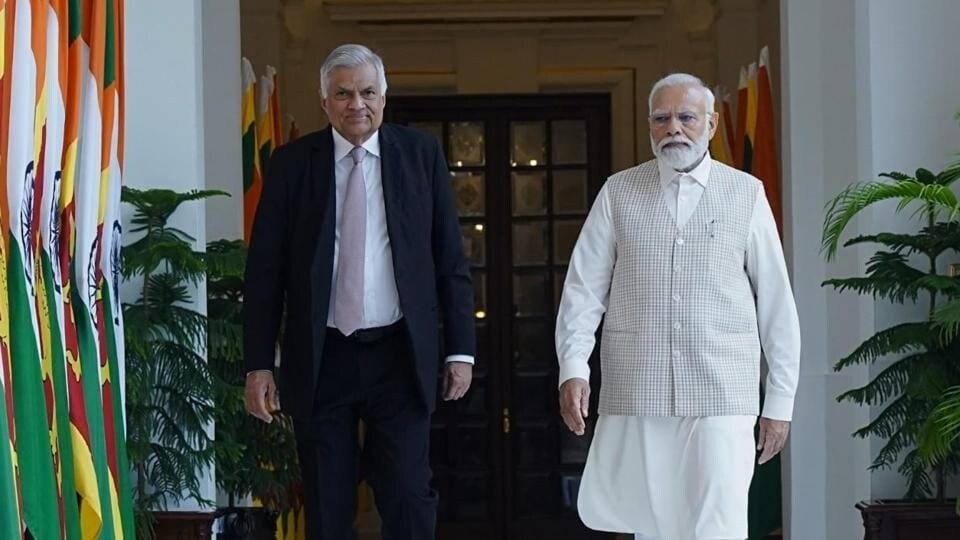
Wickremesinghe’s visit to India on July 21 had a diverse agenda. While celebrating 75 years of India-Sri Lanka diplomatic relations, he expressed gratitude to the Indian leadership for quietly blessing his much-aspired elevation to the highest office, and also helping him financially and politically in meeting domestic challenges. Wickremesinghe’s trip was also meant to ensure that Indian support for Sri Lanka’s economy and his office continued, because the semblance of economic stability obtained through support from India and others, including the International Monetary Fund (IMF), is still fragile. The IMF reform conditions – in the form of enhanced taxes and reduced subsidies – are impinging on the common people’s purses. There are political constituencies in Sri Lanka that are just waiting to revive the revolt if the reform burden on the people becomes unbearable. Some international and Sri Lankan economists such as CP Chandrashekhar and Ahilan Kadirgamar see IMF solutions as worse than the problem. Sri Lanka will have to follow the IMF reform programme until 2031, which is a long time away. Wickremesinghe is also acutely aware of the challenge that lies ahead. He wants a 30% reduction on external debt (by now nearly $40 billion) and a nine-year freeze on repayments which may not be palatable to most creditors of Sri Lanka.
Sri Lanka’s crisis at present is primarily economic; hence, the thrust of the visit was on economic cooperation between the two countries. Sri Lanka needs increasing economic involvement from India. Under its neighbourhood first and Security and Growth for All in the Region (Sagar) policies, India wants greater economic integration with its Indian Ocean neighbour. Such economic integration, for Indian policy makers, will contain the expanded Chinese economic and strategic presence in Sri Lanka. Prime Minister (PM) Narendra Modi and President Wickremesinghe have adopted a vision document on promoting connectivity and catalysing prosperity for economic partnership between their two countries. Within this framework, emphasis has been laid on maritime, air and land connectivity, Energy connectivity, through green and renewable sources, and also people-to-people connectivity by resuming ferry service between Tamil Nadu and northern Sri Lanka, abandoned since 1980 due to the ethnic conflict in the island. Of the five Memorandums of Understanding (MoU) signed, one is also on financial connectivity to allow transactions in Indian rupees through UPI in Sri Lanka. In the energy sector and for development projects in the Trincomalee area, Indian businesses such as the Adani Group will get new opportunities. Gautam Adani also met the president in New Delhi.
Being acutely aware of India’s concerns and sensitivity to the Tamil question, Wickremesinghe briefed PM Modi on his development plans and devolution proposals, including the establishment of the Truth and Reconciliation Commission on the pattern of South Africa for Tamils under the 13th amendment, which calls for a provincial council system and devolution of powers to the regions. He, however, explained his constraints regarding the devolution of the police and other sensitive powers without the approval of his parliament. He is the sole representative of his faction of the United National Party and his support in the Sri Lankan parliament comes only from Rajapaksa’s party, which is not amenable to devolving powers to the Tamils. With this in mind, PM Modi reminded his guest of Sri Lanka’s commitment to the implementation of the 13th amendment in the full and early scheduling of provincial council elections for the northeastern province. Many Tamil leaders had written separately to Modi that not much development was taking place in their region on the ground and Wickremesinghe’s proposals for devolution were not acceptable to them. Modi asked for Sri Lanka to fulfil the aspirations of its Tamil community and drive the process of “rebuilding equality, justice and peace”.
Security issues were not on the main agenda, but China lingered in the background. Wickremesinghe in France last month, categorically stated that China had no security presence in Lanka and added that Sri Lanka could not be used as a base for any threat against India. Adding a twist to India’s neighbourhood-first approach to meet the Chinese challenge, Modi said, “Security interests and development of India and Sri Lanka are intertwined and therefore, it is essential that we work together keeping in mind each other’s safety and sensitivity”. The success of obtaining security through developmental engagement with the neighbours will depend on how efficiently and in time India delivers on the economic promises.
SD Muni is professor emeritus at JNU, a Sri Lanka Rathna laureate, and a former ambassador and special envoy of the Government of India. The views expressed are personal


