
 E-Paper



Photos: Two years after blockade, Qatar shrugs off Arab boycott
To all appearances, life in the Qatar capital of Doha still glimmers, nearly two years after its Arab neighbors declared a boycott of the tiny country. In boycotting Qatar, Saudi Arabia, the United Arab Emirates, Egypt and Bahrain have accused it of backing extremist groups through its support for the Muslim Brotherhood and other Islamists across the region. They are also suspicious of Qatar's close relations with Iran, with which it shares a massive offshore gas field. Qatar, which also hosts a large US military base, denies supporting terrorism.
Updated on: Jun 07, 2019 10:20 AM IST

Share via


Copy link

1/11
 View Photos in a new improved layout
Updated on Jun 07, 2019 10:20 AM
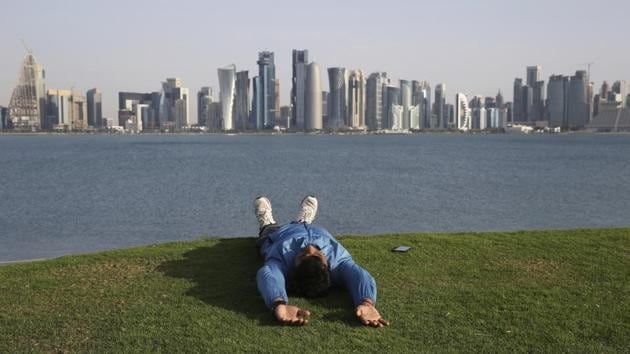
A man lies sprawled on a grass-covered hill at MIA park overlooking the skyline of Doha, Qatar. The gas-rich peninsular nation just 50 kilometers wide with a population of 2.7 million, will be the first Arab nation to host the World Cup. (Kamran Jebreili / AP)
2/11
 View Photos in a new improved layout
Updated on Jun 07, 2019 10:20 AM
Workers leave their construction sites at the Msheireb Downtown Doha district. Construction teams work around the clock to complete eight stadiums ahead of the 2022 World Cup. Visitors still flock to the city’s architectural gems, many designed by top world builders, and the city’s futuristic skyline shimmers over the Persian Gulf, projecting an image of wealth and stability in a region where tensions have soared in recent weeks. (Kamran Jebreili / AP)
3/11
 View Photos in a new improved layout
Updated on Jun 07, 2019 10:20 AM
A man helps a girl out of the water as the people swim at Sealine Beach about 40 kilometers south of Doha. Located next to sand dunes, the beach is one of the most popular spots in Qatar. Doha’s modern shopping malls still do brisk business, and on a recent hot spring day, families packed the Sealine beach south of the city. (Kamran Jebreili / AP)
4/11
 View Photos in a new improved layout
Updated on Jun 07, 2019 10:20 AM
Lasers and fireworks light up during the inauguration ceremony for Al Janoub Stadium, the first to be built from scratch, earlier last month ahead of FIFA 2022. The firm founded by the late British-Iraqi architect Zaha Hadid designed the 40,000-seat stadium to resemble the traditional dhow fishing boats, some of which still ply the coast beneath the modern skyline. (Kamran Jebreili / AP)
5/11
 View Photos in a new improved layout
Updated on Jun 07, 2019 10:20 AM
Spectators during half-time at the inauguration ceremony of the Al Janoub Stadium. The stadium has a retractable roof and a cooling system that allows hosting matches year-round, even during the country’s sweltering summers. The World Cup was moved from its usual June/July dates to November 21 through December 18 because of the heat, and shortened to 28 days because of the interruption it causes to the European club season. (Kamran Jebreili / AP)
6/11
 View Photos in a new improved layout
Updated on Jun 07, 2019 10:20 AM
A worker talks on phone as the others prepare dinner in the old Musheireb district. Qatar’s selection as a FIFA host has not been without controversy. Rights groups have long criticized its labour practices which rely heavily on migrant workers, mainly from South Asia. Qatar has recently enacted reforms, but activists still want all aspects of the “kafala” system lifted, including the requirements for exit visas for all workers. (Kamran Jebreili / AP)
7/11
 View Photos in a new improved layout
Updated on Jun 07, 2019 10:20 AM
Mohammed, an Iranian-born tram operator born and raised in Qatar, drives during a trial session at the Msheireb Downtown Doha district. The boycott led to the closure of Qatar’s only land border, with Saudi Arabia, but has caused little pain. Qatar is one of the wealthiest countries on earth due to its natural gas reserves, and has been able to circumvent the boycott with help from its regional allies like Turkey. (Kamran Jebreili / AP)
8/11
 View Photos in a new improved layout
Updated on Jun 07, 2019 10:20 AM
A worker washes the central area as cows are milked on a circular platform which can accommodate 100 bovines per rotation at the Baladna Farm, Qatar's biggest dairy and meat producer. Five weeks after the June 2017 suspension, Baladna received an air shipment of the first batch of 165 cows. The facility expanded rapidly to replace milk which had been supplied primarily by Saudi Arabia previously. (Kamran Jebreili / AP)
9/11
 View Photos in a new improved layout
Updated on Jun 07, 2019 10:20 AM
People visit the National Museum of Qatar in Doha, Qatar. Designed by French architect Jean Nouvel, it was inspired by the desert rose crystal, the buildings are shaded by clusters of large discs, while visitors enter through Islamic-style archways and opened on March 28th. (Kamran Jebreili / AP)
10/11
 View Photos in a new improved layout
Updated on Jun 07, 2019 10:20 AM
Doha’s building spree continues. Students seen here listening to their professor at the Qatar National Library in Doha. The 45,000-square-meter building designed by architect Rem Koolhaas has climate-controlled display cases in the Heritage Library. (Kamran Jebreili / AP)
11/11
 View Photos in a new improved layout
Updated on Jun 07, 2019 10:20 AM