E-Paper



Shifting of deer to maintain ecological pyramid in national parks of Madhya Pradesh
Translocation of 3,000 spotted deer from Bandhavgarh and Pench Tiger Reserves to three other national parks and a wild sanctuary in the state has started to ensure there is prey for tigers

 Prefer HTon Google


The Madhya Pradesh (MP) forest department authorities have started translocation of 3,000 spotted deer from Bandhavgarh and Pench Tiger Reserves to three other national parks and a wild sanctuary in the state in a bid to ensure that there are enough prey for tigers, a forest department official said on Friday.
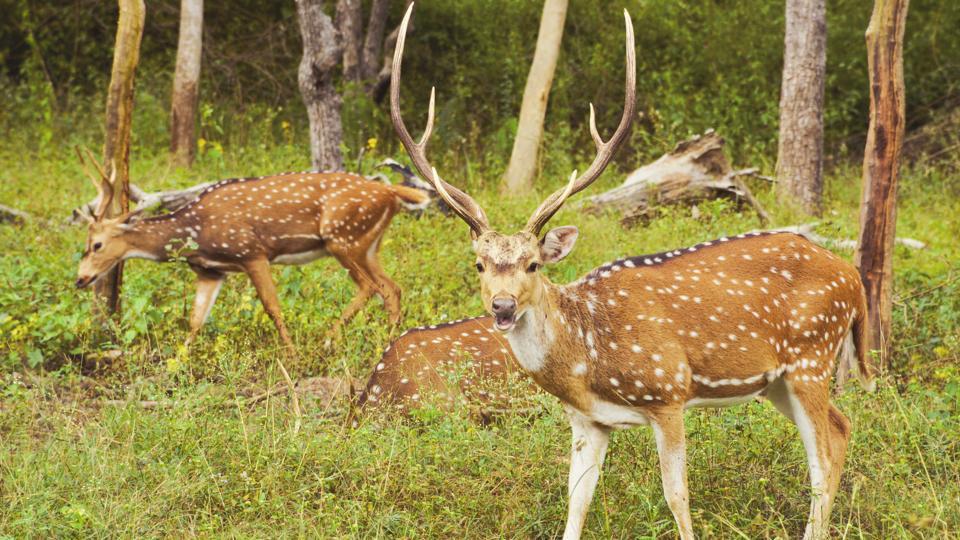
“The decision of translocation of the spotted deer was taken in early September to cater to the tigers’ prey in Sanjay Gandhi National Park in Sidhi, Nauradehi Wildlife Sanctuary in Damoh and Satpura Tiger Reserve in Hoshangabad. The population of tigers in these national parks and wildlife sanctuaries have risen in the past few years. But the population of their prey has not increased in equal proportion,” said Alok Kumar, principal chief conservator of forests (PCCF), wildlife, MP.
The population of deer in national parks and wildlife sanctuaries should be 40 per square (sq) kilometre (km) and 35 or less per sq km, respectively.
In the absence of adequate prey, the tigers can move out of their natural habitat and hunt domestic animals in adjoining villages, leading to human and tiger conflict.
“The translocation of spotted deer is being done from Bandhavgarh Tiger Reserve in Umaria and Pench Tiger Reserve in Seoni, where there is an abundance of the animals, who are causing havoc by destroying crops. The population of spotted deer is 50,000 and 70,000 in Bandhavgarh and Pench Tiger Reserves, respectively. There are around 50 spotted deer per sq km,” Kumar added.
Nauradehi Wildlife Sanctuary, which has at least five tigers after two big cats -- a tiger from Bandhavgarh Tiger Reserve and a tigress from Kanha National Park – were shifted in 2018, has reported a decline in its deer population. “It is imperative to maintain the balance, as the population of tigers has increased to five. However, there is an acute shortage of prey, including deer in the sanctuary. The state forest department granted permission of translocation of 200 spotted deer on Thursday and in all, 500 spotted deer will be shifted,” said Rakhi Nanda, divisional forest officer (DFO), Damoh.
The translocation of spotted deer, which started in September, will be completed by March 2021 through the Boma method, where an enclosure is placed to catch the animals and its exit open into a truck, said Nanda.
“We are taking care of vegetation and environment before the translocation of the spotted deer. Altogether, 2,400 spotted deer will be shifted from Bandhavgarh Tiger Reserve in Umaria to Sanjay Gandhi National Park in Sidhi. Umaria and Sidhi have similar kinds of vegetation. As a result, the spotted deer won’t face any difficulty in their survival,” said Vincet Raheem, field director, Bandhavgarh Tiger Reserve.
Experts said there is no threat to shifting of spotted deer by using the Boma method and the animals also have good adaptive features.
“Spotted deer might have faced problems while mingling with the local population. But that’s not a big issue. Similarly, spotted deer take a very short span of time in adapting to a new environment. The chances of survival of spotted deer are 100% after the translocation,” said SK Mandal, a former PCCF, wildlife, MP.