
 E-Paper



How IMD tracks Delhi's temperature? What led to the 52.9°C anomaly? | Explained
On May 29, the maximum temperatures recorded by departmental observatories and 15 AWS in Delhi ranged from 45.2°C to 49.1°C, but Mungeshpur showed 52.9°C.

 Prefer HTon Google


An automatic weather station in Delhi's Mungeshpur recorded a scorching 52.9 degrees Celsius (°C) on Wednesday, breaking India's previous highest temperature record of 51°C in Rajasthan in 2016. This unexpected spike has left weather officials at the India Meteorological Department (IMD) puzzled, prompting an investigation into possible sensor errors.
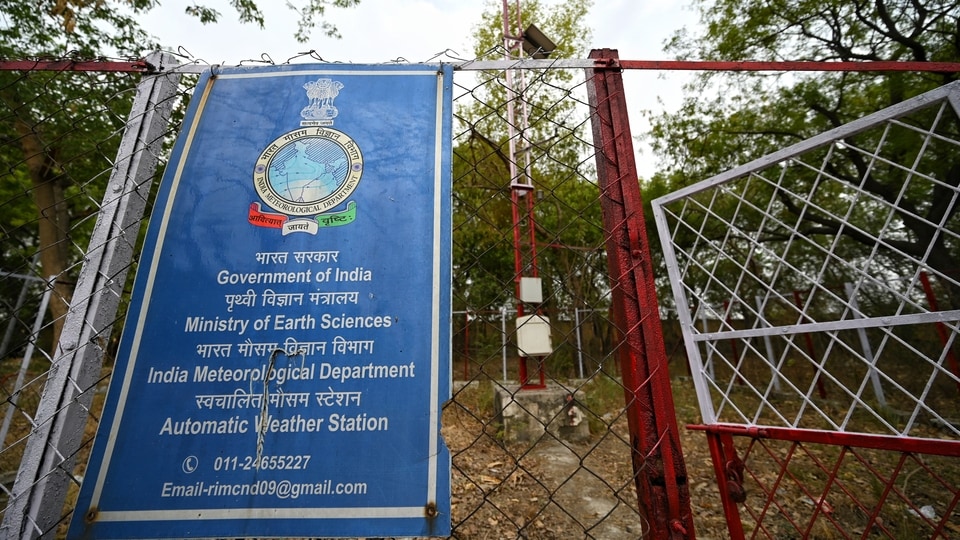
What are Automatic Weather Stations and how do they measure temperatures?
Since its establishment in 1875, the IMD has been recording weather parameters like air temperature, humidity, pressure, rainfall, and wind speed and direction at conventional observatories. Currently, IMD operates over 550 surface observatories for weather forecasting, but this manual network is insufficient for continuous monitoring of weather systems like cyclones and monsoons.
ALSO READ- Monsoon to hit Kerala, parts of northeast India in 24 hours: IMD
To improve this, IMD has expanded its network with Automatic Weather Stations (AWS) to reduce human intervention. Since the summer of 2022, IMD has installed AWS at 15 new locations across Delhi and NCR, enhancing weather monitoring alongside existing manual stations.
AWS measures ambient air temperature, relative humidity, precipitation, wind speed, and wind direction hourly. These stations automatically observe and transmit weather data, reported in Indian Standard Time (IST) on a 24-hour clock. Ambient air temperature is measured in degrees Celsius using an electrical resistance thermometer.
On May 29, the maximum temperatures recorded by departmental observatories, that are manual, and 15 AWS in Delhi ranged from 45.2°C to 49.1°C, with Mungeshpur reporting an outlier of 52.9°C.
This discrepancy may be due to a sensor error or local factors, and the IMD is currently examining the data and sensors, IMD said in a statement.
ALSO READ- 'Delhi's 52.9°C temperature could be due to error': IMD says it will examine data
Which measuring stations' data should be considered final?
Temperature variations within urban areas are influenced by local factors such as proximity to water bodies, barren land, concrete, dense urban clusters, and green areas.
The five major stations (Safdarjung, Palam, Ayanagar, Ridge, and Lodi Road) have been regularly reporting observations for an extended period. These stations, known as climate stations, provide long-term data that meets all exposure conditions. Data from these five stations should be used to identify trends and extremes, IMD says.
On Wednesday, at the Safdarjung observatory, the maximum temperature recorded was 46.8°C, and the minimum temperature recorded was 29.4°C.
ALSO READ- Delhi-NCR gets rain respite
Delhi weather forecast
Heat wave conditions in Delhi are expected to diminish over the next 2-3 days. This change is due to a gradual decrease in temperature brought about by an approaching western disturbance, rainfall and thunderstorms, and southwesterly winds from the Arabian Sea to northwest India.


