
 E-Paper



Agri minister asks Punjab farmers to adopt diversification, save water
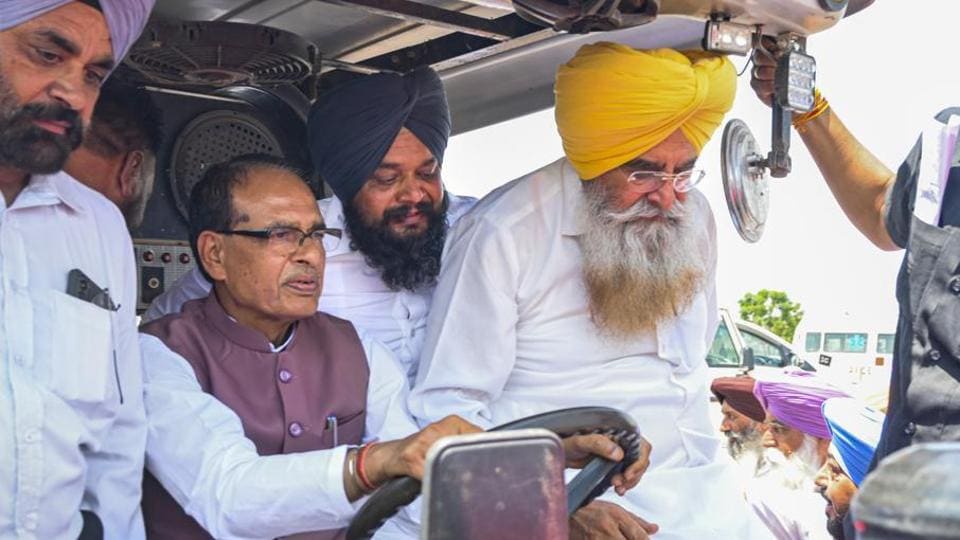
Under the Centre’s ‘Viksit Krishi Sankalp Abhiyan’, the Union minister visited Kheri Gandiyan village in Rajpura, Patiala, where he met a group of farmers who shared their innovative farming practices, besides apprising him of their problems.

 Prefer HTon Google


Union agriculture minister Shivraj Singh Chouhan on Thursday asked Punjab’s farmers to adopt diversification, asserting that it was the need of the hour to grow crops which give profit as well as consume less water.
Referring to the Centre’s decision of suspending the Indus Waters Treaty with Pakistan following the Pahalgam terror attack on April 22, Chouhan said efforts would be made to use the waters of the Indus, Jhelum, and Chenab rivers for Punjab, Haryana and Rajasthan.
He also underlined that the solution to farmers’ issues is possible through discussion and dialogue.
Under the Centre’s ‘Viksit Krishi Sankalp Abhiyan’, the Union minister visited Kheri Gandiyan village in Rajpura, Patiala, where he met a group of farmers who shared their innovative farming practices, besides apprising him of their problems. Later, Chouhan visited the Krishi Vigyan Kendra (KVK) at Rauni.
Chouhan was accompanied by Punjab agriculture minister Gurmeet Singh Khuddian, Punjab Agricultural University vice-chancellor Satbir Singh Gosal and scientists from the Indian Council of Agricultural Research (ICAR).
Lauding the role of Punjab farmers in filling the foodgrain stock of the country, Chouhan said the country has registered an all-time record production in wheat, paddy, maize and soybean this year. “For this, the state has the biggest role and I bow to the land of Punjab,” said Chouhan.
The Union minister said Prime Minister Narendra Modi has a target that crop output should increase, input cost should drop, farmers should get remunerative prices for their crops and they should be compensated if they suffer any loss.
Referring to his interaction with the farmers, Chouhan said he was impressed by the direct seeding of rice technique being used by farmers and said he would like to urge other farmers to opt for DSR for less water consumption. “I have been apprised of good crop practices, be it direct seeding, mushroom farming, making silage,” he said.
Replying to a question, Chouhan said the crop diversification programme is the need of the hour. “We should grow crops which give profit as well as consume less water,” he said.
Earlier, he asked farmers to experiment with growing fruits, vegetables and other crops. “Crop diversification is an important issue. And what are those crops which can generate more income? I am not saying that wheat and paddy will not be sown. That will be grown. We can make experiments towards growing mushrooms, fruits and vegetables,” he told farmers.
As far as the Indus Waters Treaty is concerned, he said it is our water. “Giving 80% water of Indus, Chenab and Jhelum to Pakistan at that time was not justified. Punjab, Haryana and Rajasthan require water and that water is ours. Now we will utilize that water for our farmers,” Chouhan said.
Referring to complaints about fake pesticides, Chouhan said the government will frame a new law, making a provision for stringent action against any company that makes fake pesticides and supplies to farmers.
Farmers’ concerns to be addressed
When farmers said alternate crops were purchased below the minimum support price, forcing them to stick to the conventional wheat-paddy cycle, the minister assured them that the Union government would look into the issue of procurement below MSP.
Farmer Harwinder Singh Harpalpur said, “When we opt for moong or maize, which are good alternative crops for diversification, we don’t get good prices. We have to sell them below the MSP. This needs to be addressed at the earliest.”
Swaran Singh, a farmer from Kherpur Jattan in Patiala, said: “Farmers are switching to maize as it is a good alternative to conventional wheat and paddy. But farmers should not be forced to sell it below the MSP.”
The farmers claimed that they had to sell maize far below the MSP of ₹2,225 per quintal during the 2024-25 marketing season.
This year, the Centre has increased the MSP for maize to ₹2,400 for the 2025-2026 season.
Urging farmers to opt for the technique of direct seeding of rice (DSR) against the conventional transplantation method to conserve groundwater, Chouhan said that groundwater levels in the state have reached dangerous levels, therefore, they should opt for DSR method which saves groundwater.
Shortage of DAP highlighted
Farmers said that the Centre had failed to ensure adequate di-ammonium phosphate (DAP) fertiliser ahead of the sowing of paddy and maize and check private players from indulging in black marketing.
Farmer Baljinder Singh from Maru village said: “There is an acute shortage of DAP. Farmers are helpless. The Union and state governments know how much DAP is needed by farmers during the season, but they didn’t provide enough.”
Punjab minister Khudian said, “I have informed the Union agriculture minister and he has assured supply in the coming days.”
Khudian said while the requirement was 90,000 metric tonnes, only 39,000 MT has been received so far.
On the issue of stubble burning, Chouhan said scientists should develop paddy varieties that leave less residue so that farmers don’t need to burn stubble.


