
 E-Paper



Himachal monsoon mayhem: Experts points to construction boom, poor planning besides climate change
Former director of the Geological Survey of India (GSI) and consultant with the Himachal’s energy department, LN Aggarwal, said that one of the primary reasons for landslides in the Himalayas—particularly in Himachal Pradesh—is road cutting

 Prefer HTon Google


Rain related fury this monsoon season has wrecked Himachal with colossal damage to lives and property. While 98 people have died since the onset of monsoon since June 20, 34 people are still missing, even as dozens of houses, roads, along with other structures have been harmed with the state suffering a loss of ₹800 crore.
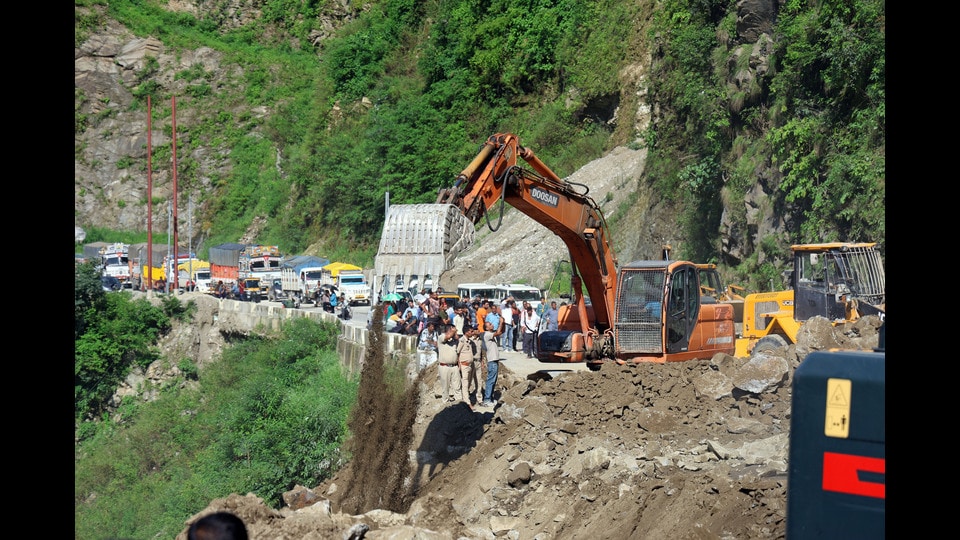
But this is not something new, Himachal has been grappling with this issue for the past many years now. With climate change being one of the reasons, the experts have also pointed to unchecked construction, flawed development models, and ecological disregard, a leading reason for this.
These recurrent incidents of cloudbursts have also forced the government to push for their study. Apart from this the state is mulling to bring in a legislation to check unplanned construction along with checking unscientific muck dumping that is leading to damages and stress on a scientific mechanism for its disposal to prevent further damages.
In future incidents of cloudburst and heavy rains may increase
Elaborating the term, Dr Suresh Atri, principal scientific officer, department of environmental science and technology, said when more than 100 mm of rain falls in a limited area in a very short time, it is called ‘cloudburst’.
“The narrow valleys, hilly areas and areas with weak soil here are not able to withstand the onslaught of heavy rain. Owing to global warming the temperature is increasing and so are these incidents,” he said.
Dr. Atri said that while forests are important for the environment, planting too many trees without planning can also be harmful. “On one hand, thousands of trees are being cut in the name of development, on the other hand, efforts are being made to compensate for the loss by planting trees, which is sometimes not balanced,” added Atri.
Cautioning that in future, incidents of cloudburst and heavy rains may increase further, Atri said: “In such a situation, it is very important that before building houses or roads, there should be a complete scientific investigation, the drainage system should be repaired and tampering with the environment should be reduced. Governments should plan infrastructure in accordance with climate change. Where there is sandy soil, or where construction is taking place on the banks of rivers and steep valleys, geological and ecological testing should be mandatory first,” said Atri.
Unplanned construction, unscientific road cutting need to be checked
Former director of the Geological Survey of India (GSI) and consultant with the Himachal’s energy department, LN Aggarwal, said that one of the primary reasons for landslides in the Himalayas—particularly in Himachal Pradesh—is road cutting. “When roads are carved into stable slopes, the natural top-to-bottom alignment of the hill is disturbed. The hills in this region are made up of layered rock formations. Road construction often exposes these layers and joints, a process known as “daylighting”, bringing them to the surface. Many of these joints contain clay and silt, which act as natural slip surfaces. When water seeps through these layers, especially during heavy rainfall, it reduces their stability and increases the likelihood of slipping,” he said.
Aggarwal, who has decades of experience in geosciences, said that once these slopes are cut, they lose their natural support and without adequate engineering measures, the exposed beds begin to slide. “Roads are often cut indiscriminately, without proper geotechnical assessment, further increasing the risk of landslides,” he said.
He also outlined another contributing factor, which he said is the construction of tunnels through these rock formations. Tunneling disturbs the internal stability of the hills. The Himalayas, being the youngest mountain range, are largely composed of unconsolidated and loose materials, making them vulnerable to landslides.
“Tectonically, the region is highly active and contains major thrusts and fault lines—large fractures formed due to ancient tectonic forces. In areas like Mandi and Thunag, older rocks have been pushed over younger ones due to thrust faults. These disturbed zones are characterized by crushed rocks that create weak, slip-prone layers,” Aggarwal said.
“Continuous rainfall further destabilises these unconsolidated materials, gradually causing movement. In many parts of Himachal, one can observe trees growing at an angle rather than upright. This indicates gradual soil movement under the surface. Once the soil becomes saturated with rainwater, the chances of a sudden landslide increase significantly,” he added.
Professor Ambrish Kumar Mahajan, who heads the department of geology at the Central University of Himachal Pradesh (CUHP) outlined several reasons behind the rising incidence of landslides in the hill state. “There are several contributing factors. One of the major reasons is the increased intensity of rainfall in recent times due to climate change. Rainfall events have become shorter but more intense, which puts additional stress on the fragile mountain ecosystem of the state,” he said.
“States like Himachal and Uttarakhand have fragile mountains. Unplanned urbanisation and vertical cutting for roads and other infrastructure further destabilise the terrain, making it more vulnerable to landslides. We must also ensure that riverbeds are not encroached upon by construction of any kind. A poor drainage system only exacerbates these issues,” he added.
Tikender Singh Panwar, an expert on urban transition based in Shimla said, “Extreme weather events that took place once in a century are now occurring more frequently. These disasters are not random. There is a need to identify vulnerabilities, map them and not build at all in landslide zones.”
BOX:
Cloudbursts Landslides Flashfloods
2025 22 17 31
2024 12 46 39
2023 27 5,502 83
2022 14 94 -
2021 7 87 16
2020 9 18 -


