
 E-Paper



How canopy at India Gate has evolved
Modi will on Thursday inaugurate Bose’s statue along with the Kartavya Path (erstwhile Rajpath) from Rashtrapati Bhavan to India Gate as the revamped Central Vista opens to the public

 Prefer HTon Google


Ahead of Netaji Subhas Chandra Bose’s 125th birth anniversary on January 23, Prime Minister Narendra Modi announced plans to install a statue of the freedom fighter at India Gate “as a symbol of India’s indebtedness to him”.
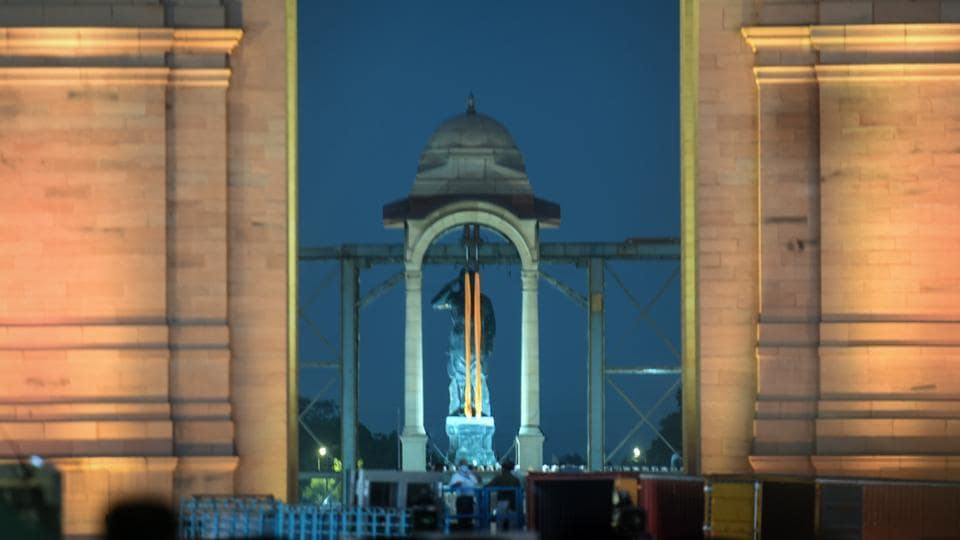
The announcement followed the inauguration of Bose’s hologram statue at India Gate’s canopy until the completion of a permanent one. Modi will on Thursday inaugurate the statue along with the Kartavya Path (erstwhile Rajpath) from Rashtrapati Bhavan to India Gate as the revamped Central Vista opens to the public.
The canopy once housed the statue of British monarch King George V. In their book ‘New Delhi: Making of a Capital’, authors Malvika Singh and Rudrangshu Mukherjee write the canopy along with the king’s statue came up in the shape of a memorial after his death in 1936, 500 feet from the war memorial. It was set on a pedestal in a circular pool of water.
Four pillars held up a cupola under which the king’s white marble statue was placed from where his “spirit” could survey the city he was instrumental in building, write Singh and Mukherjee.
Designed by British sculptor Charles Sargeant Jagger, the marble statue was unveiled in 1939. In less than 10 years, the British left India. The statue was removed after independence. The vacant cupola served as an aesthetic accompaniment to the memorial arch (India Gate).
In an article, historian Narayani Gupta wrote that even after the transfer of power, the marble statue ensconced in the canopy was allowed to stay till 1968. It was shifted to the Coronation Park after it was partially damaged during a public demonstration against it.
Prime Minister Indira Gandhi opposed the suggestion to have a statue of Mahatma Gandhi under the canopy. Governments turned down the proposal in 1969, 1979, and 1982. In June 1989, it was announced that a statue of Mahatma Gandhi would replace that of George V on the Mahatma’s birthday. But by September, the proposal was shot down again.
Gupta writes that Ramachandra Gandhi, grandson of Mahatma Gandhi, was of the view that the canopy should be allowed to remain unoccupied forever to symbolise India’s resolve to not set up an imperial successor state. Nearly 54 years after the removal of George V’s statue, Bose’s sculpture will be unveiled.
Arun Yogiraj-led team of sculptors carved the jet black 29 feet granite statue of Bose from a monolithic block weighing 280 MT.


