
 E-Paper



‘Mumbai challenges the education we received as ecologists in Europe’
European couple on 12,500-km cycling journey are surprised about leopards living in the heart of the city

 Prefer HTon Google


Mumbai: In the last 15 months, Slovakian Hanna Ollos (29) and her German partner Jonas Sommer (30) have cycled through 13 countries on a mission to document all that they can about biodiversity conservation across Eurasia. After travelling 12,500 kilometres through Germany, Czech Republic, Austria, Slovakia, Hungary, Romania, Bulgaria, Turkey, Georgia, Pakistan, Armenia and Nepal, the two ecologists found themselves in Mumbai this weekend.
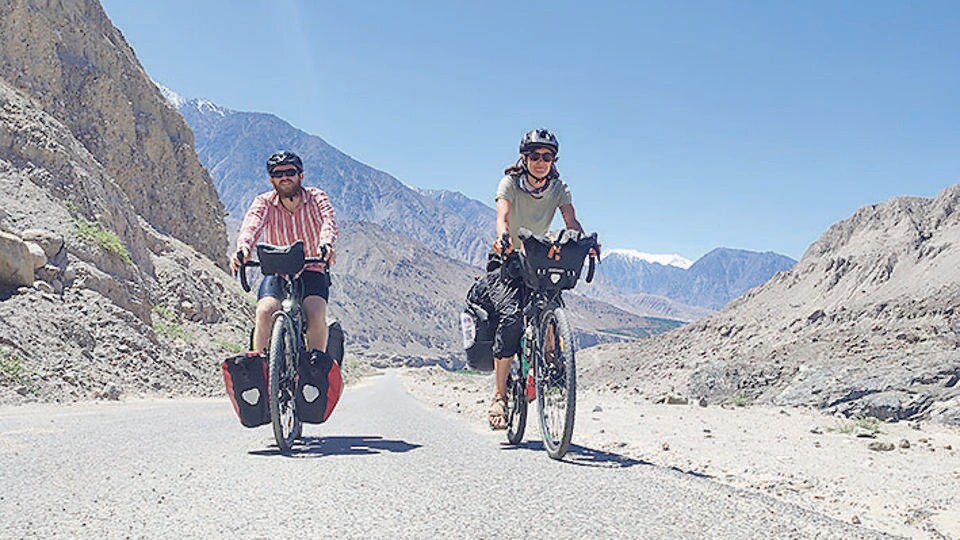
The couple’s ‘Biking 4 Biodiversity’ project will see them cycle further east into Bangladesh, Myanmar, Vietnam, Malaysia and finally Singapore over the next several months, but for now they are overwhelmed by the sensory onslaught of the city: the noise, heat, scents and crush of people in the street.
“We were not sure whether we would come to Mumbai since Indian cities are not very cycle-friendly,” said Ollos. “But soon after we arrived in India, we heard that Mumbai had a very large number of leopards in the heart of the city at Sanjay Gandhi National Park. We read that this was the highest density of leopards anywhere in the world, and this was one of the things that drew us here. We are actually being hosted by a cyclist who lives quite close to the park.”
Although they have yet to spot one of Mumbai’s famous big cats, Ollos and Sommer said they were fortunate to get a guided tour of the Bombay Natural History Society’s conservation education centre, near Film City in Goregaon East, which is contiguous with the leopards’ larger SGNP-Aarey habitat.
“We have been to seven Indian states and seen some beautiful wildlife sanctuaries and national parks since February, but we were also keen to see this unique landscape,” said Ollos. “It challenges the kind of education we received as ecologists in Europe, where we are taught about urban areas and wild areas being two separate entities. A large carnivore living so close to humans is unimaginable in a metropolitan European city.”
The two also drew strong parallels between Mumbai’s leopards and the crocodiles in the Vishwamitri river of Baroda, which they visited earlier this month. Several hundreds of these reptiles have learnt to adapt to challenging conditions, including untreated sewage and dumping of waste into their habitat. They are different species, but their fates are heavily dependent on the kind of conservation efforts that people, especially local communities, will decide to take in the future.
“So even though leopards are thriving, we also know that their habitat is shrinking,” said Sommer. “More development is taking place within this area, and the limits of what is legal and what is not are being tested, which creates a precarious situation. We’ve observed this predicament across India, be it in the conservation of tigers in Uttar Pradesh or lions in Gujarat.”
In sum, the couple’s experiences in India have elicited mixed reactions as far as conservation science goes. “I think the West has a lot to learn from Indians’ high tolerance and acceptance of wildlife,” said Sommer. “On the other hand, conservation education needs to be boosted, and environmental pollution is a real threat to biodiversity that is probably not taken very seriously. It is a bit heartbreaking to see cows on the street eating garbage.”
The two also spoke about a key difference between their travels in Europe and South Asia: the issue of international cooperation. For example, while travelling in the West, they noticed that ecology and conservation projects were being implemented in tandem by multiple EU countries. “But in Pakistan, not many experts know about wildlife conservation in India, and vice-versa,” said Ollos.
Ollos added that they had met a scientist who was working on black buck conservation in Pakistan, who followed Indian news closely because there are black buck populations in Gujarat and Rajasthan. “But because of the political situation, there can be no cooperation,” she said. “It was jarring to see the Indo-Pak border wall and think of how much natural species migration this division has impacted.”


