
 E-Paper



Ecostani: Dying, melting glaciers have served a warning. Do we care?
In all scenarios, glaciers lose mass rapidly over decades and then continue to melt at a slower pace for centuries — even without additional warming.

 Prefer HTon Google


A glacial collapse buried part of a village in Birch, Switzerland, on May 28. Many miles away, in Nepal, Yala glacier was declared dead on May 12. A new study by an international team of researchers, published on May 30, warned that if global warming targets under the Paris climate deal exceed, the non-polar glacial mass would diminish significantly — by almost half.
The Himalayas, which is termed as the third Polar glacial mass on the planet, is no less affected. According to studies by the Geological Survey of India (GSI) and the Indian Space Research Organisation (ISRO), the majority of glaciers in the Himalayan range are melting at a faster rate than it was prior to 2010.
A study in April 2025 by International Centre for Integrated Mountain Development (ICIMOD) said that annual winter snow in Himalaya in the past four years has been lowest in decades and in May it declared Yala glacier to be dead, the first for Nepal, and a rare glacial event.
To add to this, a new study by Climate Trends released on May 31 showed that concentration of black carbon (BC) emissions in the mountain range, especially Eastern and Central Himalayas, was increasing, which could have implications for water supply for 2 billion people in South Asia.
According to the report, the average snow surface temperatures in the Himalayan snow peaks have increased by more than 4°C over the last two decades, from an average of -11.27°C (2000–2009) to -7.13°C (2020–2023). Over the 23-year period, the overall mean temperature increase was -8.57°C, meaning faster melting of snow. Black carbon, whose deposits have increased, acts like a heat lamp on snow, it darkens the surface, accelerates melting, and triggers a dangerous feedback loop.
The latest World Meteorological Organisation (WMO) report has warned that there is an 80% chance that a year between 2025 and 2029 will be warmer than the record-breaking 2024 and an 86% likelihood that another year will exceed 1.5°C above pre-industrial levels, the threshold beyond which climate change will make human life more difficult.
The WMO said the 1.5°C (and 2°C) level specified in the Paris Agreement refers to the long-term level of warming inferred from global temperatures, typically over 20 years. Temporary exceedances of such levels are expected to occur with increasing frequency as the underlying rise in global temperature approaches the level. The report concluded that any additional “fraction of a degree of warming” drives more harmful heatwaves, extreme rainfall events, intense droughts, melting of ice sheets and glaciers, and heating of the ocean.
In South Asia, it would mean more water in the Indus, Ganga and Brahmaputra, for some decades, which might eventually turn dry. Around 40% of India’s Gross Domestic Product is dependent on people and industry in these river basin regions.
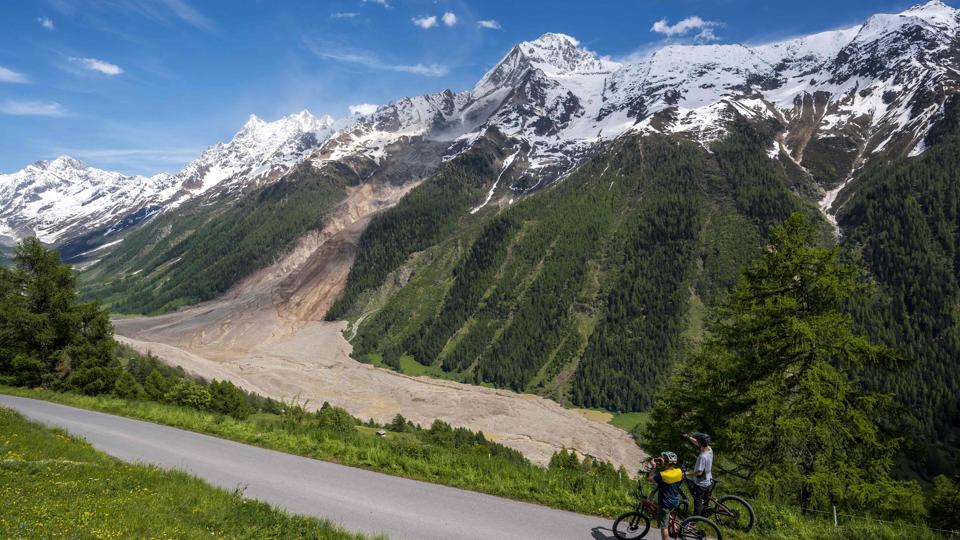
The landslide that buried most of a Swiss village this week is just one of the several examples across the world how global warming was causing glacier collapses. Officials said that in Switzerland, the mountainside gave way on May 28, 2025, near the village of Blatten, in the southern Lötschental valley, because the rock face above the Birch Glacier had become unstable after mountain permafrost melted, causing debris to fall and cover the glacier in recent years. No one was injured.
In 2016, a glacier in Tibet’s, Aru mountain range suddenly collapsed, killing nine people and their livestock, followed a few months later by the collapse of another glacier. There also have been collapses in Peru, including one in 2006 that caused a mini tsunami; most recently, a glacial lagoon overflowed in April, triggering a landslide that killed two.
The Glacial Lake OutBurst FLow (GLOF) caused by faster melting of glaciers caused massive flooding in Rishi Ganga and Dhauli rivers in Chamoli district of Uttarakhand in February 2021, killing 80 people. Two hydro power projects were badly damaged due to the heavy flow of debris.
The study by ETH Zurich told us what could happen to glaciers with the present pace of global warming with 54% of the non-polar glaciers likely to “diminish significantly”. However, if warming is limited to 1.5°C, at least 54 per cent could be preserved—more than twice as much ice as in a 2.7°C scenario. The findings, published in the prestigious journal Science, said even if global temperatures were stabilised at today’s level of 1.2°C, an estimated 39% of global glacier mass would still be lost compared to 2020 levels — contributing over 10 centimetres to global sea-level rise.
The study is the work of an international team of 21 scientists from 10 countries using eight glacier models to calculate the potential ice loss from more than 200,000 glaciers outside Greenland and Antarctica. The team evaluated a wide range of global temperature scenarios, assuming that temperatures would remain constant for thousands of years in each scenario.
In all scenarios, glaciers lose mass rapidly over decades and then continue to melt at a slower pace for centuries — even without additional warming. This long-term response means glaciers will continue to feel the effects of today’s heat far into the future, gradually retreating to higher altitudes before reaching a new equilibrium.
Glaciers are good indicators of climate change because their retreat allows scientists to measure impact of climate change. But, since they adjust over longer timescales, their current size vastly understates the magnitude of climate change that has already happened. “The situation for glaciers is actually far worse than visible in the mountains today,” said the study’s co-lead author Lilian Schuster from the University of Innsbruck.
Beyond contributing to sea-level rise, glacier loss has far-reaching consequences. It threatens freshwater availability, increases the risk of glacier-related hazards such as floods and landslides, and jeopardises glacier-fed tourism economies. These cascading impacts will be felt across regions and generations.
A high-level meeting on glacial melt was held this week in Dushanbe, Tajikistan, to discuss the impact of global warming on glaciers, which have already melt around 40% since the last ice age and most of it has happened in the past 400 and 700 years. At the meeting, which is a welcome step, there was a discussion on an action plan to reduce glacial melt. Whether it would fructify remains a big future question like several other environmental agreements.
Although there has been a lot of science and research of glacial melt, negligible policy action has been seen from the global community to protect mountain biodiversity and forests. There is no incentive for hill communities to protect the mountains, no additional prohibitive taxes are being imposed on pollution vehicles entering ecologically fragile mountainous regions and heavy use of pesticides have already polluted ground water in several mountain regions of the world.
Unlike people’s movements against air pollution, there is no collective voice to protect glaciers and mountains that provide water and life to billions. Civil society bodies and so-called climate champions have failed glaciers the most. Saving glaciers needs a new trans-continental approach with active people participation on preserving local ecology and controlling emissions.


