E-Paper



Weather Bee: India's northern snow pack at yet another record low this snow cycle
Decreasing snow pack in India's mountains signals rapid climate change and contributes to warmer northern plains.

 Prefer HTon Google


Earlier this week, HT highlighted that most of India was experiencing temperatures that suggest an early arrival of spring. Some of this has to do with a deficit in rainfall across India. However, another factor behind warmer temperatures in northern India is that the winds blowing from the north aren’t cool enough. Satellite data suggests that this is because India’s hilly regions in the north are experiencing yet another year of record-low snowpack five months into the snow cycle.
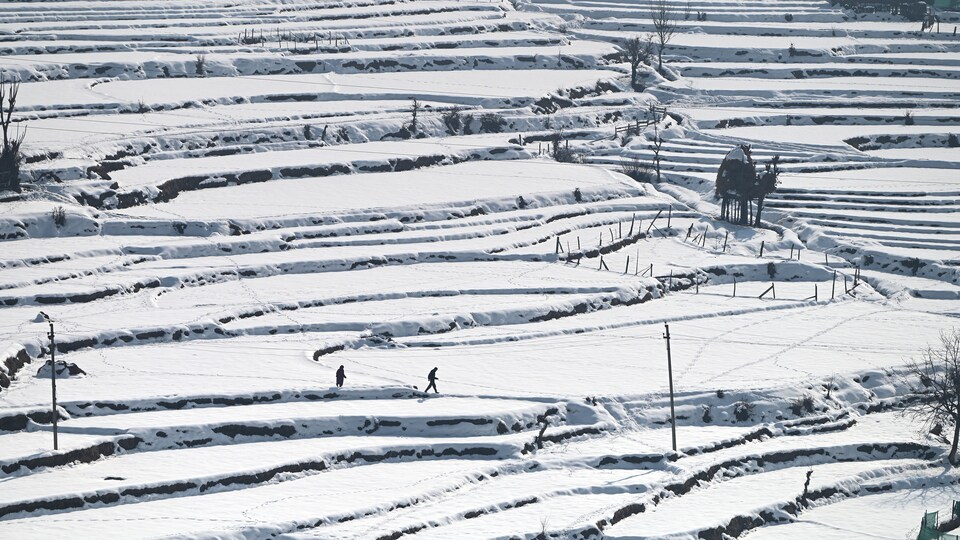
As HT had highlighted in a February 18 story, according to data from the India Meteorological Department (IMD), there has not been much precipitation in most of northern India after January 18. This includes the hilly regions of northern states, where some of the precipitation can be snow. As can be expected from this, the average snow pack over this region is unusually low for this time of the year.
Snow pack, which refers to the accumulation of snow, is measured in its water equivalent or snow water equivalent (SWE). The average SWE over India’s hilly states in the north was 297.1 mm on February 19, the last date for which this satellite-derived estimate is available from NASA. In comparison, the average SWE for February 19 for the 2001-2020 period (2001 is the first year for which February data is available) is 402.7 mm. This means that over a quarter (26%) of the usual snow pack is missing on the mountains.
The big deficit in snow pack right now means that this is the lowest snow pack for this time of the year for India’s hilly states, which has been the case for most of the current snow cycle. What is worrying about this trend is that the 2024-25 snow cycle is not unique in this. Similar records have been made almost every year for the past few years, only to be broken the next year. In other words, snow pack over India’s northern states appears to be declining long-term.
To be sure, snow pack usually starts building in October and peaks only around the middle of April. Last year, this peak arrived only on May 1. This means that there is still some time for snow pack to build over the coming months. However, even the annual peak of snow pack in the past five snow cycles was far below the usual, a trend that underlines the long-term decline of snow in India’s northern reaches. Moreover, a fast-paced recovery late in the season can mean disasters, such as avalanches and landslides.
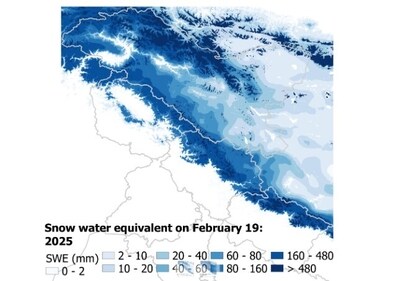
Another caveat to keep in mind while reading the trends above is that the average is calculated here for a region somewhat bigger than the political boundaries of India and also includes some regions that don’t receive snow at all. The region for which the average has been calculated can be seen in the maps below. However, these maps also show that the trend in the average is broadly true for the snow pack within India’s political boundaries. While the lower reaches – which usually do not have a very high snow pack – are almost completely devoid of snow, even the upper reaches do not have the usual amount of snow.

What do these trends in snow pack mean? As is obvious, a changed cycle of snow pack implies that the climate of the mountains is changing fast. In fact, decreasing snow pack also acts as a feedback mechanism. Less snow means darker surfaces, which absorb more sunlight and add to the rate of warming. Given the fact that the snow in the mountains also regulates temperatures in India’s northern plains, decreasing snow pack is also likely to help warm the plains of northern India in the winter season.