E-Paper



Modi’s Vadnagar school begins new chapter
The Archaeological Survey Of India took over restoration duties in 2018, and work is on to add digital infrastructure such as smart boards

 Prefer HTon Google


Vadnagar Kumar Shala Number 1, tucked away in a corner of a Gujarat town 70 kilometres away from state capital Gandhinagar, is a storied school. It was built in 1888 by donations received from SayajiRao Gaekwad III, the Maharaja of Baroda between 1875 and 1939. It became a key symbol of the town, before falling into disrepair, with its functioning halted in 2018.
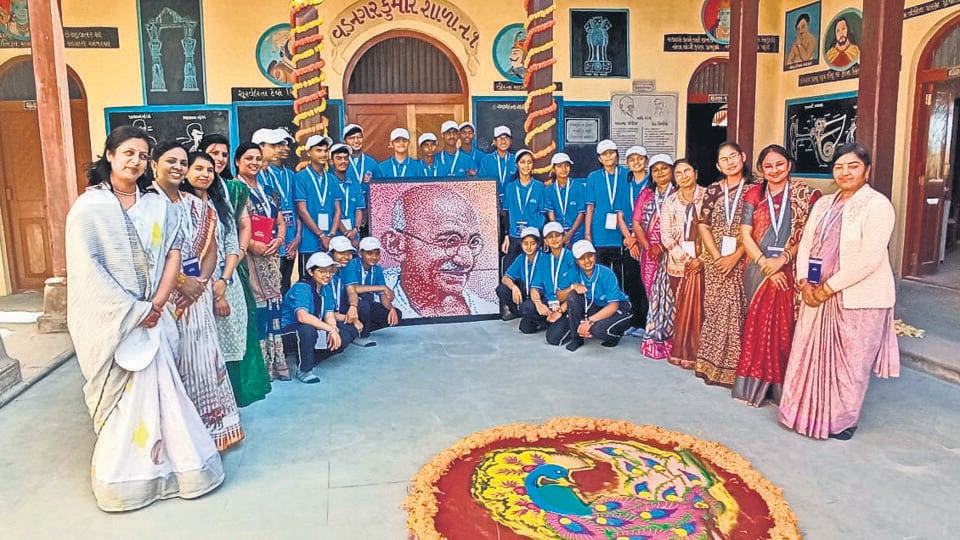
The Archaeological Survey Of India took over restoration duties in 2018, and work is on to add digital infrastructure such as smart boards.
But now, Vadnagar Kumar Shala Number 1 has a new name and a new purpose. It is called the Prerana(inspiration) school, and will play host to groups (each has 20 students) that will arrive in its halls, in turn, for a seven-day study tour to embark on a “journey of inspiration, innovation, and self discovery”.
It is a journey that is inspired by the schools most prized alumnus — Prime Minister Narendra Modi.
In June 2023, the union ministry of culture first announced its plan to launch the “Prerana(inspiration) programme to inspire youth in the country to become “catalysts of change.” In early January, the ministry launched an online portal where students of classes 9 to 12 from anywhere in the country could apply for the programme, to be selected in a three stage process that includes assessment based on short videos, writing samples and other forms of “creative expression” on subjects like “My Vision of India@2047”, and even a personal interview.
Between January 15 January 22, the newly revamped Prerana School saw its first pilot batch of 20 students. They were ten boys and ten girls, like every batch will have, and they came from six different regions, Maharashtra, Madhya Pradesh, Haryana, Rajasthan, Gujarat and the union territory of Daman. They walked into the two-floor building painted a bright yellow, and occupied its eight classrooms, four situated on the ground floor, and four on the top, forming an ampitheatre-like structure. They stayed in an annexe at the back called the Prerana Kendra that serves as the residence for students, mentors and other speakers.
A girl student from Udaipur, who did not want to be identified said they were inspired to be in the school where Prime Minister Modi studied. “I am delighted to be in Gujarat for the first time…like our Prime Minister, I aspire to dream big for my country and strive to inspire and assist people,” the class 11 student said.
“It has just been a few days but the most important lesson I’ve learnt here is the constant pursuit of one’s path, much like our Prime Minister, even in the face of the mightiest challenges. I have a profound interest in history, and I explored a nearby archaeological site yesterday. I learn that unlike civilisations like Harappa which were eventually abandoned, Vadnagar is a town that has had continuous habitation for centuries,” the student added.
Senior government officials said that the curriculum, anchored by the Indian Institute of Technology, Gandhinagar is rooted in nine value based themes: swabhiman (self-esteem); vinay, shaurya and sahas (humility, valour, and courage); parishram and samarpan (effort and dedication); karuna and sewa (compassion and service); vividhta and ekta (diversity and unity); satyanishtha and suchita (truthfulness and cleanliness); navachar and jigyasa (innovation and curiosity); shraddha and vishwas (faith and trust); and swatantrata and kartavya (freedom and duty).
The first batch was tasked with creating a portrait of Mahatma Gandhi using 10000 push pins, followed by discussions on his life and contributions. They crafted an image of Swami Vivekananda that entailed solving 625 Rubik’s Cube puzzles in a three hour period. They studied speeches by leaders such as Jawaharlal Nehru, Abdul Kalam and Atal Bihari Vajpayee, taught to them by educators from Kendriya Vidyalayas and JawaharNavodaya Vidyalaya’s, themselves trained as mentors by IIT Gandhinagar. Jay Thakkar, content researcher at Centre for Learning, IIT Gandhinagar, closely associated with the project said, “Drawing lessons from the Kutch earthquake in 2001, where thousands of lives were lost, and witnessing the region’s remarkable resurgence into one of the most industrialized and developed areas of the country, the present batch was exposed to a diverse range of ideas. This included creating a charka that generates electricity and producing their own radio, fostering an environment that aims to instil leadership qualities in them.”
A central motif at the institution is Prime Minister Narendra Modi himself. On one wall, is a board that details the Prime Minister’s life in seven phases- youth, awakening, pracharak, political calling, sevak of Gujarat, sevak of Bharat and global leader.
Speaking to HT over the phone, Prahlad Modi, the prime minister’s younger brother said: “From our family home, situated close to the school, all five brothers — Narendrabhai, Somabhai, Amrutbhai, Pankajbhai, and I — began our educational journeys at the Vernacular school. Our uncle and cousin brothers also attended the same school. The Prime Minister himself attended the school from Class 1 to Class 7. It must have been between 1956 and 1963.” After class 7, the Prime Minister studied at the BN High School in Vadnagar.
The officials added that the curriculum includes success stories of organisations such as ISRO and pivotal decisions made by Prime Minister Modi, such as the surgical strikes. Among the people the study groups meet are those who have known Prime Minister Modi, and there are discussions on Modi’s vision for a new India, emphasizing the important of preserving culture and heritage.
Manish Jain, professor and coordinator at the Centre for Creative Learning, IIT Gandhinagar, where the course was designed, said, “Values are best grasped through experience; they cannot be simply taught. Grooming our children into future world leaders is not an overnight endeavor, and it extends beyond mastering subjects like math and science in school. What better beginning to this journey than immersing them in an environment where India’s most popular and globally recognized leader once studied.”