
Sign in

Next CJI Sanjiv Khanna's parents wanted him to be a CA, not a lawyer: Report

Inspired by his uncle, Justice HR Khanna, who also served as a Justice of the Supreme Court, Justice Sanjiv Khanna chose to pursue law instead.

Published on: Oct 30, 2024, 19:08:35 IST
Share
Share via
  • facebook
  • twitter
  • linkedin
  • whatsapp
Copy link
  • copy link

Justice Sanjiv Khanna, who is set to take oath as the 51st Chief Justice of India on November 11 initially faced parental expectations to become a chartered accountant as they believed a legal career would be challenging.
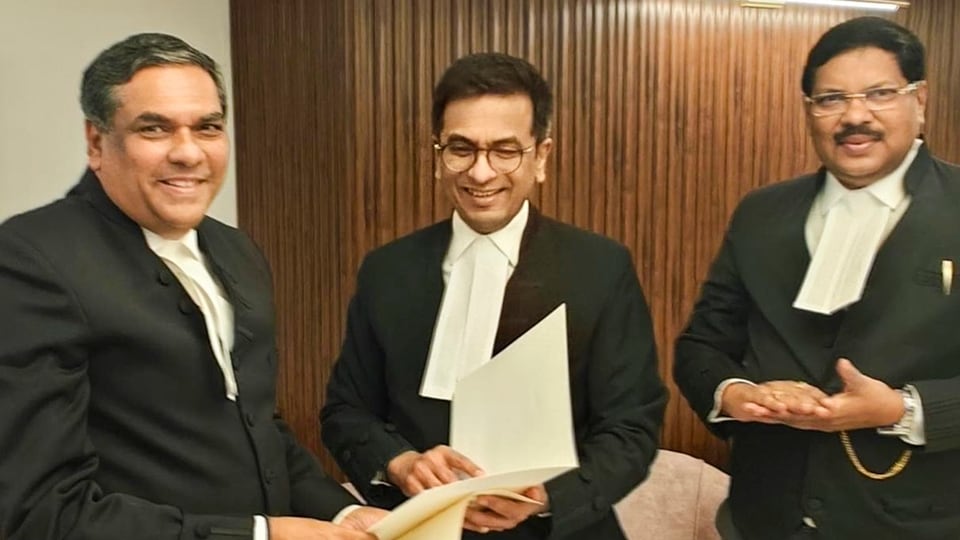
Chief Justice of India (CJI) Justice DY Chandrachud shares a letter of recommendation naming Justice Sanjiv Khanna (L) as his successor. (PTI file photo)

However, inspired by his uncle, Justice HR Khanna, who also served as a Justice of the Supreme Court, he chose to pursue law instead.

“He always considered his uncle an ideal role model and keenly followed his work. Justice HR Khanna not only polished his own shoes but also those of other family members and used to wash his own clothes as well,” NDTV reported, citing sources.

Sanjiv Khanna has kept all of Justice HR Khanna's judgments, notes and registers and plans to gift them to the Supreme Court library once he retires.

On his first day as a Supreme Court judge in 2019, he was in the same courtroom where his uncle served. Although a portrait of Justice HR Khanna is displayed there, Sanjiv Khanna has not yet taken a photo in that space, but he intends to do so before his retirement, the report adds.

He is anticipated to complete his tenure on May 13, 2025. Justice Sanjeev Khanna's mother Saroj Khanna served as a lecturer at Lady Shri Ram College, while his father Devraj Khanna was a lawyer who later became a judge at the Delhi High Court.

Justice HR Khanna served on the bench that issued a unanimous ruling in the landmark “habeas corpus case” of ADM, Jabalpur vs. Shivkant Shukla in 1976.

Following the appointment of Justice MH Beg as the Chief Justice of India by Indira Gandhi's government in January 1977, Justice HR Khanna resigned from his position.

His resignation is widely regarded as a significant moment in the history of India's judiciary, underscoring his dedication to judicial independence and the principles of law.

  • HT News Desk
    ABOUT THE AUTHOR
    HT News Desk

    Follow the latest breaking news, major developments and agenda-setting stories from India and around the world with the newsdesk at Hindustan Times. Operating round the clock, the desk brings together experienced editors, reporters and correspondents to deliver fast, accurate and contextual reporting across subjects that influence public policy, governance, business, society and international affairs. The HT News Desk covers politics, elections, government policies, the economy, business and markets, science and technology, the environment, law and order, infrastructure, education, climate issues and geopolitics, while closely tracking developments across states, institutions and global capitals. The team also leads coverage of major breaking news events, policy announcements, court proceedings, natural disasters, public emergencies and significant international developments. Reports published by the newsdesk are based on information gathered from reporters on the ground, official statements, government agencies, court records, regulatory filings, recognised institutions and other authoritative sources. Stories undergo editorial scrutiny and verification processes to ensure accuracy, fairness and relevance, and are updated as events evolve and additional information becomes available. Whether covering a key political decision in New Delhi, an economic policy shift affecting millions, a landmark court ruling or a major global event, the HT News Desk aims to provide readers with reliable, fact-based journalism that delivers not only the latest developments but also the context and analysis needed to understand their wider implications.Read More