E-Paper



PM Modi, Germany’s Scholz discuss India’s role to end Russia-Ukraine conflict
PM Modi said the India-Germany partnership has emerged as a “strong anchor” at a time when the world is grappling with conflict and uncertainty

 Prefer HTon Google


NEW DELHI: India and Germany on Friday unveiled agreements to ramp up cooperation in defence and security, emerging technologies and migration and mobility as Prime Minister Narendra Modi and Chancellor Olaf Scholz held up the bilateral strategic partnership as crucial for ensuring a free and open Indo-Pacific.
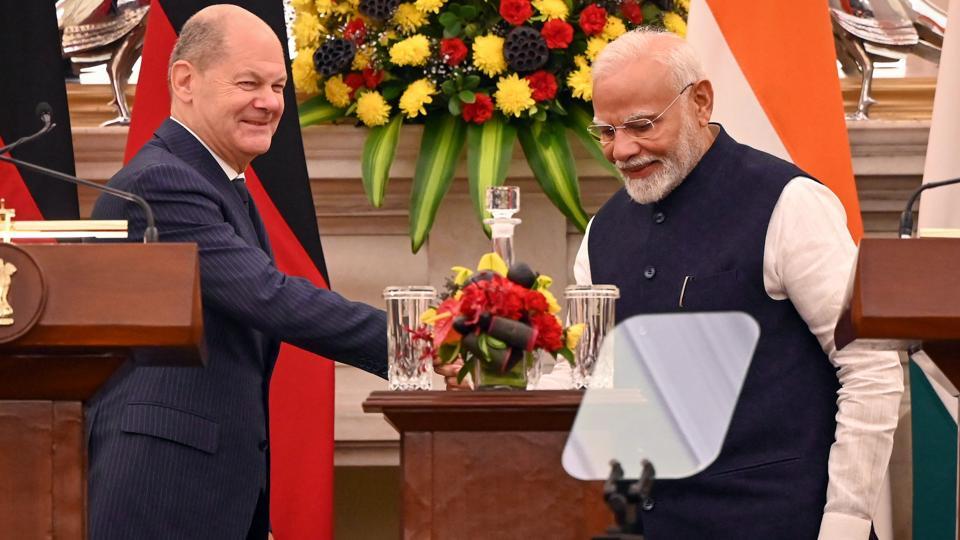
The two leaders jointly chaired the biennial Intergovernmental Consultations (IGC), a framework that has ministers from both sides holding discussions in their respective areas to prepare a roadmap for collaboration over the next two years. Efforts to end the Russia-Ukraine and Israel-Hamas conflicts also figured in the talks, officials said.
In his opening remarks at the IGC, Modi said the India-Germany partnership has emerged as a “strong anchor” at a time when the world is grappling with conflict and uncertainty, and there are serious concerns about the rule of law and freedom of navigation in the Indo-Pacific.
Addressing a joint media interaction after the IGC meeting, Modi said the conflicts in Ukraine and West Asia were a concern for both countries, and India stands ready to make every possible contribution for the restoration of peace.
“We both agree on ensuring freedom of navigation and adherence to the rule of law in accordance with international laws in the Indo-Pacific region,” Modi said, speaking in Hindi.
Scholz noted that the international rules-based order has come under “massive pressure” because of Russia’s attack on Ukraine, and said: “Especially in times like these, it is of the utmost importance that India is an anchor of stability in South Asia.”
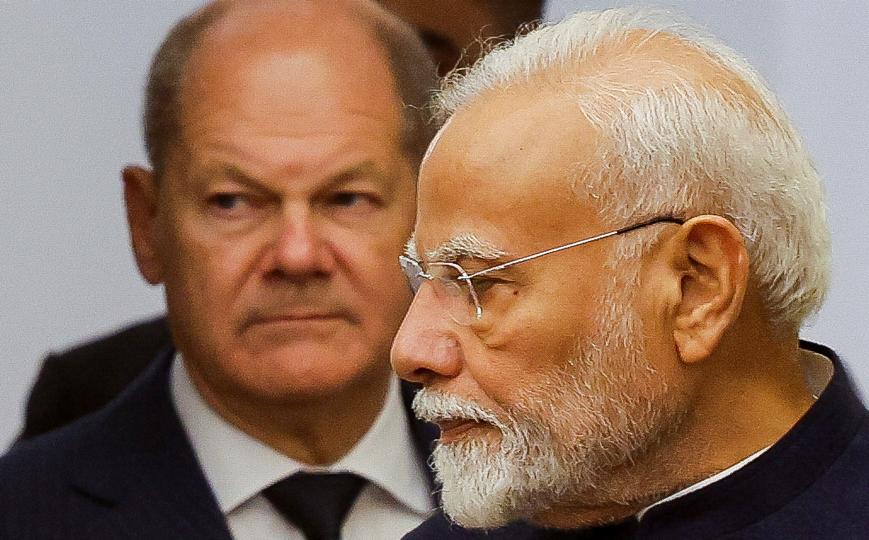
He pointed to the deployment of two German warships in the Indo-Pacific and the joint exercise they had conducted with the Indian Navy and said this underlines that both sides stand for the rules-based international order and freedom of maritime trade.
Besides a mutual legal assistance treaty in criminal matters and an agreement on the exchange and mutual protection of classified information, the two sides unveiled a roadmap on innovation and technology partnership, a joint declaration of intent for research and development of advanced materials and the Indo-German green hydrogen roadmap.
They also finalised a joint declaration of intent in employment and labour, a memorandum of understanding on cooperation in skill development and vocational training, and a joint declaration of intent on a green urban mobility partnership.
As part of efforts to deepen defence cooperation, Germany announced its armed forces will position a liaison officer at the Indian Navy’s Information Fusion Centre in Gurugram, which tracks shipping and illegal activities across the Indian Ocean. Germany will also support India’s efforts to have observer status in the Eurodrone programme, aimed at developing an advanced UAV for France, Germany, Italy and Spain.
Modi noted the mutual legal assistance treaty will bolster joint efforts to combat terrorism and separatist elements, while the agreement on the exchange of classified information is a new step in growing defence and security cooperation that “reflects our deep mutual trust”.
He welcomed Germany’s new “Focus on India” strategy, describing it as a blueprint for modernising the bilateral partnership, and an India-specific “Skilled Labour Strategy”. The innovation and technology roadmap for critical and emerging technologies and skill development will strengthen cooperation in artificial intelligence and semiconductors and help build trusted and resilient supply and value chains, he said.
Scholz raised the conflicts in Ukraine and West Asia at both the joint media interaction and an earlier address at the Asia-Pacific Conference of German Businesses (APK 2024), and highlighted the fallout of Russia’s invasion of Ukraine on the international rules-based order.
“If Russia was to succeed with its illegal, brutal war against Ukraine, there would be repercussions far beyond Europe’s borders. Such an outcome would endanger global security and prosperity as a whole,” he said at the business meeting.
“Let us do whatever we can to bring about political solutions to these conflicts. Solutions that are based on international law and the principles of the UN Charter,” he added.
At the joint media interaction, Scholz pointed to India’s support for a “lasting and just” peace in Ukraine and said he was “pleased about your readiness to make use of the reliable relations you have developed with all parties to contribute to a political solution of the conflict”.
Foreign secretary Vikram Misri told a media briefing that Modi and Scholz had discussed the conflicts in Ukraine and West Asia in “considerable detail”. Modi shared his impressions from recent interactions with the leadership of Russia and Ukraine and provided details of steps taken by India in “pursuing conversations on all sides of the conflict and some of the ideas different actors have been talking about”, he said.
“We are not neutral in this conflict, we are on the side of peace. We stand ready to assist any initiative towards peace, leveraging the ability that we have of being able to engage with all sides in this conflict,” Misri said.
Both sides also agreed on the need to avoid further escalation of violence in West Asia and a ceasefire, release of all hostages, and a political process leading to a two-state solution.