E-Paper



One in three child deaths in Gorakhpur hospital is due to encephalitis
Japanese Encephalitis and Acute Encephalitis Syndrome deaths continue to account for roughly two-thirds of child deaths from all causes.


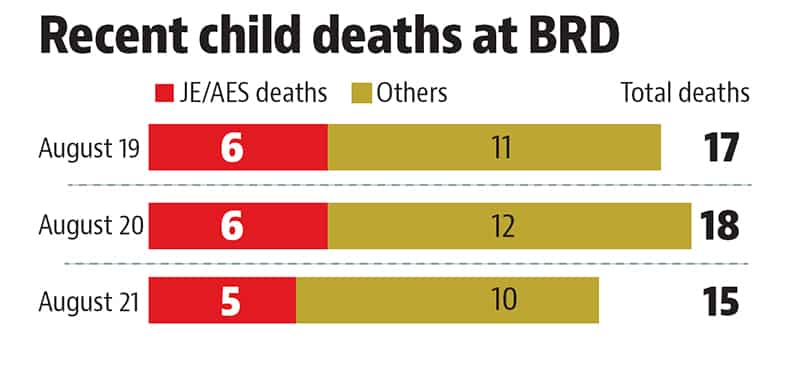
Uttar Pradesh chief minister Yogi Adityanath has ordered criminal action against hospital staff and the gas firm for 30 child deaths between August 9 and August 11. However, 15-18 children continue to die every day at the 950-bed Gorakhpur’s Baba Raghav Das (BRD) Medical College and Hospital.
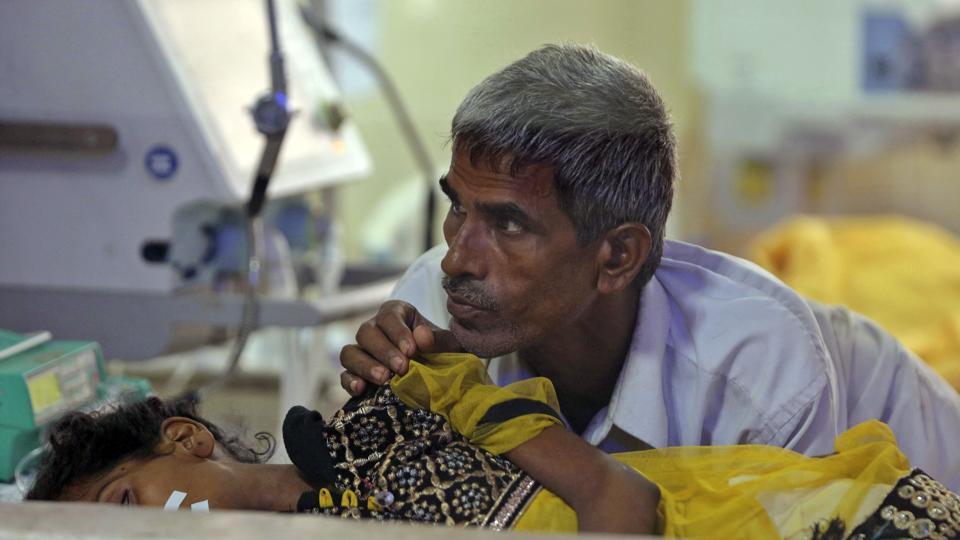
One third of these deaths are due to encephalitis.
Japanese Encephalitis (JE) and the deadlier Acute Encephalitis Syndrome (AES) became the national buzzwords after 30 children died between August 9 and 11 in BRD Medical College, Gorakhpur’s largest government hospital, amid allegations that a private company contracted to supply oxygen cylinders cut supply over a payment dispute.
A total of 97 of the 1,527 child deaths between July 1 and August 14 were from the mosquito-borne Japanese Encephalitis and AES, which is caused by other toxins, viruses and bacteria, among others.
JE and AES deaths continue to account for roughly two-thirds of child deaths from all causes.
Encephalitis is the swelling in the brain that leads to sudden high fever, headache, neck stiffness, disorientation, coma, seizures, spastic paralysis and, finally, death.
From January 1 till August 22, the hospital recorded 625 AES admissions, of which 158 children died. More than 30% of the cases and deaths were reported during July and till mid August.
Of the 2,729 child deaths from all causes in 2016, close to 45% (1,218) occurred when monsoon peaks between July and October.
On August 14, 24 deaths occurred within a single day, when there were no disruptions of any kind.
“On an average, there are between 10 and 20 deaths each day at this time of the year. AES has got very high mortality rate of around 30% and since this is a referral hospital, all the infants admitted in the neonatal wards are brought in when they are critical,” said a senior administrative official, requesting anonymity.
The newly-appointed principal, Dr PK Singh, says, “We get very sick babies because most parents seek local remedies and treatment from quacks before they bring their children to the hospital. Add to it the load of sick newborns and pre-term babies and deaths go up.”
“You might find two to three babies on one bed or two babies in one incubator but that’s because we try not to turn anyone away. We provide the best of care possible under the given circumstances, which is not enough at times,” said Dr Singh.
“Since children are vaccinated against mosquito-borne JE, deaths have gone down. Most deaths are now from AES,” said Dr Harish Tiwari, lecturer, department of community medicine, BRD.