
 E-Paper



Delhi Assembly Election 2020: Countdown begins for pitched Capital contest
On Monday, chief election commissioner (CEC) Sunil Arora announced the schedule of the polls, the results for which will be declared on February 11.

 Prefer HTon Google


Delhi will hold elections to its 70-member assembly on February 8, the Election Commission of India said on Monday, setting the stage for a high-stakes political battle that will pitch the Aam Aadmi Party’s (AAP) campaign to retain power by showcasing its performance against the Bharatiya Janata Party’s (BJP) efforts to wrest the national capital, where it has been out of power for two decades.
The AAP won a remarkable 67 seats in the assembly polls in 2015. The BJP secured only three seats in the polls then, but subsequently won all three municipal corporations and the seven Delhi seats in the 2019 Lok Sabha elections. The Congress, which ruled Delhi for three consecutive terms until 2013 under the late Sheila Dixit, drew a blank in the elections necessitated by the resignation of chief minister Arvind Kejriwal over an anti-corruption bill.
On Monday, chief election commissioner (CEC) Sunil Arora announced the schedule of the polls, the results for which will be declared on February 11. With the announcement, the model code of conduct came into effect. “Political parties will have a good 15 days to campaign. This time, we have taken special care to avoid Sunday as the voting day,” the poll watchdog chief said.
The election schedule comes at a time when the Capital is grappling with law-and-order concerns over the amended citizenship law. The Delhi Police have faced repeated criticism over the handling of the protests, which turned into violent clashes after their action near Jamia Millia Islamia in December. They faced fresh heat on Monday after a mob of masked men ran riot at the Jawaharlal Nehru University (JNU), attacking students and teachers with iron rods and sticks.
In response to a question on the current situation in Delhi, Arora said: “I won’t say we [the EC] are very sanguine, but we are hopeful that they [police] will be able to control the situation (and make it) conducive for polls.” He added, “And in any case in the polling process, if there is some kind of an extraordinary situation, always [there] are provisions for kind of deferring the polls. All these provisions are there. The Constitution empowers ECI to take a call if needed.”
The CEC said that the date had been fixed after interacting with Union home ministry officials, senior Delhi Police officers and chief secretary of the state. “We have written commitments from senior police officers, assuring law and order is controlled and situation is made conducive for the polls,” Arora added.
In its campaign, the AAP has tried to showcase its performance in the Capital over the past five years, with a focus on education — where it claims to have improved government schools — and health care —where it has set up mohalla clinics — as key successes.
The BJP, on the other hand, says the central government took over the process to conferring ownership rights to four million residents of unauthorised colonies because of delays by the AAP government. It passed a legislation in the Winter Session of Parliament to enable the change, and followed it up with a rally, addressed by Prime Minister Narendra Modi, to cite it as an achievement. While the BJP is primarily focusing on the Centre passing a law to grant ownership rights to residents of unauthorised colonies, the AAP is talking about the development work carried out in these colonies during its five-year tenure.
But besides local issues, the election will also have a strong national backdrop. The passage of the Citizenship (Amendment) Act provoked protests in the Capital over the past month, with universities and pockets such as Jamia emerging as centres of opposition. While the AAP and the Congress have criticised the law, claiming it is discriminatory, the BJP has strongly defended it, claiming it is humanitarian in nature by allowing persecuted minorities to find a home. The party has also launched an outreach campaign on the issue. Observers believe a lot will hinge on whether the issue results in a degree of sharp polarisation — primarily on religious lines.
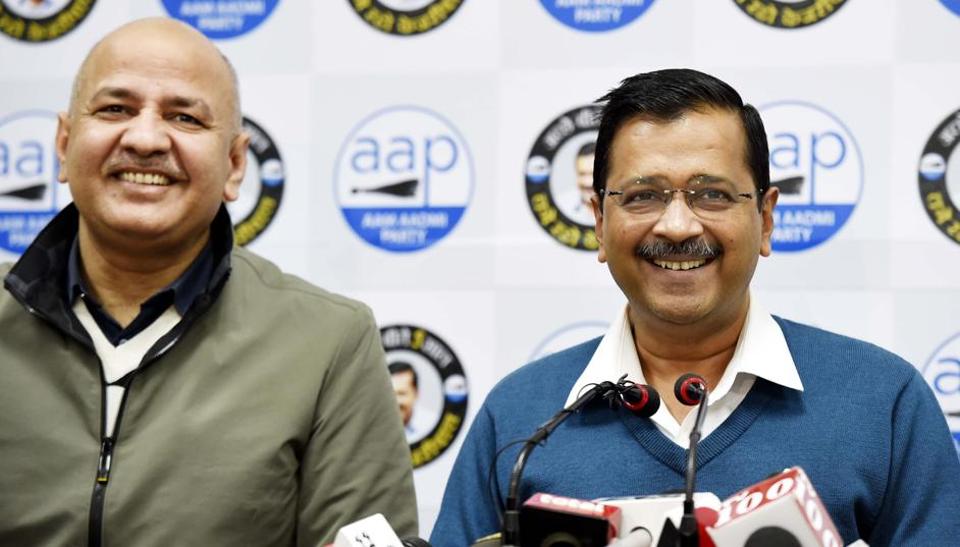
Shortly after the schedule of the elections was announced, Delhi chief minister and AAP convener Arvind Kejriwal said his party will seek votes on the basis of the work done by the government over the last five years. “If I have done work, then vote for me. If I have not done work, then don’t vote for me,” Kejriwal said at a news briefing. He asked the supporters of the BJP and the Congress to vote for Delhi and not for “your political party”.
The BJP, meanwhile, said the ruling AAP’s time in Delhi was up. “AAP has found a new strategy of taking BJP’s criticism in its stride by suggesting that they will implement many of them in the next five years. But I want to tell the Aam Aadmi Party that your time is up,” said Union minister Prakash Javadekar, who is the BJP’s Delhi incharge.
The Congress said it was prepared for the contest. “We… will run an aggressive campaign, which will compare the works done by the Congress under (former chief minister) Sheila Dikshit and the current (Arvind) Kejriwal government in Delhi,” said Kirti Azad, the campaign committee chairman of Congress’s Delhi unit.
For the BJP, Delhi is important for both substantive and symbolic purposes. Attaining power in the Capital will help it smoother coordination between the central government, which it controls, and the local government. The elections also come in the backdrop of the party having suffered a setback in Jharkhand and Maharashtra, and performing below expectations in Haryana. It will also help given the attention the national capital occupies in the media, and help weaken a critical and rival in Kejriwal.
But for AAP, the election is a battle for survival. After its plans to expand in Punjab hit a roadblock in 2017 and rout in the Lok Sabha elections, Delhi has emerged as the sole bastion of the party. A win here will help it attain the status of an established party while a loss will raise questions about its survival.
The Congress will be a key factor in the upcoming elections as it determines whether the anti-BJP votes — including Muslim votes — consolidate or split. In the two Lok Sabha and assembly elections held between 2013 and 2019, the AAP’s fortunes have depended on the Congress’s performance to a large extent. While a complete failure contributed to the AAP’s sweep in 2015, its vote share reaching double digits helped the BJP.
The election will also be a sign of whether voters will continue to vote on local issues and for local leaders — as they appeared to have done in recent state assembly polls — or on national leaders and issues — as they did in the Lok Sabha elections and make a distinction between the two in different polls.
There are 14,692,136 voters in Delhi and 2,689 polling stations will be set up on the day of the voting, Arora said, addressing the briefing along with election commissioner Ashok Lavasa. The term of the sitting assembly will end on February 22.
Arora said the EC’s 2017 ruling that prohibits the Centre from announcing schemes specific to states going to the polls will apply in Delhi’s case. The BJP government is likely to present its annual budget in Parliament on February 1.
Sanjay Kumar, director at the Centre for the Study of Developing Societies, said: “I see the Delhi polls completely as a biparty contest between the AAP and the BJP. The Congress may see an increase in its vote share, but it is unlikely to cause much damage to others.”


