
 E-Paper



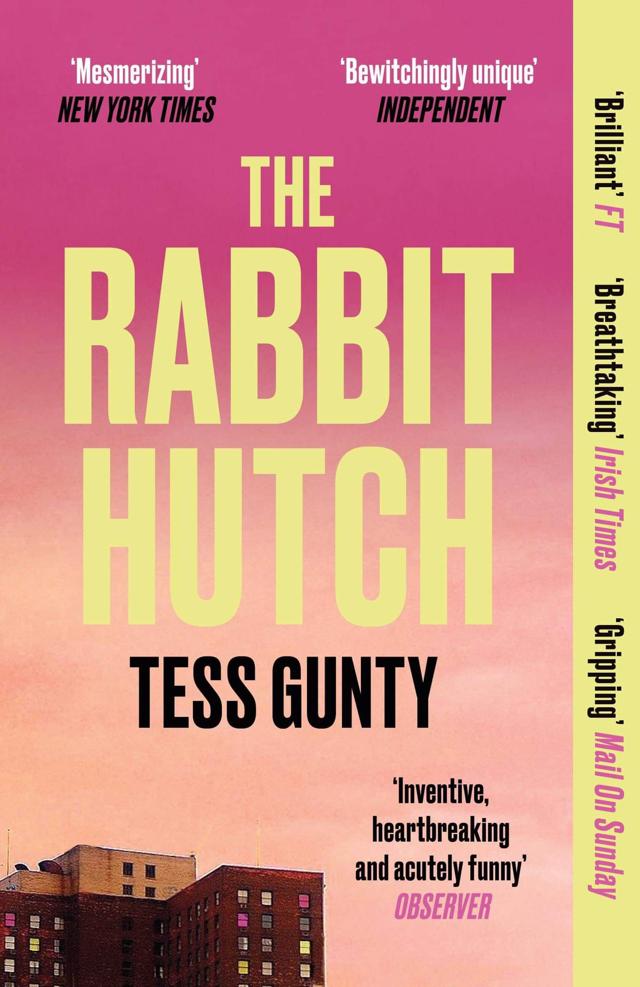
Tess Gunty, author, The Rabbit Hutch– ‘I never force a moral project on my work’
The winner of the US National Book Award for fiction on being transported to an extraordinary place when she’s writing

 Prefer HTon Google


The Rabbit Hutch opens with Blandine’s transcendent experience of exiting her body. What made you settle on this metaphysical beginning? Do you see it as a metaphor for the larger themes explored in the novel, such as identity and transformation?
I was interested in a phenomenon commonly reported across cultures and times periods during experiences of spiritual ecstasy: a total collapsing of boundaries between self and other. One study on the neuroscience of mystical experiences observed the brains of people who achieved transcendence through various means and from various traditions — meditation, prayer, drugs — and in each case, no matter how the mystical experience was reached, the part of the brain that produces narratives of the self went quiet. Ego-death seemed to be at the center of every description of divine ecstasy recorded by medieval female mystics of the Catholic tradition, too.
My writing is driven by a yearning for a reimagined society, one that abolishes extractive hierarchies of domination and replaces them with regenerative ecosystems of mutualistic care. In The Rabbit Hutch, I wanted to resist the American ethos of rugged individualism that positions material accumulation as the purpose of life and instead push toward something collective, choral, and remedial. I find the ecstatic disintegration of borders between selves, communities, ecosystems, and eras reported across mystical experiences instructive toward this end.
Blandine, an autodidact with a mysterious past, has a rich inner life. Could you talk about how you arrived at her complex character, and how you developed her to draw out her motivations, fears, and desires?
Blandine was the only character in this novel who told me what to do on every page. Many people assume that she is simply a cipher for me. While this is not the case — I feel equally present in every character — it is true that Blandine and I do share many values, preoccupations, and concerns. Importantly, though, she also possesses strengths I lack, and fortune dealt us radically different cards at birth. I find it impossible to write characters who are too similar to me — my self-criticism enters the text and the narration becomes hostile. I was able to root for Blandine precisely because she was distinct from me. She was the hero I wanted to see: a young woman who insisted on remaining the protagonist of her life despite the interpersonal and structural forces working to reduce her to a peripheral character, to someone who exists merely to serve the economic and personal ambitions of others. She forges a path in opposition to the hierarchies of domination into which she was born, resists injustice in her immediate community, and pursues alternative models of personal and collective liberation.
Some say it’s impossible for a young woman to be as brilliant as she is, but the abundance of young male geniuses in literature reveals this to be a sexist critique. When I began writing Blandine, I was just a few years older than she is. Like most girls and women, she has been conditioned to believe that beauty is the most valuable and mobilizing currency she can possess, but she rejects this value-system, instinctively understanding that all currencies are widely accepted fictions that reinforce existing power structures. Instead, she anchors her self-worth in her intellectual and ethical pursuits. Hyper-visibility is a cage for Blandine; it has made the men in her orbit treat her like a resource they are entitled to exploit. Like her hero, Hildegard von Bingen — the 12th-century German abbess, mystic, and polymath — Blandine is determined to critically investigate the systems in which and against which she lives, refusing to conform to their corrosive ideals. It was a joy to conjure a young heroine who possessed this kind of moral and intellectual ferocity.
How does Blandine’s connection to the work of Hildegard von Bingen and her affinity for Chastity Valley influence her?
Hildegard views the uncommodified natural world as God. She describes paradise as a verdant, healthy, diverse bionetwork and treats nature as a direct expression of the divine. She is one of many theologians to challenge a particular Christian understanding of “dominion” as divine permission to exploit ecosystems, instead promoting a philosophy of ecological nurture and protection. She writes against the patriarchal, colonial attitude that treats all life forms — people, animals, plants — as resources that those in power are divinely authorized to abuse. Many Catholic theologians today employ Hildegard’s work to promote a theology of ecological stewardship in response to the environmental crisis. Blandine finds solace and kinship in Hildegard’s attitude toward the natural world. Blandine’s attachment to the Valley — the only remaining green space in her town — was powered by a kind of ecological despair I feel all the time. In towns like Vacca Vale, the Anthropocene is visible everywhere you look: in the disposable, utilitarian architecture; the car-dependent urban design; the complete demolition of natural habitats in order to build strip malls and superstores; the vacant automobile factories; the monocrops of corn and soybeans; the historic flooding; the water pollution; and the chemical contamination of groundwater and soil. All of this is based on the damage I witnessed in the postindustrial Midwest, where I’m from. Indiana, my home state, has the most polluted natural water bodies in America. The river in my home town was toxic with sewage and agricultural runoff. Across the Rust Belt, companies have poured lethal quantities of poisons like lead and benzene into the earth — most notoriously in Flint, Michigan.
Our biosphere is in the midst of a sixth mass extinction, permanently losing species every year. Those who suffer most acutely from this abuse both within and outside of the US are the people with the lowest carbon footprints. Bangladesh, for instance, has some of the lowest per-capita emissions, and climate change is forecasted to make much of the country unlivable. Some have described Blandine as a budding eco-terrorist, but I think it’s vital to reframe the term. The irreversible damage that fossil fuel companies, industrial agricultural operations, chemical companies, logging businesses, and others have done to the present and future of this planet is the true eco-terrorism. I argue that we should reserve the term for those decimating present and future life on Earth, not for those protesting such decimation. Corporate ecological devastation functions on an unfathomable geologic scale. Portraying Blandine’s resistance to Chastity Valley’s destruction was a way to stage a macro crisis on a micro scale.
Did you have the themes of the novel when you started writing? Besides love and cruelty, it also explores the concept of loneliness and isolation in a communal living environment, and the vulnerabilities and strange intimacies of being human.
I never approach my writing with an outline, and seldom approach with a set of questions or themes. As I draft, I try to trust an associative logic, working to surprise myself across every passage, welcoming unsolvable mysteries and dark matter into the prose, allowing the process to deliver me where it will. Outside of my writing practice, I try to nourish my curiosities and challenge my beliefs, always pursuing knowledge. As I entered this project, I had one objective: to evoke the purgatorial sensation I felt across the postindustrial Midwest. I am consistently drawn to the question: How does structural violence and neglect generate interpersonal violence and neglect? I never force a moral project on my work, and I never write to impart a lesson, but if you access a dream-logic as you draft, what you care about most will naturally surface. The subconscious mind is much more interesting and honest than the conscious mind is; it’s better equipped to hold contradictory truths, to observe mystery without handcuffing and interrogating it, to achieve negative capability.
Vacca Vale is portrayed as a place of stark contrasts — both a void and a culturally vibrant space. Could you talk about how you navigated the challenge of creating such a setting?
My undergraduate advisor, the writer Joyelle McSweeney, offers a lexicon of contrast that I find resonant with my own practice. She says she’s drawn to indivisible opposites, phenomena that is “double but not binary — that is, they have a doubleness to them that includes an infernal superposition where both are true — or not true — at once. When would-be binaries collapse, they release an infernal energy whose behaviour can’t be predicted.” I, too, am pulled to sites of paradoxical simultaneity. I collect apparently opposing forms of tinder — settings, characters, psychological states, obsessions — and try to provide enough oxygen for their infernal superposition to generate friction.
Conjuring a fictional city of unpredictable energies and indivisible opposites granted me access to a mythic, folkloric realm where everything defamiliarized. The unknown became known and the known became unknown. Impossibilities became possible. As you write, it can feel like the tinder you’ve amassed is kindling, igniting, and transforming on its own. As the work blazes, you’re sometimes a fire scientist, observing and predicting its path. Other times, you’re a panicked firefighter attempting to control the course of the burn. But when the writing is going really well, you’re the fire.
Can you elaborate on the symbolism of the Rabbit Hutch, the housing complex where various characters’ lives intersect?
The novel begins with two epigraphs, one of which is from Michael Moore’s documentary, Roger and Me, which is about Flint, Michigan — the postindustrial, Midwestern town where he grew up. He comes upon a woman who has lost her job and now sells rabbits for a living, both as pets and as meat. The woman, Rhonda Britton, points to the rabbits and tells Michael Moore: “If you don’t have 10 separate cages for them, then they start fighting…that’s why you got to butcher them when they get a certain age, or you have a heck of a mess.”
By the time I watched this documentary, I had already drafted about a hundred pages of the novel, and rabbits had been appearing everywhere. The low-income housing complex where my characters lived was named La Lapiniere, an antiquated French term meaning “rabbit warren” or “rabbit hutch,” because a wonky donor wanted the building to sound chic. Most of the natural predators that would control the rabbit population in this town had been hunted to extinction, so rabbits were filling the streets of Vacca Vale. I was drawn to rabbits as ciphers because they evoke so many conflicting associations in America, perched between innocence and corruption: the Easter Bunny, Donnie Darko, Playboy, the white rabbit that transports Alice to Wonderland, prey to all predators, sympathetic pests, the creature that magicians pull out of top hats, the rare species that people keep as both pets and food sources. This storm of subconscious connotations makes rabbits useful agents of chaos and danger, signalling the presence of the supernatural.
All of that was already swirling around my mind when I watched Roger and Me, so the exchange between Michael Moore and Rhonda Britton took my breath away. It struck me as a haunting allegory for horizontal violence, a term I first encountered in the work of the anti-colonial theorist Frantz Fanon. Because colonizers barricade themselves in fortresses of power, the rage that subjugated groups direct at them laterally misfires into the oppressed community. The rabbits want to kill the cages that they’re crammed inside, but they can’t, so they attack each other. This framing helped me understand the boys in my novel, who have never been permitted to express vulnerability, long for family and approval, and are trapped inside nested Russian-dolls of cages they cannot break open. They commit monstrous acts, but as I inhabited the forces operating within and upon them, I saw what they were trapped inside, and I felt as much compassion for them as I did for their victims.
The multivocal novel blends various narrative techniques, including obituary comments, epistles, and black-marker drawings. How did you decide on these forms? Did you also want to keep your focus on violence against animals/animal sacrifice?
I’ve found violence against animals unbearably distressing for as long as I can remember. While colonial settlements have always been catastrophic for the animal and plant life within and around them, ours is an era of unprecedented violence against animals. Deforestation, overfishing, water pollution, air pollution, global warming, and industrial agriculture are responsible for the torture and disappearance of billions of animals per year. As I was drafting this novel, I worked as a copywriter for the American Museum of Natural History, writing about a plethora of animal species I had never encountered before. Inevitably, I would become attached to a species only to discover that human activity was driving it to extinction. I also worked as a research assistant on a book of nonfiction about factory farming and the environmental crisis, which made me acutely aware of mass ecological destruction.
Ever since childhood, I’ve written fiction to explore occurrences that trouble, intrigue, and obsess me. Just as the origins of dreams are not immediately visible to the dreamer, the relationship between the Anthropocene and the boys’ cultish practice took some time to reveal itself. Eventually, though, I realized that the animal sacrificing was a translated, small-scale rendering of a structural phenomenon that greatly disturbs me.
In The Rabbit Hutch, I only reference the animal sacrificing in a few sentences, and I never gratuitously describe it. Still, some people find it unbearable. I understand this reaction — I, too, possess an abnormally low tolerance for depictions of animal cruelty. In general, I find all portrayals of violence (psychological and physical, against human and non-human animals) intolerable. I can’t watch most popular shows and films for this reason; the scenes haunt me for months, sometimes years. I used to be ashamed of this hypersensitivity, but I have learned to embrace it as part of my nature and recognize its gifts. Even when I have to turn off the film or step out of the exhibit or put down the book, however, I never condemn a disturbing work of art for reflecting a disturbing reality. When people become angry at me or my novel for referencing violence against a dozen rabbits, I encourage them to use that anger as an entry point into real-world systems that are torturing, slaughtering, and disappearing billions of animals per year, both wild and domesticated, systems in which they are almost certainly complicit.
Interestingly, the people who attack me or my book for evoking animal cruelty are seldom vegans. I expect moral purity from no one, not even from the person I hold to the most impossible standards (myself), but I do advocate for the clear-eyed acknowledgement of complicities in abusive systems. I encourage everyone, including myself, to cope with cognitive dissonance through investigation rather than avoidance. This is the noble struggle, the beginning of change. Do not blame the mirror for what it reflects.
Your writing is rich in texture and subtext. How did you strike a balance between detailed description and keeping the narrative propelling forward, between the richness of detail with the interior lives of your characters?
I always write assuming that my reader is more intelligent and more interesting than I am — that I am collaborating with a rich and expansive inner life. If I’m not entertaining, engaging, challenging, and surprising myself across every sentence of every page, I have no hope of captivating that reader. I write in a willful state of discovery, working to animate the pages so that they generate their own velocity and volition. It may not be the most efficient way to write a novel — it usually requires me to delete hundreds of pages in revision — but the creative process resists optimization, and for that, I admire it. I consider the artist’s effort to alchemize close attention into life itself — to produce a regenerative, freely-entered experience that vivifies both self and other — as a form of revolt against the attention extraction economy.
The novel has been ecstatically received and you’ve got major awards, too. How do you think it’s going to affect what you write next?
It astonishes me. It’s impossible to articulate the scope of my awe and gratitude; every time I try, language evacuates me. Before I published, I was led to believe that the literary world was risk-averse and dying. Now that I have spent a year meeting booksellers, readers, critics, librarians, editors, and fellow writers across the world, it’s abundantly clear that neither of these things are true. It’s a profoundly energized and hopeful ecosystem largely devoted to creative risk and social progress. While there is still work to be done, the literary world is teeming with people eager to platform challenging work and underrepresented voices, championing extraordinary books that would have been excluded at other points in history.
After a year of joyful but demanding publicity, I am finally able to return to my writing desk. I’m working to rehabilitate my creative practice, deconstructing the colossal pressures I’ve applied to my second novel by reconnecting with my childhood relationship to writing. I fell in love with fiction without any awareness of market forces, prizes, criticism, sales, or publishing. My relationship with my fiction was private and sacred. I’m trying to restore this mindset, now. I want to treat my second novel the way I treated my fiction as a child: as a portal into wonder, joy, escape, confrontation, mystery, thrill, danger, magic. As it was in childhood, my ambition now is not to attract acclaim or avoid criticism — it is merely to transport myself somewhere extraordinary and see what I find there.
Shireen Quadri is the editor of The Punch Magazine Anthology of New Writing: Select Short Stories by Women Writers


