
 E-Paper



Covid-affected clusters getting bigger in Chandigarh
Manimajra becomes the hub with four containment zones having cumulative population of 880 notified in recent days

 Prefer HTon Google


The size of Covid-affected clusters is getting bigger in congested parts of Chandigarh.
There are currently 280 active containment and micro-containment zones that demarcate these clusters with higher incidence of infections. Around one-third people in these containment zones are in just seven clusters, with Manimajra accounting for four (see box).
Since March this year, when the city was hit by the pandemic’s second wave, the administration has notified curbs in more than 400 areas, which, after the Centre’s push, has emerged as a key strategy to contain the virus spread.
In the initial months of the pandemic, Bapu Dham Colony had become its epicentre in the city. With large clusters spread across the colony, the administration had declared nearly all of its pockets as containment zones.
After the first wave receded, the administration had started creating micro-containment zones, which generally had three to four houses with 10 to 20 people. The strategy continued as the city was hit by the second wave, with multiple such zones carved out in March and April.
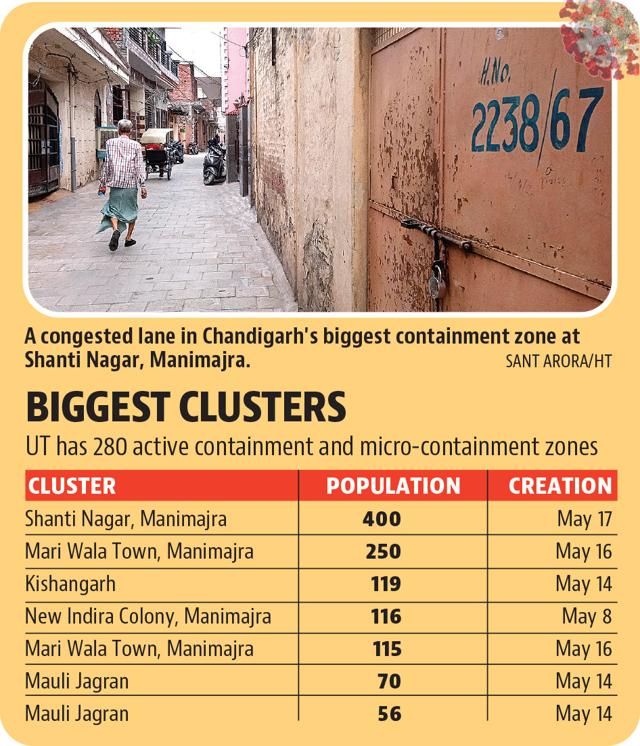
However, now the cluster size has gone up in peripheral areas, such as Manimajra, where there is high population density with more people living in relatively smaller houses in congested neighbourhoods. With this, the administration has again started creating containment zones, such as the one in Manimajra’s Shanti Nagar that was notified on May 17 and has a population of 400.
‘In congested areas, size has increased’
“We are creating containment zones on the basis of contact tracing report and infection incidence in a locality. The aim is to limit the spread and break the infection. In congested areas, the size of the cluster has increased,” said deputy commissioner Mandip Singh Brar.
Another senior official said that in the earlier weeks of the second wave, cases were mainly coming from sectors.
“In May, villages and rehabilitation colonies also started reporting positive cases. As these areas are congested, more people are coming under containment restrictions for every new positive case reported than in relatively sparsely populated sectors,” said the official, who didn’t want to be named.
Manimajra is becoming the new hub with the highest number of houses and a major chunk of population under containment curbs. Micro-containment zones were being created here since the start of the second wave, but, worryingly, it is in the last one week that the size of clusters has become bigger.
Dr Rajesh Kumar, former head of the department of community medicine and public health, PGIMER, said, “Congested areas are more prone to spread of the infection. This indicates more people can be exposed to the infection in these areas. In a locality with less than five positive cases, a micro-containment zone is created. If cases are 5-15 in a contiguous area, then containment zone has to be created.”


